


PMP exam validates project leadership competence across process domains. PMP exam scheduling begins after PMI approves the application and issues an eligibility ID for exam registration.
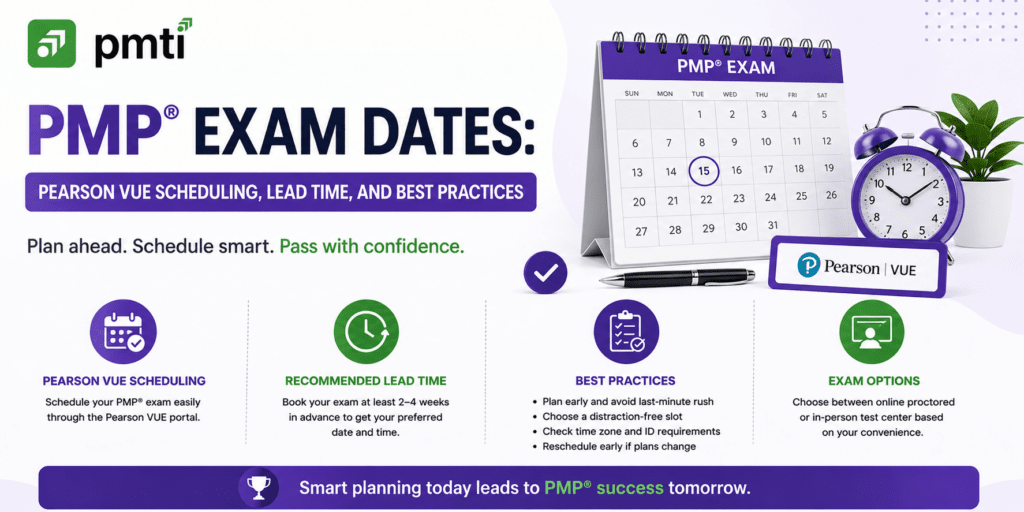
PMP exam booking occurs through the Pearson VUE platform. Candidates log in to the PMI dashboard, select “Schedule Exam,” and are redirected to Pearson VUE to choose test center or online proctored options. PMP exam dates depend on seat availability and testing center capacity. PMP exam lead time varies by location, with many candidates booking 2–4 weeks in advance to secure preferred dates.
PMP exam is available in two formats: online proctored testing and in-person testing at authorized Pearson VUE centers. Online exam requires stable internet, webcam monitoring, and identity verification. In-person exam requires arrival at the test center with approved identification.
PMP exam date selection best practices include scheduling the exam after completing full syllabus review and at least 3–5 full-length mock exams. Mock exam scores above 75–80% indicate readiness. PMP exam includes 180 questions completed within 230 minutes.
PMI does not publish an exact passing score. PMP exam uses psychometric scoring based on performance across domains. PMP certification confirmation appears within a few days after passing.
PMP exam readiness improves with structured revision, proper sleep, early arrival or system check, and calm focus during testing.
When Can You Take the PMP Exam?

The PMP exam dates are chosen by candidates based on availability at Pearson VUE test centers or through the online proctored option. PMP exam scheduling allows individuals to select specific dates and times that fit their preparation timeline once PMI approves the application and issues the eligibility ID. PMP exam dates vary by geographic location and test center capacity, so early booking increases the chance of securing preferred slots. Candidates should review available PMP exam dates and related scheduling details in the PMP exam scheduling and timing details resource, which outlines how to select dates through the Pearson VUE platform.
Where can I take the PMP exam?
You can take the PMP exam at an authorized Pearson VUE test center or through an online proctored testing option from your home or office. PMP exam location depends on candidate preference, availability, and local testing capacity.
PMP exam at a test center takes place at certified Pearson VUE testing centers that provide secure, in-person supervision. Candidates select a nearby test center during scheduling based on available dates and seats. Details about Pearson VUE testing centers for PMP appear in the Pearson VUE testing centers for PMP guide.
PMP exam through online testing allows candidates to take the exam remotely with live proctor monitoring. Online testing requires a stable internet connection, webcam access, and a quiet, private environment.
PMP exam location choice depends on convenience, comfort level, technical setup, and preferred testing environment.
How to schedule a PMP exam with Pearson VUE?
To schedule a PMP exam with Pearson VUE, candidates must complete application approval in the PMI exam portal and then book a test slot through the Pearson VUE system.
Listed below are steps to complete PMP scheduling.
- Log in to the PMI exam portal: Access your PMI dashboard after receiving exam eligibility approval.
- Click “Schedule Exam”: Select the PMP credential and proceed to scheduling.
- Redirect to Pearson VUE
Enter the Pearson VUE platform through the secure link provided by PMI. - Select delivery type: Choose between online testing or in-person test center appointment.
- Search for available locations or time slots: Enter your preferred city for test center exams or view available online dates.
- Choose date and time: Select a suitable PMP scheduling slot based on preparation readiness and availability.
- Review exam policies: Confirm identification requirements, rescheduling rules, and exam conditions.
- Confirm booking: Submit the selection and receive a confirmation email from Pearson VUE with appointment details.
PMP scheduling remains flexible within the one-year eligibility period granted by PMI. Early booking increases access to preferred dates and locations.
What is the lead time to book a PMP exam slot?
The lead time to book a PMP exam slot is flexible and depends on seat availability at Pearson VUE test centers or online proctored scheduling windows. PMP booking lead time ranges from a few days to several weeks based on location, demand, and time of year.
Pearson VUE releases exam appointments on a rolling basis within the one-year eligibility window granted by PMI. High-demand cities and peak seasons will require booking 2-4 weeks in advance to secure preferred dates and times.
PMP scheduling window allows candidates to reschedule within PMI policy limits, but early booking reduces risk of limited availability. Early confirmation improves preparation planning and minimizes last-minute scheduling stress.
How to select an ideal PMP exam date?
To select an ideal PMP exam date, align PMP exam scheduling with preparation timing, mock exam performance, and personal productivity cycles. Ideal PMP exam scheduling balances study planning, seat availability in Pearson VUE, and mental preparation before certification success. A study by Roediger and Karpicke titled “Test-Enhanced Learning” in 2006 found that repeated practice testing improved long-term retention by up to 50% compared to repeated review alone. PMP exam readiness improves when candidates schedule the exam after consistent mock scores above 75-80% and allow buffer time for structured revision and logistical checks.
Choose an exam date at least 3-4 weeks ahead to create a defined preparation window. Avoid peak testing periods to secure better availability and preferred time slots. Schedule during your most productive time of day to optimize cognitive performance and focus stability. Double-check time zone and location accuracy in Pearson VUE to prevent scheduling errors.
Allow time for at least one full mock exam under 230-minute conditions before test day. Plan rescheduling at least 48 hours in advance to avoid penalties. Prepare backup internet and valid ID for online exams to reduce testing logistics risk. Confirm booking details through the Pearson VUE confirmation email. Keep your schedule light on exam day to protect mental energy. Stay calm and review key formulas the night before to reinforce recall without cognitive overload.
Where to get the PMP Exam training
To get the PMP exam training candidates should use the official PMI Authorized Training Partner (ATP) directory on the PMI website to find vetted providers. PMP training from an ATP ensures alignment with the PMBOK Guide and PMI exam content outline. Recommended training providers include global ATPs such as PMTI, Simplilearn, Velociteach, and GreyCampus that offer structured courses with contact hours required for eligibility. PMP training is available through classroom instruction, live virtual sessions, and self-paced online formats designed for exam preparation. ATP courses include mock exams, domain-based study plans, and practice questions that mirror PMP exam scenarios. Using PMI ATP training supports the required 35 contact hours and improves readiness through guided instruction and documented completion records essential for the PMP application.
What is the passing score for the PMP exam?
The passing score for the PMP exam is not a fixed numerical value because PMI uses a psychometric scaled scoring method to determine pass or fail results. PMP passing score is calculated based on overall performance across exam domains rather than a published percentage threshold.
PMP exam scoring adjusts for question difficulty across different exam versions to maintain fairness and consistency. PMI does not disclose an official percentage. Industry estimates based on candidate data suggest an approximate effective range of 60%-70%, but this figure is unofficial and not confirmed by PMI.
PMP proficiency levels are reported as Above Target, Target, Below Target, or Needs Improvement for each domain. PMP exam scoring requires overall performance at Target level or higher across most domains to achieve a passing result.
PMP passing score determination reflects scaled exam scoring methodology rather than a fixed cutoff percentage.
Is the PMP exam available online?
Yes, the PMP exam is available online through Pearson VUE online proctored testing. Online PMP exam delivery allows candidates to complete the exam remotely from home or office under live remote testing supervision.
Online PMP exam requires a stable high-speed internet connection, a functioning webcam, microphone access, and a quiet, private testing environment. Pearson VUE online system performs a pre-exam system check to verify technical compatibility. Online PMP exam requires government-issued identification and workspace inspection through webcam monitoring before the test begins.
Remote testing enforces strict rules, including no unauthorized materials, no additional screens, and no interruptions during the 230-minute exam session. Proper technical setup and environment preparation ensure smooth online PMP exam execution.
When are the PMP test dates?
The PMP test dates are available year-round through continuous testing offered by PMI scheduling via Pearson VUE. PMP test dates are not fixed to specific global windows because candidates select their own appointment based on seat availability and personal readiness.
PMP test dates are accessible globally through both in-person test centers and online proctored delivery. Continuous testing allows candidates to schedule exams any day of the week depending on location capacity and time slot availability.
PMP scheduling flexibility supports global accessibility and preparation timing within the one-year eligibility period granted after application approval.
How often is the PMP exam offered?
The PMP exam is offered year-round through continuous testing administered by PMI via Pearson VUE. PMP exam frequency is not limited to quarterly or fixed global testing windows because candidates schedule appointments based on availability within the one-year eligibility period after application approval.
PMP exam frequency supports global accessibility through both in-person test centers and online proctored delivery. PMI testing schedule allows candidates to choose dates throughout the year, subject to seat availability and local capacity. Pearson VUE operates thousands of testing centers in over 180 countries, which increases exam availability and scheduling flexibility.
A study by Arthur, Bennett, Edens, and Bell titled “Effectiveness of Training in Organizations” in 2003 found that structured certification and training programs produce measurable performance improvement across industries. Continuous PMP exam availability supports timely certification pursuit and alignment with professional development goals.
How long does it take to get PMP certification after the exam?
To get the PMP certification after the exam, it takes 1-5 business days following exam confirmation. PMP certification timeline begins immediately after completing the exam, where candidates receive a provisional pass or fail result on screen at the test center or online platform.
PMP results are officially confirmed by PMI within a few days through the PMI dashboard. PMP certification status updates in the PMI account once the exam result is validated. PMI then issues a digital certificate and provides access to the digital badge through Credly, which candidates share on LinkedIn and professional platforms.
Physical certificates are no longer automatically mailed. PMP exam confirmation and credential activation occur quickly, allowing immediate use of the PMP designation once official status appears in the PMI registry.

