


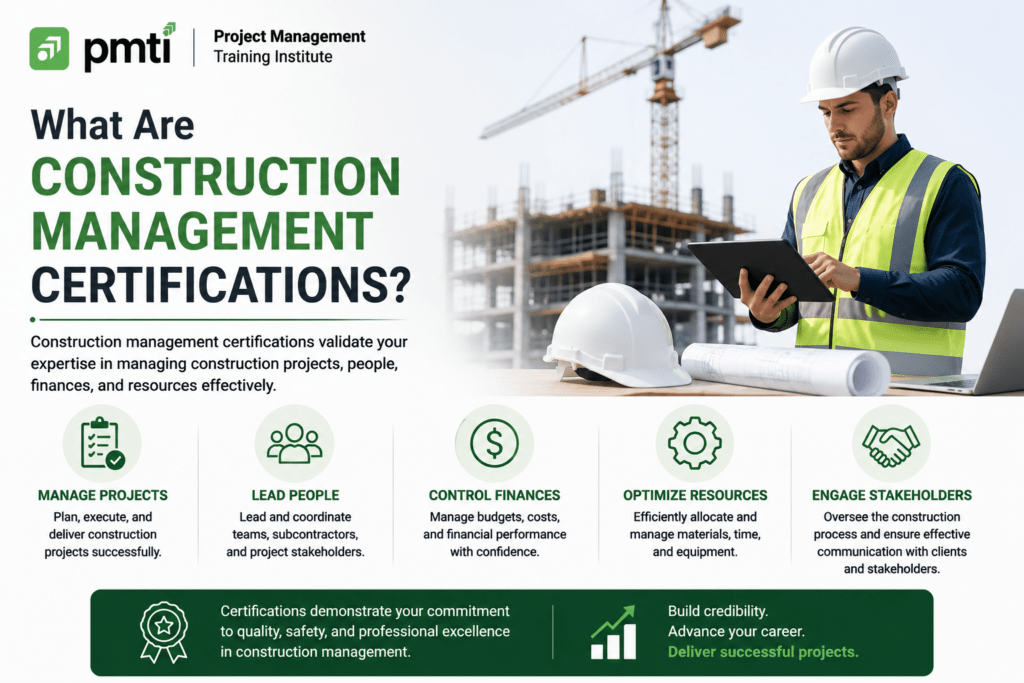
The guide contains all the necessary information regarding the active construction management certifications: CCM, CMIT, LEED AP BD+C, OSHA 30, and PMP. It includes requirements for each certification, test structures and locations, costs and potential earnings, as well as the future employers. It even contains information on the possible career paths and designations that can be attained, from entry-level construction positions to advanced leadership roles in construction programs and projects.
What Are Construction Management Certifications?

Construction management certifications are formal recognition of the ability to manage construction projects and the associated people, finances, and resources. Certifications also cover the ability to oversee and manage the construction process and all interactions with clients and stakeholders.
Three organizations offer construction management certification that are acknowledged by U.S. employers and government agencies:
- CMCI (Construction Manager Certification Institute) awards the CCM and CMIT, the two primary construction management certifications in the U.S.
- USGBC (U.S. Green Building Council) awards LEED credentials, which construction managers earn to demonstrate their knowledge of sustainable construction and design practices.
- PMI (Project Management Institute) awards the PMP, which construction managers earn to validate their project management skills. The PMP is widely accepted by employers as the project management certification.
What Is the CCM Certification?
The CCM or Certified Construction Manager is the highest credential for construction management in the United States. It is awarded by the Construction Manager Certification Institute (CMCI), which is the certifying body of the Construction Management Association of America (CMAA). CCM recognizes construction management professionals who have mastery of all nine knowledge areas of construction management, starting from the pre-design phase and ending with the post-construction phase. This certification is acknowledged by federal and state agencies, and private owners who run capital construction programs.
CCM Certification Attributes
| Attribute | Value |
| Certification | Construction Manager Certified (CCM) |
| Awarding Body | Construction Manager Certification Institute (CMCI) |
| Parent Organization | Construction Management Association of America (CMAA) |
| Certification Level | Professional (4 years of field experience required) |
| Exam Questions | 200 |
| Duration | 4 hours |
| Exam Centers | Prometric testing centers (U.S. and international) |
| Application Fee | $275 |
| Exam Fee | $375 |
| Recertification Cycle | 3 years |
| Continuing Education | PDU Equivalent Continuing education credits needed for recertification |
CCM is the construction industry’s PMP (Project Management Professional). It is a recognized credential that is required for advanced and executive construction management positions. More than 8,000 construction managers in the United States hold active CCM certification.
What Is the CMIT Certification?
The Construction Manager in Training (CMIT) certification is the entry-level credential of CMCI. It is designed for construction professionals who have not yet attained the 48 months of RIC experience required to apply for CCM. It is a preparatory step to obtain the CCM certification. It is also a signal of professional dedication to construction management.
CMIT Certification Attributes
| Attribute | Value |
| Issuing Body | CMCI |
| Experience Required | Under 48 months of construction management experience |
| Purpose | Entry credential; pathway to CCM |
| Exam | None; credential based on application and education check |
| Application Fee | ~$125 |
| Validity | Active until CCM eligibility is reached |
Constructors that achieve CMIT while gaining RIC experience signal to employers that they are on a path of credentialed professional development. In fact, CMIT is a preferred qualification for associate project manager and project engineer roles with Turner, Skanska, Gilbane, and other large contractors.
What Are the CCM Eligibility Requirements?
To be eligible for the CCM, candidates must have 48 months of RIC construction management experience. The education criteria change depending on the candidates’ level of education. “Responsible-in-Charge” is a PMI/CMCI standard: the candidate must have been in charge of the outcome of the construction project (not just part of the team).
Education Track 1 — Bachelor’s Degree or Higher
| Requirement | Value |
| Degree Field | Construction management, civil engineering, architecture, or an associated field |
| RIC Experience Required | 48 months (4 years) |
| Application Requirement | Detailed experience documentation with supervisor verification |
Education Track 2 — Associate’s Degree or Some College
| Requirement | Value |
| Degree | Associate’s degree or partial college education |
| RIC Experience Required | 60 months (5 years) |
Education Track 3 — High School Diploma Only
| Requirement | Value |
| Education | High school diploma or equivalent |
| RIC Experience Required | 96 months (8 years) |
What Counts as Responsible-In-Charge (RIC) Experience
CMCI considers RIC experience as holding Responsible-In-Charge (RIC) status on construction projects with full accountability for the results of the construction that falls within any of the 9 knowledge areas. The applicant must have had the power to make, or the ultimate authority over, the decisions pertaining to the constructions.
Relevant Experience Includes
- Project Manager and Site Manager roles with budget and schedule responsibility for a construction project
- Owner’s Representative roles with construction phase control over contractor(s) performance
- Supervising daily field operations of a construction crew with documented responsibility for safety, quality, and schedule
- Managing construction contracts by reviewing submittals, issuing and processing change orders, and managing RFIs
What Does NOT Qualify as Relevant Experience
- Design-only jobs with no construction phase control
- Estimating or quantity surveying with no responsibility for project delivery
- Construction labor or trades with no supervisory control
- Administrative coordination tasks with no authority over project controls
What Is Covered in the CCM Exam?
Based on the CMAA’s Standards of Practice for Construction Management (7th Edition), the CCM Exam has 200 questions which cover 9 areas of construction management across 5 project phases. Questions are based on scenarios and practical challenges of managing construction projects and do not focus on recalling definitions.
9 Knowledge Areas for CCM Certification
1. Project Management Covers selection of the project delivery method (Design-Bid-Build, Design-Build, CM at Risk, Integrated Project Delivery), project organization, and management of project stakeholders and communications, as well as basics of program management.
2. Cost Management Covers preparation of cost estimates, preparation and management of project budgets, cost control processes and systems, and completion of the project using Earned Value Management (EVM), pricing of change orders, management of owner’s contingency, and final cost/reporting at project closeout.
3. Time Management Covers scheduling using the Critical Path Method (CPM), analysis of construction schedules, control of milestones, review of contractors’ schedules, change orders, time impact analysis, and developing a schedule recovery plan.
4. Quality Management Involves planning quality assurance and control, reviewing submissions, developing inspection and testing procedures, managing nonconformances, and preparing commissioning documentation for building system.
5. Contract Administration Involves understanding contract types and structures, evaluating bids, awarding contracts, managing subcontracts, processing RFIs, negotiating change orders, managing claims, and resolving disputes through mediation and arbitration.
6. Safety Management Involves understanding OSHA regulations for construction sites, developing site safety plans, monitoring contractor safety compliance, and investigating incidents, as well as the Construction Manager’s responsibility for identifying and correcting hazards.
7. Construction Document Technology Involves understanding construction drawings, specifications (MasterSpec/CSI), reviewing BIM (Building Information Modeling), as-builts, and managing record documents.
8. Sustainability Involves understanding construction as part of the LEED and WELL certification processes, construction of peace materials, management of construction waste, and building commissioning.
9. Program Management Involves managing several construction projects as a coordinated program, managing resources shared across project portfolios, program reporting, and capital program governance for owners with projects.
5 Project Phases Tested
200 exam questions are divided among 5 project phases.
Pre-Design Phase: Program definition, site analysis, selection of project delivery method, development of budget and schedule baselines.
Design Phase: Review of design documents, coordination of the design team, constructability analysis, value engineering.
Procurement Phase: Development of bidding strategy, bid analysis and selection, award of contract, prequalification of subcontractors.
Construction Phase: This is the most heavily weighted phase and comprises management of the active delivery of all 9 areas of knowledge.
Post-Construction Phase: Management of commissioning, the punch list, closeout documents, building occupancy, and the warranty.
What Are the Steps to Attain CCM Certification?
4 steps are required to attain CCM Certification: check eligibility, apply, schedule the exam, then sit for the exam. CMCI governs the entire process via the online system at cmaanet.org.
Step 1: Check Eligibility
Review the CMCI Certification Handbook to verify the required work experience to qualify for the education level, and to understand the approved formats for experience documentation and the boundaries for RIC experience in each of the 9 knowledge areas.
Step 2: Apply and Prepare
The application includes 9 knowledge areas documented via RIC. Each entry must explain the project type, your role, the level of authority, project cost, and the 9 knowledge areas. Each entry must include a contact for verification, either the supervisor or project owner. Each description should contain 120-200 words.
Submit the application with degree documentation to your transcript and the application fee. CMCI will review the application in 30-45 business days.
Step 3 — Schedule the Exam
Approved applicants have 180 days to schedule the exam. The fee is $375, and must be paid at scheduling. Prometric testing centers are available at over 180 locations in the United States and worldwide.
Step 4 — Take the Exam and Receive Results
The exam consists of 200 questions and is administered in one 4-hour session. Results are available at the testing center immediately after completion. Candidates who do not pass are given a score report which breaks down their results by knowledge area, indicating the 9 areas in the exam which require further preparation.
What Is the CCM Certification Cost in 2026?
The total CCM certification investment for most candidates, based on the exam preparation study resources selected, and whether a preparation course is part of the study resources, is estimated to be between $1,200 and $2,800.
CCM Certification Cost Breakdown
| Cost Item | Amount |
| CMCI Application Fee | $275 |
| Prometric Exam Fee | $375 |
| CMAA Membership (optional, exam discount included) | $195/year |
| CCM Exam Preparation Course | $400–$1,200 |
| CMAA Standards of Practice (7th Edition) | $80 (member) / $120 (non-member) |
| Practice Exam Subscriptions | $100–$250 |
| Total First-Time Candidate Investment | $1,230–$2,220 |
CMAA membership costs $195, and exam fee for members is $275, so membership is cost-positive for candidates, as they save $100, and gain access resources and study materials at the member rate. Candidates who do not pass on the first attempt must pay a reduced retake fee. The fee is $250 if the candidate is a CMAA member, and $375 if the candidate is not a member.
What Other Certifications Do Construction PMs Hold?
Beside CCM, construction PMs generally hold 5 other certifications: PMP, LEED AP, OSHA 30, PE, and CPC. CCM, by itself, does not cover all the competencies.
PMP — Project Management Professional
PMP is the universal project management certification provided by PMI. All construction employers, including the federal government, acknowledge PMP as the benchmark certification for the positions of senior project manager, program manager, and PMO manager.
Reasons Construction PMs Pursue PMP in Addition to CCM:
- CCM demonstrates construction project-related knowledge, whereas PMP demonstrates knowledge of project governance for all types of projects
- Federal construction contracts for the Army Corps of Engineers, GSA, and DOT, among others, usually list PMP as a preferred or required certification for construction PMs
- PMP is a must-have certification for senior project manager and program manager positions in major GCs, like Bechtel, Fluor, Jacobs, Turner, and AECOM, for programs valued at $100M and above
- PMP certified construction PMs typically earn 18–22% more compared to their counterparts who do not hold PMP certification
LEED AP BD+C — Leadership in Energy and Environmental Design
LEED AP BD+C is the credential of the USGBC for construction professionals who work on projects that are certified LEED. Projects of federal construction programs, constructions of major projects in higher education and healthcare, typically require LEED certification for the PM.
OSHA 30 – Construction Safety Certification
OSHA 30-Hour Construction Industry Outreach Training Certificate is an important safety credential for construction site supervisors and construction PMs. For most large construction companies, OSHA 30 is required for all field-based construction project management positions. It is an intensive safety training program that lasts 30 hours and does not require a test for completion.
Cost: $150 – $300
PE – Professional Engineer
Licensed Professional Engineers moving into construction management hold PE licenses in civil, structural, or mechanical engineering. PE is a state license, and to gain PE licensure one must complete the FE and PE exams and have 4 years of post licensure engineering work. It is common for senior owners’ representatives and public agency construction managers to have PE licensure in addition to CCM.
CPC – Certified Professional Constructor
The CPC is awarded by the American Institute of Constructors (AIC) and recognizes competency of a general contractor. It is not as popular as CCM, but it is useful as a construction credential in lieu of CCM where there are no CMAA chapters.
What Jobs Does Construction Management Certification Open?
CCM certification is essential for 7 executive level construction roles which include Construction Manager, Owner’s Representative, Project Executive, Construction Program Manager, Capital Program Director, Construction Project Director, and PMO Director (Construction). The roles listed have budget authority of between $5 million and $5 billion.
Construction Manager
Scope: Oversees all aspects of a specific construction project, including management of the general contractor and all trade subcontractors, schedule and budget control, and direct reporting to the Project Owner.
Budget Authority: $5M – $200M
Salary Range: $95,000 – $128,000
Owner’s Representative
Scope: Serves as the owner’s agent throughout the design and construction phases to monitor contractor activities, approve change orders, and ensure the project meets the owner’s program requirements.
Budget Managed: $20M–$500M+
U.S. Average Salary: $105K–$140K
Senior Construction Project Manager
Scope: Manages large, complex projects that contain multiple trade packages and subcontractors. Manages project teams of 10 to 50 and has full P&L responsibility for project execution.
Budget Managed: $50M–$500M
U.S. Average Salary: $115K–$150K
Construction Program Manager
Scope: Integrates multiple construction projects into a program and manages common resources, and interdependencies and develops program-level reports for owners.
Budget Managed: $100M–$5B+
U.S. Average Salary: $135K–$175K
Capital Program Director
Scope: Manages a client’s ongoing capital program and chooses the methods of delivery and manages the performance of contractors while reporting program status to boards and executives.
Budget Managed: $500M–$10B+
U.S. Average Salary: $155K–$210K
Project Executive / VP Construction
Scope: Manages the construction division or significant client accounts at a GC or a CM company. Also manages revenue, team, and bids and is responsible for managing senior clients.
U.S. Average Salary: $160K–$250K
Construction PMO Director
Scope: Develops constructs and establishes the methods of project governance and standards of project management to ensure uniformity within all active construction programs at a large owner, government agency, or a principal general contractor.
U.S. Average Salary: $150K–$200K
What Will Construction Managers Earn in 2026?
Construction Managers in America make anywhere from $82,000 to $175,000. The 4 main factors affecting these salaries are location, years of experience, project size, and certification. Those with CCM certification make about 15% to 20% more than those with no construction certification.
Construction Manager Salary by Certification Level
| Role | Non-Certified Average | CCM-Certified Average | PMP+CCM Average |
| Construction Manager | $82,000 | $98,000 | $115,000 |
| Senior PM | $105,000 | $125,000 | $140,000 |
| Program Manager | $118,000 | $138,000 | $158,000 |
| Capital Program Director | $140,000 | $165,000 | $185,000 |
Source: U.S. Bureau of Labor Statistics (Occupational Outlook Handbook 2024); CMAA 2024 Industry Compensation Survey; Glassdoor 2026
Highest Paying Construction Markets
- San Francisco Bay Area — Certified Senior PMs earn $145,000–$185,000 (driven by tech and life sciences construction)
- New York City / New Jersey — $130,000–$175,000 (commercial real estate and infrastructure)
- Washington, D.C. / Virginia — $125,000–$165,000 (federal construction and data centers)
- Houston, TX — $115,000–$155,000 (energy and industrial construction)
- Dallas–Fort Worth, TX — $110,000–$150,000 (commercial and mixed-use)
- Chicago, IL — $115,000–$155,000 (transportation and healthcare)
BLS Outlook: The U.S. Bureau of Labor Statistics anticipates construction manager jobs will grow 5% by 2033. This growth will be fueled by construction to modernize healthcare facilities and data centers, and increased investment in infrastructure. This rate of growth is expected to be rapid compared to other professions.
Which Businesses Recruit CCM-Certified Construction PMs?
The top ten companies hiring CCMs in 2026 are Bechtel, Fluor, Jacobs, AECOM, Turner Construction, Skanska USA, Gilbane Building Company, the U.S. Army Corps of Engineers, GSA (General Services Administration) and state DOTs. All these companies run capital construction programs in the $100 million–$50 billion range.
Bechtel
Runs construction and engineering programs in the mining, nuclear, and energy sectors as well as infrastructure and requires CCM or PE for Senior CM roles.
Program Budget Range: $500M–$50B
Fluor
Worldwide EPC (engineering, procurement, construction) contractor that handles industrial, governmental, and infrastructure programs. Requires PMP and/or CCM for Project Manager roles for programs over $100M.
Jacobs
Handles government and infrastructure and advanced manufacturing programs and is an active recruiter for CCMs and PMPs for federal agency owner’s representative contracts.
AECOM
Among the top program management firms in the world, by revenue, manages capital construction programs for transportation agencies, federal government, and private clients. CCM is the preference for construction manager programs over $50M.
Turner Construction
The largest general contractor in the U.S. Requires PMP for Project Executive roles, and prefers CCM for Owner’s Representative and Senior CM roles.
U.S. Army Corps of Engineers
The world’s largest public engineering company. Requires or prefers CCM and/or PMP for civilian construction manager and program manager roles, GS-13 and up.
GSA (Public Buildings Service)
Responsible for overseeing the construction and renovation of federal buildings across the country. CCM is considered a mandatory requirement for the roles of senior resident engineer and construction manager for major federal projects.
Is PMP Certification Essential in Construction Management?
While PMP is not a prerequisite for CCM, for 65% of the senior-level roles in capital programs that exceed $100 million, construction employers demand PMP certification for senior project managers, program managers, and PMO directors. PMP and CCM focus on different areas of expertise, and having both certifications removes the limitation that having either certification creates.
What CCM Offers That PMP Doesn’t
- Knowledge of construction-phase delivery and various types of construction contracts (GMP, lump sum, cost-plus), as well as constructability, review OSHA compliance, and submission standards
- Recognition of construction management capability from construction industry owners and public agencies and contractors
- Access to the CMAA professional community and construction sector networking
What PMP Offers That CCM Doesn’t
- A cross-industry perspective on PM governance, and PMBOK-aligned frameworks that are recognized by federal agencies and defense contractors, as well as non-construction program PMs
- Recognition outside of construction, allowing a construction PM to step into a non-construction program and portfolio management role
- Eligibility to senior program management roles where construction is just one of the many program delivery approaches
To target the Capital Program Director, Construction PMO Director, and Construction Director roles in large construction companies and consulting firms, and the Vice President of Construction role in owner organizations, CCM and PMP is the construction professional’s combined credential of choice, with a salary premium that is on average 25–35% higher than employment peers that are certified in CCM only.
The PMTI PMP Certification Training fulfills the PMI requirement for 35 contact hours after attending the boot camp for 4 days. Construction professionals have adequate project leadership experience to map directly to PMP eligibility. Most construction project managers (PMs) complete a 4-year degree and have more than 3 years of project leadership experience. The PMP certification eligibility requirements should be reviewed to confirm that you are eligible prior to submitting the application.
What Is the Construction PM Career Development Path?
The career path for a construction PM progresses through 5 levels: Field Engineer/Project Engineer → Construction PM → Senior Construction PM → Construction Program PM → Capital Program Director or VP. Earning a certification also enhances the salary growth experienced at each level. CCM and PMP are the primary certifications that support the most accelerated promotions at each level.
Level 1 – Field Engineer/Project Engineer (0 to 4 Years)
Scope: Assists the PM in coordinating daily activities in the field, tracks RFIs, logs submittals, schedules inspectors and subcontractors, and documents/submits field reports pertaining to quality inspections.
Average Salary: $58,000 – $78,000
Note: This level provides the required RIC experience for CCM certification and the required project leadership experience for the PMP certification. CMIT certification can also be earned at this level.
Level 2 – Construction Project Manager (4 to 8 Years)
Scope: Has overall responsibility for one project and is the lead on all project teams that can range from 5 to 20 staff. Has the authority to manage a project with an approximate budget that can range from $5M to $50M.
Average Salary: $85,000 – $115,000
Note: This is the level at which individuals are eligible for both CCM and PMP. CCM certification is for construction-related projects, and the PMP certification is for projects unrelated to construction.
Level 3 — Senior Construction Project Manager (8–14 Years)
Scope: Oversees fully-managed, high-value, complex projects, in the range of $50M to $500M. Prepares and plans projects requiring multiple trade packages and multiple phases with direct relationships with the project owners.
Average Salary: $115,000–$148,000
Note: At this level, CCM and PMP enable incumbents to move to Program Manager roles in 3–5 years.
Level 4 — Construction Program Manager (12–18 Years)
Scope: Manages multiple coordinated construction projects that comprise a program. Deals with cross-program resources, cross-project reporting, and program-level benefits realization for the owners.
Budget: $100M–$5B+
Average Salary: $135,000–$175,000
Level 5 — Capital Program Director / VP of Construction (18+ Years)
Scope: Oversees all construction program governance for the organization and manages the selection of delivery methods, governance of contractor performance, and construction project management (PM) resources, and provides reports to boards.
Average Salary: $155,000–$250,000
How Does CCM Recertification Work?
CCM recertification requires 24 continuing education credits (CECs) in a 3-year period, which must be submitted through CMCI’s online portal prior to the expiration date of the credential. CMAA’s continuing education units (CEUs) are the same as PDUs in the PMI system, where 1 CEC equals 1 hour of qualifying professional development.
CEC Requirements
| Requirement | Details |
| Total CECs per Cycle | 24 CECs within 3 years |
| Acceptable Sources | CMAA education programs, conferences, and webinars; college coursework; professional speaking; and published articles |
| Recertification Application Fee | $100 for CMAA members and $150 for non-members |
| Late Renewal Period | 6-month grace period and a penalty fee |
Sources Qualifying for CCM CECs
- Sessions at CMAA national and regional conferences (1 hour = 1 CEC)
- CMAA online learning modules and webinars
- College courses in construction management, engineering, or project management
- Presentation at industry conferences or seminars
- Publication of articles in construction management journals
Frequently Asked Questions: Construction Management Certification
Which Certification Is Better, CCM or PMP, for Construction Professionals?
Neither CCM or PMP is better. CCM is specialized in construction and primarily recognized in the construction industry. PMP is a cross-industry certification and is recognized by federal agencies, defense contractors, and employers outside of construction. Construction professionals pursue both CCM and PMP if their target role is with a major construction company or a government agency, and is with an approximate program value of $100M or greater. CCM is the construction-focused certification and is the first step to a career in construction. PMP is construction-adjacent and a cross-industry certification offered at a higher level.
How Long Does the CCM Certification Take?
CCM certification takes between 4 and 8 months. CCM certification breaks down into the following time estimates: Preparation of the CCM application (4–6 weeks), review of the CCM application by CMCI (6–8 weeks), preparation for the CCM Exam (8–16 weeks), and scheduling the CCM Exam at Prometric (1–2 weeks). Applicants who use CMCI’s prescribed template to prepare the documentation of their construction management projects prior to the CCM application step gain up to 6 weeks.
What Is Known About CCM Pass Rates?
CMCI does not disclose CCM pass rates. Industry trainers suggest a first-attempt pass rate between 60–75% for those who participate in commercially available structured programs. Those who rely on the CMAA’s Standards of Practice combined with scenario-based practice questions perform significantly worse than this figure. Scenario-based questions are an example of the exam’s Applied Judgement Format. Scenario-based questions don’t have obvious answers. They require candidates to engage in Active Practice, which consists of working with a set of exam questions that closely resemble how questions will be posed on the exam, as opposed to Passive Practice, which consists of reading the exam prep materials and the CMAA’s Standards of Practice.
Can You Take PMP and CCM Exams Together?
PMP and CCM certifications are independent from one another. There is no requirement to take either one before you take the other, and there is nothing preventing you from taking either one at the same time. Generally, CCM is taken first to demonstrate competency in construction. Over the next one to two years, PMP is then acquired. There are instances where the PMP is taken first, especially if the person is working with a non-construction employer and is planning on moving into the construction area of program management.
Does Military Construction Experience Satisfy the CCM Requirement?
Yes. Construction projects that are performed by military construction project managers in the Army Corps of Engineers, the Naval Facilities Engineering Systems Command (NAVFAC), and the Air Force Civil Engineer units satisfy CCM requirements. This is the case if the PM had full command authority to manage the delivery of the construction program. Military construction PMs gain CCM qualifying RIC experience in about four to six years of service. PMTI’s PMP Certification Training for Veterans explains how military project management experience fulfills the PMP eligibility criteria, which is a similar process.
Which Industries Beyond Construction Value the CCM Credential?
CCM is largely construction-focused — general contracting firms, construction management firms, construction program owners, and public agencies that oversee construction capital programs. CCM is acknowledged for Owner’s Representative and Capital PM positions by industries that construct large scale programs, including healthcare systems, universities, transportation agencies, and real estate developers. CCM is less recognized where construction is one of many project types. In that context, a project management credential (PMP) will generally be better recognized.
Begin Your Path to CCM Certification: PMP
Construction professionals that pursue CCM and want to step into senior program management, PMO management, and construction program roles within the government will benefit from adding a PMP certification. PMP exam requirements easily correlate to construction PM requirements, as the PMP exam requires 3 years of leading construction PM roles and 35 PM contact hours.
PMTI is a PMI Authorized Training Partner and offers PMP Certification training in live, online PMP boot camps, and corporate group training throughout the USA and Canada. Construction teams pursuing corporate group PMP training qualify for PMTI’s group training rates.
The 4-day boot camp fulfills the 35 contact hours for the PMP, includes a 200-question exam prep simulation, and PMI application support with a money-back guarantee for candidates who complete the boot camp.
For PMP Certification Training for Construction PMs, follow the link.


