


What Is the PMI-PBA Certification?

The PMI-PBA (Professional in Business Analysis) is an internationally recognized PMI certification designed around business analysis in the context of project management. It targets project professionals such as Business Analysts, Project Managers, and business analysis specialists.
Key Facts at a Glance:
- Issued by the Project Management Institute (PMI)
- The only PMI certification exclusively focused on business analysis
- 200-question exam completed in 4 hours (240 minutes)
- Covers 5 performance domains: Needs Assessment, Planning, Analysis, Traceability & Monitoring, and Evaluation
- Validates competencies in both predictive (waterfall) and Agile project management frameworks
Scope of the PMI-PBA Certification
The PMI-PBA validates 5 core business analysis competencies:
- Needs Assessment
- Requirements Planning
- Requirements Analysis
- Traceability and Monitoring
- Solution Evaluation
Beyond technical competencies, it also evaluates:
- Ability to manage project requirements end-to-end
- Alignment of project results with business objectives
- Stakeholder engagement throughout the project lifecycle
Who Is the PMI-PBA Designed For?
PMI-PBA targets four primary professional groups:
-
- Business Analysts who are part of project teams
- Project Managers who have a substantial requirements role
- Product Owners in Agile frameworks
- Requirements Managers and Business Architects in large-scale enterprise environments
| Professional Profile | PMI-PBA Relevance |
| Business Analyst | Core focus — validates central BA competency from a PM lens |
| Project Manager with BA Responsibilities | Verifies combined role capability |
| Product Owner | Validates requirements and value delivery in Agile frameworks |
| Requirements Manager | Verifies skills in traceability and stakeholder analysis |
| Business Architect | Validates alignment of business requirements with enterprise strategy |
Note: PMI-PBA is not designed for professionals completely outside project teams or those without formal business analysis skills. Eligibility requires 36–60 months of documented experience.
Eligibility Requirements
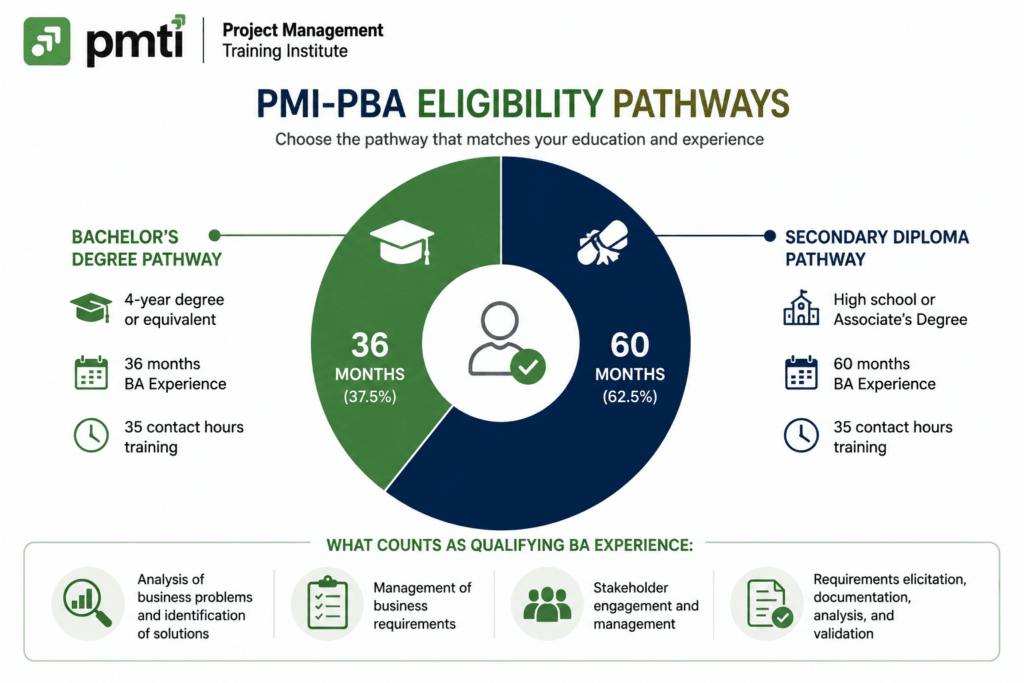
| Eligibility Pathway | Education | BA Experience | Training Required |
| Bachelor’s Degree | 4-year degree or equivalent | 36 months | 35 contact hours |
| Secondary Diploma | High school or Associate’s Degree | 60 months | 35 contact hours |
What counts as qualifying BA experience:
- Analysis of business problems and identification of solutions
- Management of business requirements
- Stakeholder engagement and management
- Requirements elicitation, documentation, analysis, and validation
Exam Fees & Costs
| Fee Type | Amount |
| PMI Annual Membership | $139 |
| Exam Fee (PMI Members) | $405 |
| Exam Fee (Non-Members) | $555 |
| Total Estimated Cost (incl. training) | $2,000 – $4,000 |
Becoming a PMI member is recommended to reduce costs.
What Does the PMI-PBA Exam Cover?
| Exam Attribute | Detail |
| Total Questions | 200 |
| Exam Duration | 240 minutes (4 hours) |
| Delivery | Pearson VUE — test center or online proctored |
| Question Format | Multiple-choice, multiple response, scenario-based |
| Passing Score | Not published — domain-level proficiency ratings |
| Exam Domains | 5 (see breakdown below) |
Questions are scenario-based, not definition-based — candidates must apply judgment to real project situations.
Proficiency ratings (all 5 domains must meet Target or above):
- Above Target
- Target
- Below Target
- Needs Improvement
The 5 PMI-PBA Performance Domains
| Domain | Weight | ~Questions | Focus Area |
| Needs Assessment | 18% | ~36 | Business problems, opportunities, goals, and stakeholders |
| Planning | 22% | ~44 | Requirements management approaches and stakeholder planning |
| Analysis | 35% | ~70 | Elicitation, documentation, modeling, and prioritization |
| Traceability & Monitoring | 15% | ~30 | Requirements tracking, change management, and traceability |
| Evaluation | 10% | ~20 | Solution effectiveness, business value, and transition support |
1. Needs Assessment (18% | ~36 Questions)
- Identifying the business problem, opportunity, or initiative
- Assessing current state, business goals, and success criteria
- Determining and defining project stakeholders
2. Planning (22% | ~44 Questions)
- Choosing a requirements management approach (predictive, Agile, or hybrid)
- Developing the requirements management plan
- Planning stakeholder engagement throughout the project
3. Analysis (35% | ~70 Questions)
The largest and most critical domain, covering the full requirements lifecycle:
- Elicitation techniques: interviews, workshops, surveys, observations
- Documentation: use cases, user stories, process flows
- Requirements modeling, analysis, validation, and prioritization
4. Traceability & Monitoring (15% | ~30 Questions)
- Defining and maintaining relationships between requirements and business goals
- Managing changes through impact analysis
- Requirements traceability and configuration control
5. Evaluation (10% | ~20 Questions)
- Confirming the solution addresses the business problem
- Assessing solution effectiveness against defined success criteria
- Facilitating organizational change management post-implementation
Career Roles & Salary Expectations
| Role | U.S. Salary Range |
| Business Analyst | $80,000 – $110,000 |
| Senior Business Analyst | $100,000 – $130,000 |
| Requirements Manager | $105,000 – $135,000 |
| Product Owner | $100,000 – $130,000 |
| Business Architect | $110,000 – $140,000 |
High-demand sectors:
- Financial Services and Banking
- Healthcare and Life Sciences
- Enterprise IT and Technology
- Government and Defense
- Management Consulting
PMI-PBA vs. PMP: How They Compare
| Attribute | PMP | PMI-PBA |
| Scope | Broad — all PM delivery dimensions | Narrow — BA within PM context |
| Experience Required | 36–60 months project management | 36–60 months business analysis |
| Exam Questions | 180 | 200 |
| Exam Duration | 240 minutes | 240 minutes |
| Primary Domains | People, Process, Business Environment | Needs Assessment, Planning, Analysis, Traceability, Evaluation |
| Best Fit For | Project managers leading teams | Business Analysts managing requirements |
| Salary Premium | 33% higher median (PMI 2023) | Role-specific premium in BA-intensive industries |
These are complementary, not competing, certifications. Professionals who hold both have the strongest earning potential and broadest career access.
How to Obtain the PMI-PBA: Step-by-Step
- Verify Eligibility — Confirm 36 months of BA experience (bachelor’s degree) or 60 months (secondary diploma), including requirements elicitation, documentation, analysis, and stakeholder management.
- Complete 35 Hours of BA Education — Obtain qualifying business analysis training aligned to the five exam domains.
- Submit the PMI Application — Document BA experience by project (hours, descriptions, supervisory contacts) via PMI’s online portal. Allow 5–10 business days for review; applications may be audited.
- Pay Fees & Schedule the Exam — Pay the exam fee and book through Pearson VUE (in-person or online proctored).
- Pass the PMI-PBA Exam — Complete all 200 questions within 240 minutes, achieving Target or Above Target in all five domains.
Certification Renewal
The PMI-PBA is valid for 3 years.
| Renewal Requirement | Detail |
| Renewal Cycle | 3 years |
| Total PDUs Required | 60 |
| Business Analysis PDUs | Minimum 35 |
| General PDUs | Up to 25 |
| Submission Platform | PMI CCR dashboard |
| Non-Compliance Result | Credential suspension and expiration |
Ways to earn PDUs: training courses, webinars, conferences, self-directed learning, and volunteer work in BA or project management.
Frequently Asked Questions
What is the PMI-PBA? A PMI credential recognizing competency in business analysis within project management — covering problem identification, requirements management, and project outcome delivery in both traditional and Agile environments.
How hard is the exam? Rigorous — 200 scenario-based questions in 240 minutes. The Analysis domain alone accounts for ~70 questions, requiring deep knowledge of elicitation, modeling, and prioritization techniques.
What salary can I expect? U.S. salaries range from $80,000 to $140,000+ depending on role, industry, and experience.
How does PMI-PBA differ from CBAP?
- PMI-PBA: BA in a project management context; issued by PMI; best for project-focused BAs
- CBAP: General BA practice; issued by IIBA; best for BAs doing large-scale strategic corporate analysis
Is it worth it? Yes — if your role involves managing stakeholder requirements and delivering business value through project teams. It creates a credential distinction for senior BA and Requirements Manager roles that non-certified professionals lack.
What are the renewal requirements? 60 PDUs per 3-year cycle, with at least 35 in business analysis activities, all recorded in the PMI CCR system before expiration.


