


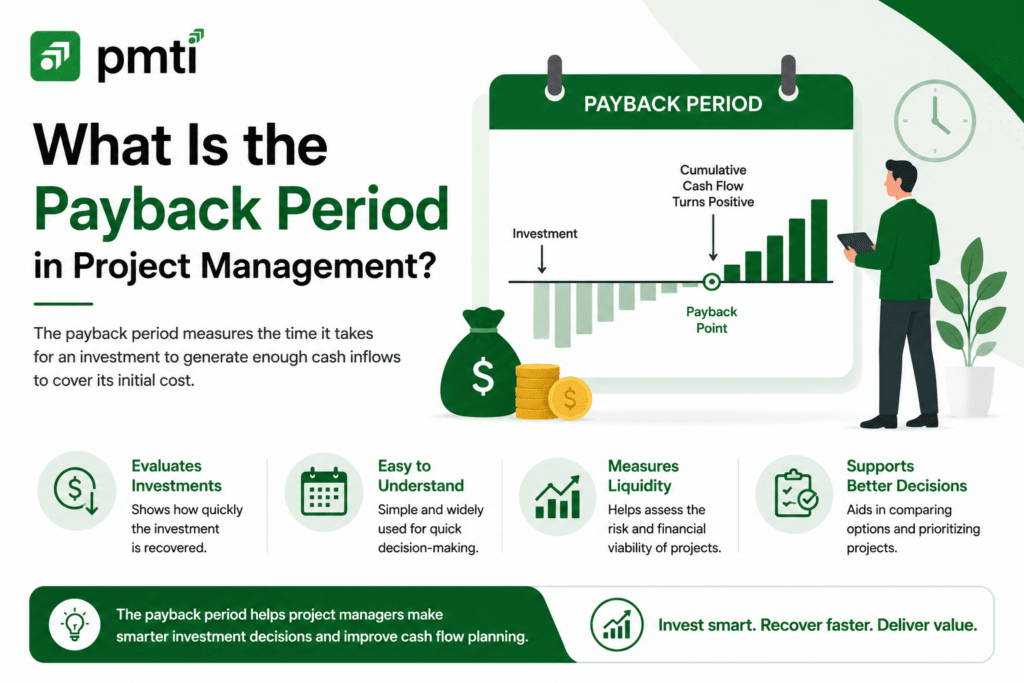
What Is the Payback Period in Project Management?
The payback period is the amount of time required for a project to recover its initial investment through positive cash flow. Project selection committees use this figure to compare competing project proposals and prioritize investments that return capital fastest.
What Is the Payback Period Formula?

The payback period formula divides the initial investment by the periodic cash flow: Payback Period = Initial Investment / Periodic Cash Flow. The result carries the same time unit as the cash flow figure — a monthly cash flow input produces a payback period in months.
- Initial Investment measures the total upfront capital committed to the project.
- Periodic Cash Flow measures the revenue the project generates during a fixed interval, assumed constant across the calculation.
How Do You Calculate the Payback Period?

A project manager calculates the payback period by dividing total upfront cost by the recurring cash flow the project generates per period. Two examples illustrate the formula against different cash flow intervals.
Example 1 — Annual Cash Flow A manufacturing upgrade requires an initial investment of $180,000 and generates $45,000 per year in positive cash flow.
Payback Period = $180,000 / $45,000 Payback Period = 4 years
Example 2 — Monthly Cash Flow A software rollout requires an initial investment of $36,000 and generates $3,000 per month in positive cash flow.
Payback Period = $36,000 / $3,000 Payback Period = 12 months
How Do You Interpret the Payback Period?
A shorter payback period signals lower financial risk, since the project recovers its capital and reaches profitability faster. Project selection committees favor shorter payback periods when comparing proposals with similar investment size and risk profile.
- Compare payback periods across competing proposals before allocating capital.
- Flag projects with long payback periods for additional risk review.
- Confirm that periodic cash flow assumptions remain realistic before finalizing the calculation.
- Pair payback period results with ROI and NPV before making a final selection decision.
What Are the Advantages and Disadvantages of the Payback Period?
The payback period offers a fast, easy-to-communicate risk metric, but it ignores cash flow variability and the time value of money. Project managers use it as a screening tool rather than a complete investment justification.
Advantages:
- Provides a quick comparison metric across multiple project proposals.
- Communicates investment risk in a single, easy-to-understand number.
- Identifies high-value projects with fast capital recovery.
Disadvantages:
- Ignores the time value of money across the recovery period.
- Assumes constant cash flow, which rarely holds in practice.
- Excludes profitability generated after the payback point is reached.
How Does the Payback Period Appear on the PMP Exam?
The PMP exam tests payback period as a conceptual project-selection tool rather than a calculation-heavy topic, typically limited to one or two questions. Candidates need to recognize that a shorter payback period indicates a financially stronger project choice.
Sample Question 1: A project selection committee is comparing two proposals. Proposal A has a payback period of 10 months. Proposal B has a payback period of 16 months. Which proposal should the committee recommend based on payback period alone? A) Proposal A B) Proposal B C) Both proposals equally D) Neither proposal
Sample Question 2: Proposal A requires a $15,000 investment with a 20-month payback period. Proposal B requires a $22,000 investment with a 14-month payback period. Which proposal is stronger, and why? A) Proposal A, because the investment is smaller B) Proposal A, because the payback period is longer C) Proposal B, because the investment is larger D) Proposal B, because the payback period is shorter
Answers: 1) A — the shorter payback period indicates faster capital recovery and lower risk. 2) D — payback period, not investment size, determines the stronger choice; Proposal B recovers capital faster.
Frequently Asked Questions
Is Payback Period Heavily Tested on the PMP Exam?
Payback period is a low-frequency topic on the PMP exam, generally appearing in one or two conceptual questions rather than calculation-heavy scenarios. Candidates benefit more from understanding when to apply it than from memorizing complex variations.
How Does Payback Period Differ From ROI?
Payback period measures the time needed to recover an initial investment, while return on investment (ROI) measures the overall profitability of a project relative to its cost. A project can have a short payback period and a low ROI, or the reverse, since the two metrics answer different questions.
Does Payback Period Account for the Time Value of Money?
Payback period does not account for the time value of money, treating a dollar received in year one the same as a dollar received in year five. Net present value (NPV) corrects for this limitation by discounting future cash flows to their present-day value.

