

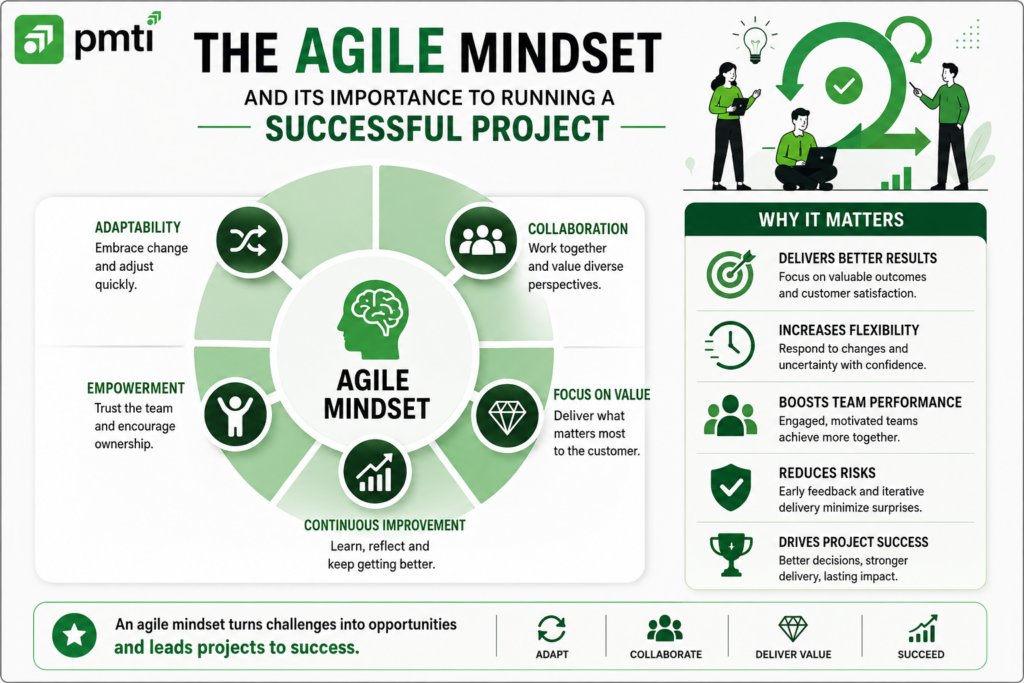
What Is an Agile Mindset?
An Agile mindset emphasizes collaboration and flexibility over all else. To an Agile mindset, the delivery of true stakeholder value takes precedent over the maintenance of scoped processes and planned outcomes. The mindset is the heart of every Agile Methodology; however, a team can precisely execute all Scrum rituals and ceremonies while still lacking the mindset that renders those rituals and ceremonies effective.
How Is an Agile Mindset Different From an Agile Methodology?
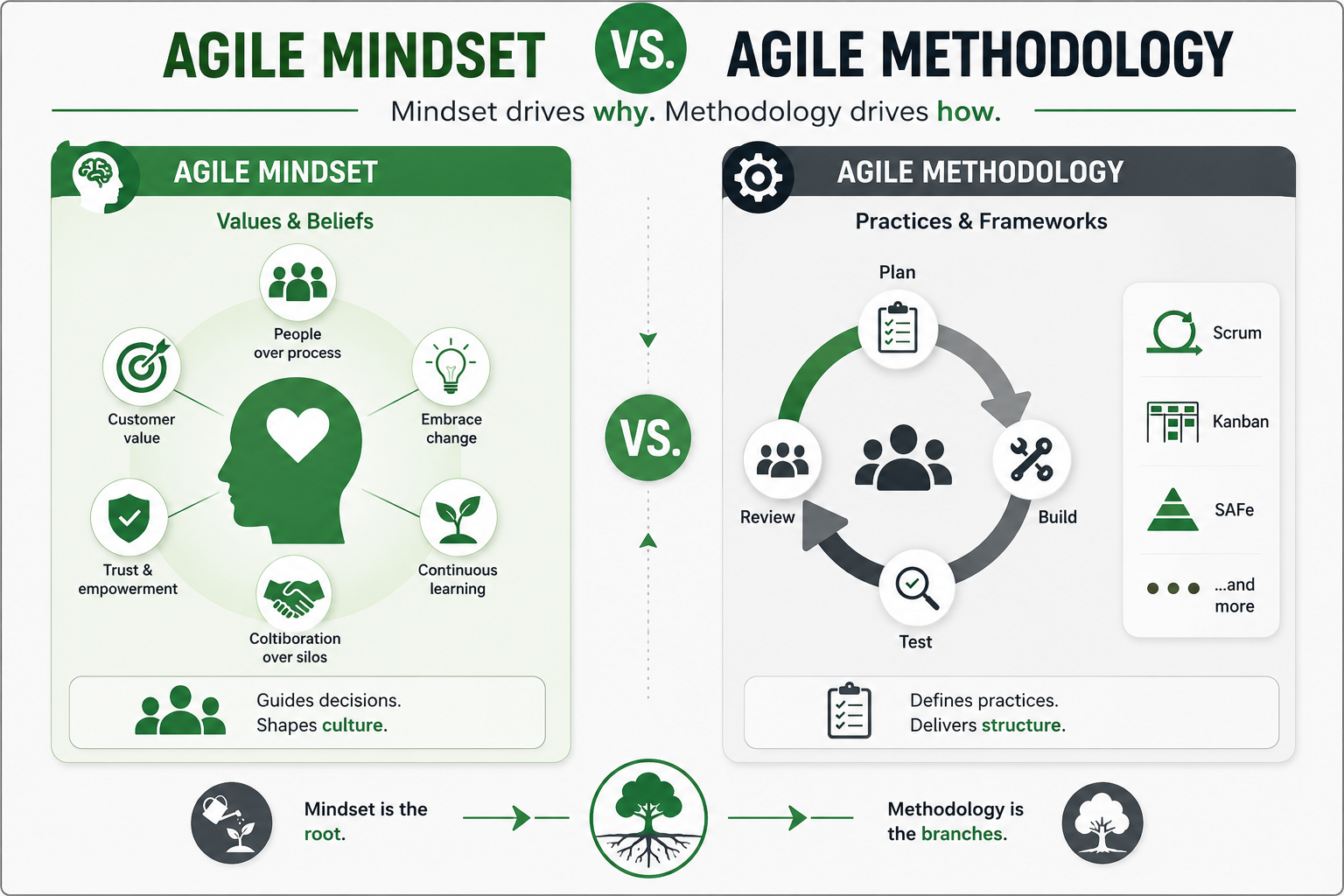
The Agile mindset refers to the value formation and belief systems that underpin the decision-making space, while the Agile methodology refers to the structured activities frameworks and processes, such as Scrum, Kanban, or SAFe. A team can conduct every single Scrum ceremony without fail; however, without an Agile mindset, it is still possible to run a predictable, Waterfall-structured project and apply an Agile mindset to the fixed project governance and phases.
What Are the Four Core Values of the Agile Manifesto?
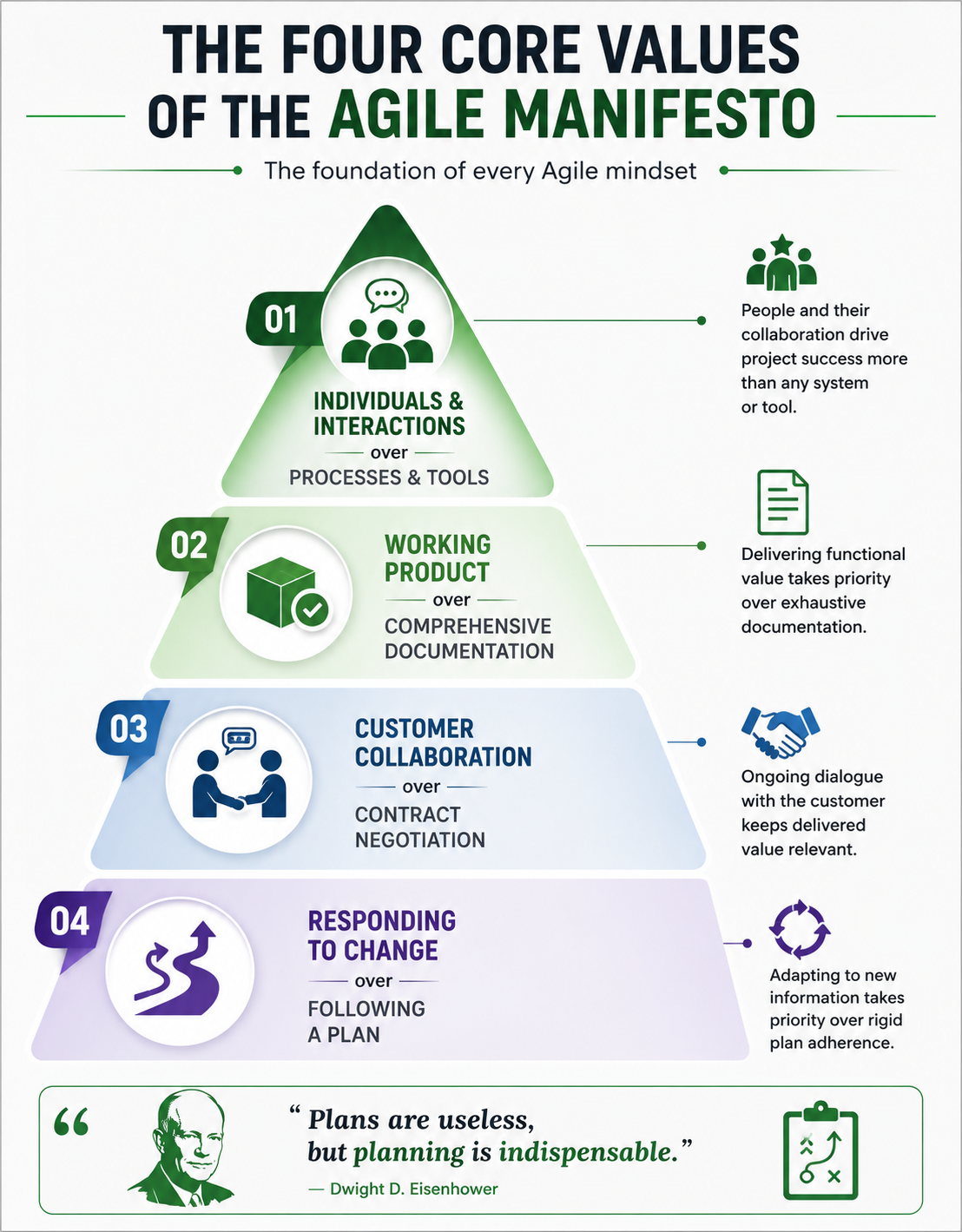
The Agile Manifesto defines four paired values, each favoring one priority over another without discarding the second item entirely. These values form the philosophical foundation every Agile mindset is built on.
- Individuals and Interactions over Processes and Tools — people and their collaboration drive project success more than any system or tool, even though consistent processes still matter.
- Working Product over Comprehensive Documentation — delivering functional value takes priority over exhaustive documentation, though documentation remains necessary for long-term supportability.
- Customer Collaboration over Contract Negotiation — ongoing dialogue with the customer keeps delivered value relevant, since needs identified at contract signing frequently shift by the time of delivery.
- Responding to Change over Following a Plan — adapting to new information takes priority over rigid plan adherence, without abandoning planning as a discipline. Dwight D. Eisenhower captured this well: “plans are useless, but planning is indispensable.”
What Are the Characteristics of a Project Manager With an Agile Mindset?
A project manager with an agile mindset places stakeholder value before any plan. Change is expected and welcome.
- Prioritizes the highest-value work first, rather than working strictly in the order originally planned.
- Adapts project plans continuously as new information and stakeholder feedback arrive.
- Engages stakeholders regularly to confirm that the definition of value has not shifted.
- Delivers working increments early and often, rather than withholding value until a single final release.
- Reflects on completed work through retrospectives, applying lessons learned to the next iteration.
How Does an Agile Mindset Help Prevent Scope Creep?
An agile mindset accounts for scope creep by looking at change as an input that another relevant stakeholder is adding to the project scope, as opposed to a change for which the stakeholders are absorbing the impact and disrupting the project. An agile mindset encourages a team to openly discuss the addition of new project requirements with stakeholders and, if necessary, adjusts the project scope while accounting for the new requirements.
Can an Agile Mindset Apply to Non-Agile (Predictive) Projects?
An Agile mindset applies to predictive, Waterfall-structured projects just as directly as it applies to Agile ones, since the underlying values — stakeholder engagement, responsiveness, and a focus on real delivered value — are not tied to any specific methodology. A predictive project manager who regularly re-engages stakeholders and stays alert to evolving priorities, all within the project’s formal change control process, is applying an Agile mindset inside a non-Agile structure.
Why Does the Agile Mindset Matter for the PMP Exam?
The Agile mindset carries significant weight on the current PMP exam, since Agile and hybrid approaches make up roughly 60% of exam content following the July 2026 exam content outline update, and the People domain — the exam’s largest single domain by original design intent — tests exactly this kind of situational judgment. Candidates should expect scenario-based questions asking what an Agile-minded project manager would do next, not just recall of manifesto terminology.
Sample Question 1: A team’s original contract specifies a fixed deliverable, but the customer’s actual needs have clearly evolved since signing. What is the Agile-minded response? A) Insist on delivering exactly per the original contract to avoid disputes B) Collaborate with the customer to understand current needs and adjust accordingly C) Deliver as originally contracted, then require a new contract for any changes D) Escalate to legal before making any adjustment
Sample Question 2: A team spends three weeks producing exhaustive documentation before writing any working code or building any functional deliverable. Which Agile Manifesto value does this most directly violate? A) Individuals and Interactions over Processes and Tools B) Working Product over Comprehensive Documentation C) Customer Collaboration over Contract Negotiation D) Responding to Change over Following a Plan
Sample Question 3: Which statement best distinguishes an Agile mindset from an Agile methodology? A) They refer to the same thing and can be used interchangeably B) Mindset refers to underlying values; methodology refers to the specific structured practices applying those values C) Methodology only applies to software development projects D) Mindset applies only to teams using Scrum
Sample Question 4: A project manager on a fixed-phase, predictive project regularly re-engages stakeholders to confirm evolving priorities, adjusting within the project’s formal change control process. This behavior reflects: A) A violation of proper predictive project governance B) An Agile mindset applied within a predictive framework C) Uncontrolled scope creep D) Poor initial planning
Answers: 1) B — collaborating with the customer to address evolved needs reflects the Agile Manifesto’s preference for customer collaboration over rigid contract adherence. 2) B — prioritizing exhaustive documentation over a working product directly violates this value. 3) B — mindset is the underlying value system; methodology is the structured practice implementing it. 4) B — applying Agile values like stakeholder responsiveness within a predictive structure, through proper change control, is a textbook example of an Agile mindset operating outside an Agile methodology.
Frequently Asked Questions
Is an Agile Mindset the Same as Scrum?
No, the Agile mindset is not the same as Scrum. Scrum is just one of the many ways to implement the Agile mindset. Another example is when a project is run with a predictable, clearly defined structure and phased approach, while the mindset of the project manager is focused on stakeholder engagement, flexibility, and delivery of real value.
Can a Waterfall Project Have an Agile Mindset?
Agile thinking can be adopted in a Waterfall project; the focus on stakeholder engagement, flexibility, and the real value delivered is not an Agile mindset alone. The project maintains its form and structure; it’s the mindset that changes how the project managers engage with stakeholders and how they react to newly discovered information in that structure.
What Are the Four Values of the Agile Manifesto?
The four values of the Agile Manifesto are individuals and interactions over processes and tools, working product over comprehensive documentation, customer collaboration over contract negotiation, and responding to change over following a plan. Each value favors one priority without fully discarding the other.
Why Is the Agile Mindset Tested So Heavily on the PMP Exam?
The Agile mindset is tested heavily because Agile and hybrid approaches now represent a significant share of current PMP exam content, and PMI’s People domain specifically evaluates a candidate’s judgment in stakeholder-facing, change-responsive scenarios. Understanding the values conceptually is not sufficient — candidates need to recognize Agile-mindset-aligned behavior inside realistic project scenarios.