


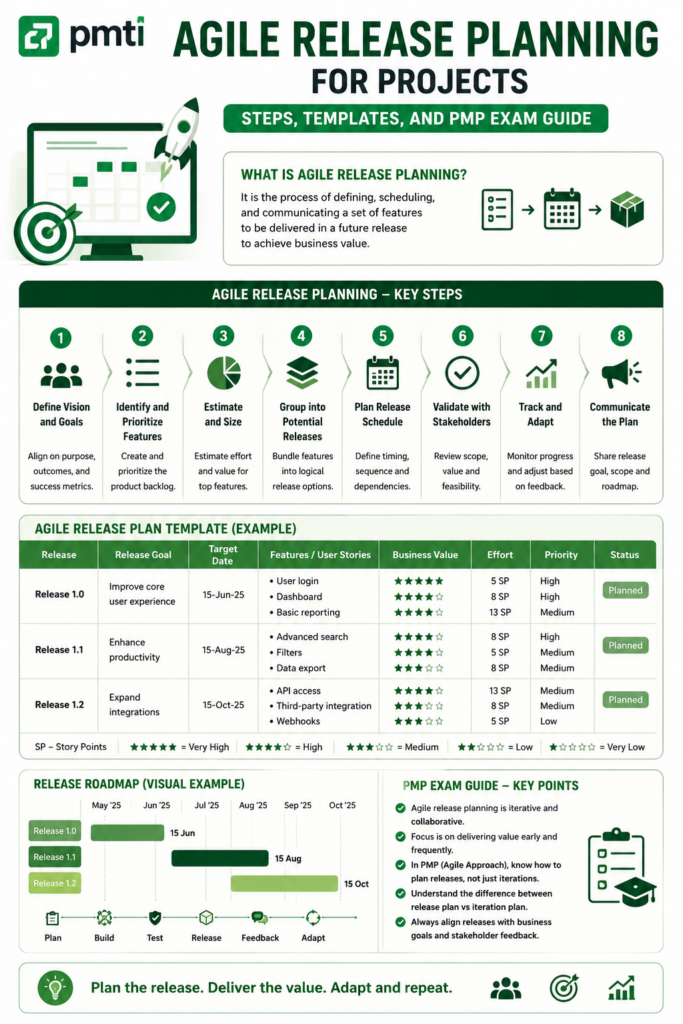
What Is Agile Release Planning?
Agile release planning is the process of mapping a product backlog across multiple sprints to determine what will be delivered, in what sequence, by a target release date. It replaces the traditional model of one large, infrequent product release with a series of smaller, incremental releases building toward continuous product improvement.
How Is Agile Release Planning Different From Sprint Planning?
Agile release planning operates at a multi-sprint horizon, determining which features ship in which release over several iterations, while sprint planning operates within a single iteration, determining which specific tasks the team commits to completing in the next two to four weeks. The two activities work together — release planning sets the destination, and each sprint plan is one leg of the journey toward it.
Teams building their first release plan typically define the release cadence before drilling into individual sprints. Agile Sprint Planning: A Step-by-Step Guide for Success in 2026 covers how to run each individual sprint that feeds into the release.
What Are the 5 Steps to Create an Agile Release Plan?
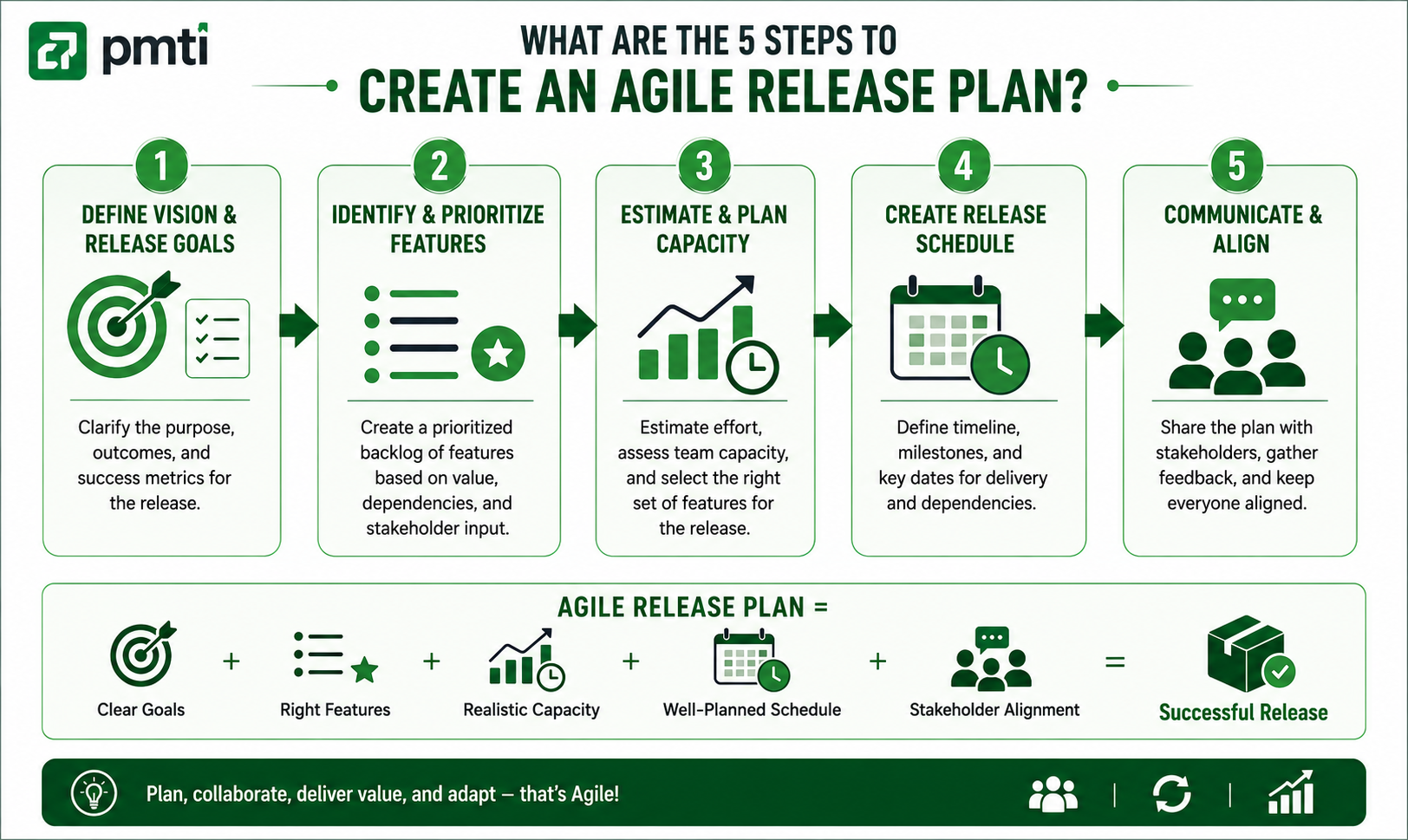
Creating an agile release plan follows five steps: defining the product vision, building the product backlog, building the iteration backlog for each sprint, tracking progress with a release burndown chart, and releasing the product increment.
Step 1: Define the Product Vision
The product vision step establishes shared agreement among stakeholders on what the product is, who it serves, and why it matters, before any backlog work begins. A clear vision keeps every later prioritization decision anchored to the same underlying goal.
- Identify the target customer the product is built for.
- Define the specific problem the product solves.
- Clarify what differentiates the product from existing alternatives.
Step 2: Build the Product Backlog
The product backlog step compiles every known feature, function, and requirement the product needs, drawn from stakeholder input, customer research, and development team feedback. This backlog becomes the master list every future sprint draws its work from.
- Review documented product requirements and desired business outcomes.
- Analyze current customer needs through research or direct feedback.
- Consult the development team on technical feasibility and effort.
Step 3: Build the Iteration Backlog
The iteration backlog step selects and refines the specific subset of product backlog items each sprint will deliver, converting broad requirements into estimated, prioritized user stories. This step repeats at the start of every sprint throughout the release cycle.
- Scope the specific work included in the upcoming iteration.
- Write user stories describing each piece of work from the customer’s perspective.
- Estimate the effort required for each user story.
- Prioritize user stories by value and dependency.
- How to Write Agile User Stories Effectively details the format and acceptance-criteria structure teams use to convert backlog items into estimable, sprint-ready stories.
Step 4: Track Progress With a Release Burndown Chart
The release burndown step visualizes remaining work across the full release cycle, giving the team and stakeholders a shared, continuously updated view of progress toward the release date.
- Collect progress data at the end of each sprint.
- Update the release burndown chart on a fixed, recurring cadence.
- Adjust release scope only when data clearly supports the change.
Step 5: Release the Product Increment
The release step verifies every planned user story is complete and meets acceptance criteria, then deploys the finished increment to production.
- Verify all committed user stories are complete.
- Confirm every acceptance criterion has been met.
- Deploy the release package to production.
- Monitor the release and conduct a retrospective to capture lessons learned.
What Is the Difference Between a Release Burndown Chart and a Sprint Burndown Chart?
A release burndown chart tracks total remaining work across every sprint in the release cycle, while a sprint burndown chart tracks remaining work within a single sprint only. Confusing the two is a common mistake: a healthy sprint burndown can exist alongside a release burndown showing the team is falling behind the overall release target, since the sprint-level view never shows the full multi-sprint picture on its own.
How Often Should a Team Release a Product Increment?
Release cadence depends on team velocity, product risk tolerance, and how quickly the market or stakeholders need new value, with most teams settling on a fixed cadence of two weeks, one month, or one quarter rather than deciding release timing ad hoc. A shorter cadence reduces the risk and cost of any single release going wrong, while a longer cadence allows more feature accumulation per release at the cost of slower stakeholder feedback.
- Two-week cadence — suits teams needing rapid feedback and low per-release risk, common in SaaS and consumer software.
- Monthly cadence — balances feedback speed against the overhead of frequent releases, common for mid-complexity products.
- Quarterly cadence — suits products where each release requires more extensive validation, such as regulated or enterprise software.
How Does Agile Release Planning Appear on the PMP Exam?
The PMP exam tests agile release planning through scenarios requiring candidates to distinguish release-level from sprint-level activities and to identify appropriate responses when a release falls behind schedule. Given Agile and hybrid content’s substantial weight on the current exam, candidates should expect release planning concepts embedded in broader Agile scenario questions.
Sample Question 1:
A product owner is prioritizing items in the product backlog for an upcoming release. Which factor should carry the most weight in that prioritization? A) The order items were originally requested B) The business value and dependency relationships of each item C) Which items are easiest for developers to build D) Alphabetical order of feature names
Sample Question 2:
A team’s sprint burndown chart shows steady, on-track progress each sprint, but the release burndown chart shows the team is unlikely to hit the target release date. What does this indicate? A) The sprint burndown chart is calculated incorrectly B) Individual sprints are performing well, but cumulative progress is falling short of the overall release scope C) The release burndown chart is unnecessary once sprint burndowns are tracked D) The team should ignore the release burndown and trust the sprint-level data
Sample Question 3:
What is the primary purpose of agile release planning? A) To plan the tasks for a single upcoming sprint only B) To coordinate a product backlog across multiple sprints toward a target release date C) To replace the need for a product backlog D) To document requirements after the product has shipped
Sample Question 4:
A team is deciding between a two-week and a quarterly release cadence for a new consumer mobile app. Which factor most strongly favors the shorter, two-week cadence? A) The need for extensive regulatory validation before each release B) The team’s need for rapid customer feedback and lower risk per release C) A preference for accumulating as many features as possible before release D) Limited development team capacity
Answers: 1) B — business value and dependencies drive proper backlog prioritization, not request order or ease of implementation. 2) B — this is the classic case for tracking both charts; sprint-level success can mask release-level shortfall. 3) B — release planning’s core purpose is coordinating multi-sprint work toward a release target, distinct from single-sprint planning. 4) B — rapid feedback and lower per-release risk are the primary drivers favoring a shorter release cadence, particularly for consumer-facing products.
Frequently Asked Questions
Is Agile Release Planning the Same as a Product Roadmap?
Agile release planning is not the same as a product roadmap — a roadmap communicates high-level, longer-term product direction, while a release plan details the specific backlog items, sprints, and timeline for one concrete upcoming release. A roadmap typically spans multiple releases; a release plan governs just one of them in detail.
How Long Should a Release Cycle Be?
There is no universal ideal release cycle length — the right cadence depends on team velocity, product risk, and how quickly stakeholders need feedback, with two weeks, one month, and one quarter all common depending on context. Teams generally start with a shorter cadence and lengthen it only if the overhead of frequent releases outweighs the feedback benefit.
Who Owns the Product Backlog?
The product owner holds primary responsibility for the product backlog, prioritizing items based on stakeholder input, customer research, and business value, though the full team contributes to refining and estimating each item. Ultimate prioritization authority rests with the product owner even when the broader team shapes the backlog’s content.
What Happens if a Sprint’s Work Isn’t Finished by the Release Date?
Incomplete sprint work typically returns to the product backlog for reprioritization in a future sprint or release, rather than delaying the current release indefinitely. Agile release planning assumes some scope flexibility by design, which is why the release burndown chart matters — it surfaces this kind of shortfall early enough to make a deliberate scope decision instead of an emergency one.