


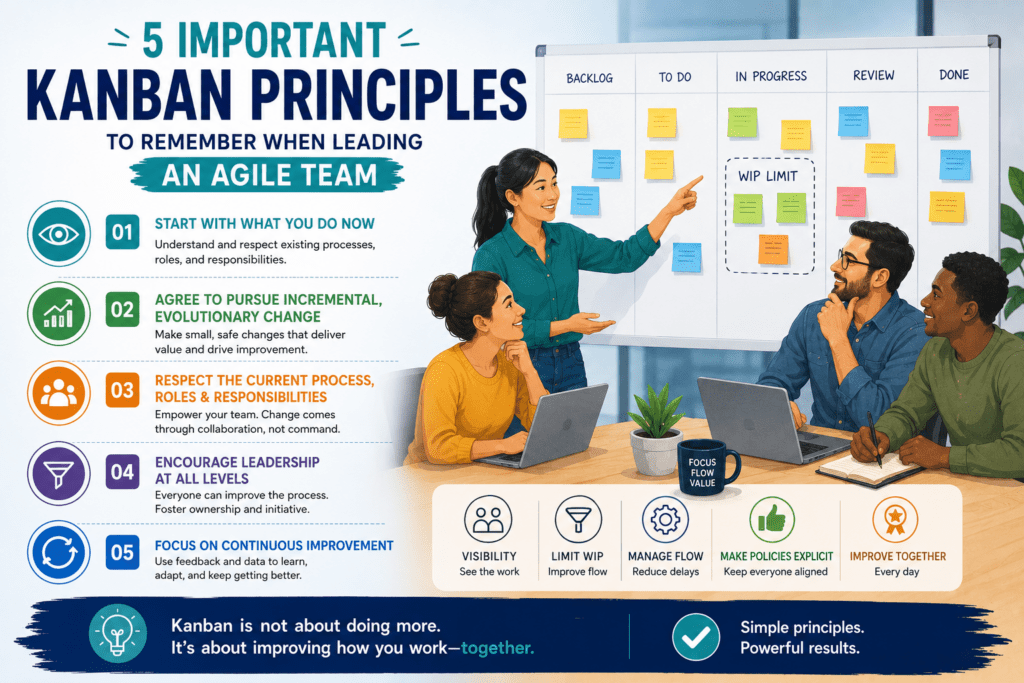
Like all practice innovators, David J. Anderson defined fewer principles than practices. The five foundational elements of Kanban highlighted in this article are in fact only four principles defined in the original Kanban Method. Work in Progress (WIP) Limits is one of the six practices and should be classified as such. In practice, most Kanban practitioners consider WIP Limits the most important practice. It even sits at the heart of Kanban’s four principles, as Anderson’s own taxonomy would confine it to the level of practices.
What Is Kanban?
Kanban is a visual workflow management method that uses a pull system to limit work in progress and expose bottlenecks, adapted from Toyota’s manufacturing floor into a framework for software and knowledge work by David J. Anderson. Unlike time-boxed Agile frameworks such as Scrum, Kanban has no fixed iterations — work flows continuously, pulled into progress only when capacity exists to handle it.
What Are the Core Principles of the Kanban Method?
Four ideas explain how a team can implement the Kanban Method to existing processes without disrupting the current workflow: incremental changes, starting with what is currently being done, respecting existing roles, and enabling managing at all levels. Another idea, limiting work in progress (or WIP), is included as a practice that is most elevated by Kanban’s essence.
1. Start With What You Do Now
To implement Kanban, teams are instructed to begin with the current process and roles without making any changes: the Kanban method is explicitly non-disruptive. Visuals and incremental changes are put in the method of choice, and only then do we think about reengineering the process.
2. Agree to Pursue Incremental, Evolutionary Change
This principle commits the team to gradual, continuous improvement rather than a single sweeping transformation. Organizations where a large-scale change is resisted the most, and/or where politics make sweeping changes dangerous, experience the most benefit of the evolutionary approach.
3. Respect Current Roles, Responsibilities, and Job Titles
This principle maintains the current roles and job titles during initial Kanban, realizing that current structures incorporate valuable elements that should not be discarded, as new, unwanted, and unnecessarily feared/resisted titles will be assigned. Kanban does not require an organization to implement new role titles, as some other Agile frameworks do.
4. Encourage Acts of Leadership at All Levels
Distributed leadership is a principle of Kanban that recognizes everyone on a team as a potential leader; if someone sees a problem in the process, this principle empowers them to lead the charge to find a solution. This directly correlates Kanban with servant leadership because both models of leadership regard leadership as a distributed behavior as opposed to a singular title.
5. Limit Work in Progress (WIP)
This principle caps the number of work items a team can have in progress, thereby mandating the completion of work before starting more work. This exposes hidden bottlenecks. This principle of Kanban is perhaps the most recognizable as the board is divided into columns with a visible cap on the card count. This principle of Kanban enables the other four principles to not be purely philosophical.
How Does Kanban Differ From Scrum?
Kanban relies on work items constantly in motion with no prescribed iterations and no prescribed roles, while Scrum relies on work items being contained within a prescribed number of iterations, or sprints, and relies on prescribed roles, such as Scrum Master and Product Owner. A Kanban team can pull a single work item into the system at any time; meanwhile, a Scrum team commits to a set of work items at the start of a sprint and is not allowed to leave that commitment until the end of the sprint.
- Kanban — continuous flow, WIP limits, no fixed roles or ceremonies required.
- Scrum — fixed-length sprints, defined roles, structured ceremonies (planning, stand-up, review, retrospective).
How Do You Apply Kanban Principles When Leading an Agile Team?

Applying Kanban principles as a team lead means visualizing the current workflow first, setting a realistic WIP limit, and using acts of leadership from any team member to continuously surface and resolve process problems.
- Visualize the team’s actual current workflow before changing anything about it.
- Set a WIP limit low enough to expose bottlenecks without stalling throughput entirely.
- Encourage any team member to flag process problems, not only those in formal leadership roles.
- Review workflow policies regularly, adjusting incrementally rather than through large periodic overhauls.
How Does Kanban Appear on the PMI-ACP and PMP Exams?
Kanban appears on the PMI-ACP examination as one of the Agile methodologies you are expected to identify and use. The framework is covered more broadly as one of the Agile and hybrid methods on the PMP examination. There will be multiple choice questions and some scenario based questions requiring you to differentiate the Kanban and Scrum methodologies.
Sample Question 1: A team wants to begin using Kanban without disrupting current operations or requiring anyone to change job titles. Which Kanban principle does this reflect? A) Encourage acts of leadership at all levels B) Start with what you do now C) Limit work in progress D) Agree to pursue incremental change
Sample Question 2: A Kanban board shows a column with significantly more cards than its WIP limit allows. What does this indicate? A) The team is performing exceptionally well B) A bottleneck exists at that stage of the workflow C) The WIP limit should be removed entirely D) The board is configured incorrectly and should be rebuilt
Sample Question 3: Which statement correctly distinguishes Kanban from Scrum? A) Kanban uses fixed-length sprints; Scrum uses continuous flow B) Kanban uses continuous flow with no fixed iterations; Scrum uses fixed-length sprints with defined roles C) Kanban requires a Scrum Master; Scrum does not D) Kanban and Scrum are identical frameworks with different names
Sample Question 4: A team member outside of a formal leadership role identifies a recurring process bottleneck and proposes a fix during a team discussion. Which Kanban principle does this reflect? A) Respect current roles, responsibilities, and job titles B) Encourage acts of leadership at all levels C) Start with what you do now D) Limit work in progress
Answers: 1) B — starting with current processes and preserving existing job titles reflects the “start with what you do now” principle. 2) B — a column exceeding its WIP limit is a direct visual signal of a bottleneck at that workflow stage. 3) B — Kanban’s continuous flow with no fixed iterations contrasts directly with Scrum’s fixed-length sprints and defined roles. 4) B — initiative from any team member, regardless of formal title, reflects the principle of encouraging leadership at all levels.
Frequently Asked Questions
Is Kanban Agile?
Kanban is an Agile technique of various other methods that tends to be flexible and geared towards continuous enhancement, even though it preceded the 2001 Agile Manifesto and was founded in Lean manufacturing first, rather than software development. With or without blending with Scrum, a lot of organizations prefer to have Kanban as their main Agile framework.
Does Kanban Use Sprints?
Unlike Scrum, Kanban doesn’t use sprints. Workflow progresses continuously in Kanban and is pulled into progress based on the available capacity in contrast to Scrum’s fixed-length iterations.
What Is a WIP Limit?
A WIP limit is a certain amount of work in progress in a specific workflow stage, and this limit is strictly enforced by finishing all existing works before initiating anything new. WIP limits signal bottlenecks on Kanban boards, unlike a backlog.
Can Kanban and Scrum Be Combined?
Kanban and Scrum can be combined in a hybrid approach often called Scrumban, which layers Kanban’s continuous-flow visualization and WIP limits on top of Scrum’s defined roles and ceremonies. Teams adopt this blend when they want Scrum’s structure but find fixed sprint boundaries too rigid for their actual workflow


