



Disciplined Agile (DA) is a process-decision toolkit, not a single methodology, that helps individuals, teams, and organizations choose and tailor their own way of working by drawing on practices from Scrum, Kanban, SAFe, Lean, XP, and other established approaches. Scott Ambler and Mark Lines developed DA at IBM before PMI acquired the toolkit in August 2019. As of 2025, PMI significantly restructured how practitioners enter the DA certification path — a change every current guide to this topic needs to reflect.
What Is Disciplined Agile?
Disciplined Agile is a context-sensitive, hybrid toolkit that guides people, teams, and organizations through choosing and continuously improving their own way of working, rather than prescribing one fixed set of practices the way a single framework like Scrum does. DA pulls proven techniques from multiple sources — Scrum, Extreme Programming, Kanban, Lean Startup, SAFe, and others — and provides decision guidance for selecting the right combination for a specific context.
How Is Disciplined Agile Different From a Single Agile Framework Like Scrum or Kanban?
Disciplined Agile is framework-agnostic, offering goal-driven decision guidance for choosing among practices from multiple frameworks, while Scrum and Kanban are each a single, defined set of practices applied consistently. A team using DA might select Scrum’s sprint structure for one workstream and Kanban’s continuous flow for another, guided by DA’s process goal diagrams rather than being locked into one framework’s rules throughout.
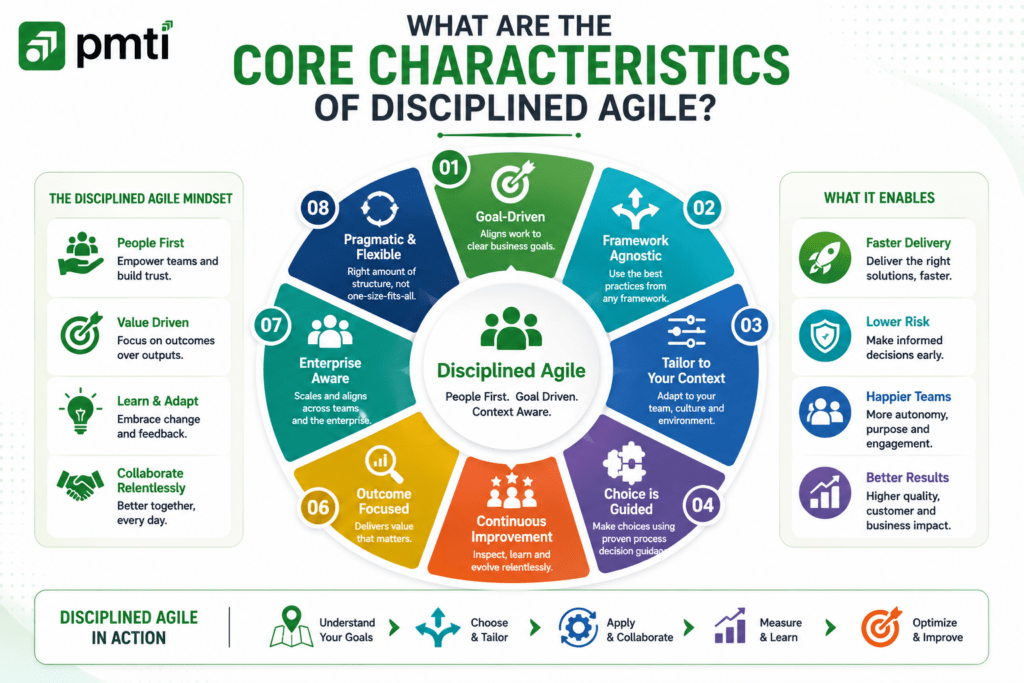
What Are the Core Characteristics of Disciplined Agile?
Disciplined Agile Delivery (DAD) is described by its founders as a people-first, learning-oriented, goal-driven approach that is enterprise-aware and scalable, extending beyond software delivery into functions like IT operations, enterprise architecture, portfolio management, and vendor management. This enterprise-wide scope is what distinguishes DA from frameworks focused primarily on a single development team’s delivery process.
How Do You Get Started With Disciplined Agile?
As of 2025, PMI retired the Disciplined Agile Scrum Master (DASM), Disciplined Agile Senior Scrum Master (DASSM), Disciplined Agile Coach (DAC), and Disciplined Agile Value Stream Consultant (DAVSC) certifications, replacing DASM as the primary entry point with a new Disciplined Agile Foundations (DAF) course. Authorized Training Partners stopped delivering the retired courses by May 31, 2025, and the final date to sit for those certification exams was November 30, 2025.
- Disciplined Agile Foundations (DAF) — launched April 29, 2025, now the primary entry-level path into the DA toolkit.
- Disciplined Agile Leadership — a new course launched in Q4 2025, merging the former DAC and DAVSC certifications for more experienced practitioners.
- Existing DASM and DASSM holders — certifications earned before retirement remain valid; PMI has not required recertification under the old credential.
Anyone researching Disciplined Agile training after 2025 should confirm which current course a provider is describing, since some training pages and materials published before the transition may not yet reflect the DAF-based entry path.
Who Should Pursue Disciplined Agile Training?
Disciplined Agile training suits business leaders, project managers, and Agile practitioners who need to coordinate work across multiple functions — software delivery, IT operations, portfolio management, and enterprise architecture — rather than optimize a single team’s process in isolation. Organizations connecting several existing Agile teams under one coherent enterprise strategy are the most common adopters.
How Does Disciplined Agile Relate to PMI-ACP?
PMI-ACP certifies broad knowledge across multiple named Agile frameworks through a single exam, while Disciplined Agile is itself one specific toolkit with its own dedicated certification path, distinct from but complementary to PMI-ACP. Practitioners frequently pursue both, since PMI-ACP’s broad framework knowledge supports the framework-agnostic decision-making DA training requires.
How Does Disciplined Agile Appear on the PMP and PMI-ACP Exams?
Both exams test Disciplined Agile as one of several Agile and hybrid approaches candidates should recognize, with PMI-ACP going deeper into DA-specific concepts than the PMP exam does. Candidates should understand DA’s core distinction — a decision toolkit rather than a single framework — since scenario questions often hinge on that distinction.
Sample Question 1: A team wants a framework that allows them to select different practices for different workstreams based on context, rather than committing to one fixed set of rules. Which approach best fits this need? A) Scrum B) Disciplined Agile C) Waterfall D) Kanban exclusively, with no other frameworks involved
Sample Question 2
As of 2026, which course serves as the primary entry point into the Disciplined Agile certification path? A) Disciplined Agile Scrum Master (DASM) B) Disciplined Agile Foundations (DAF) C) Disciplined Agile Coach (DAC) D) Disciplined Agile Value Stream Consultant (DAVSC)
Sample Question 3
An organization wants to coordinate Agile practices not just within software delivery, but across IT operations, portfolio management, and enterprise architecture as well. Which approach is best suited to this scope? A) A single-team Scrum implementation B) Disciplined Agile C) A sprint-only Kanban board D) Traditional Waterfall governance
Sample Question 4
A practitioner earned their DASM certification before PMI’s 2025 restructuring. What is the status of that credential today? A) It has been automatically revoked B) It remains valid, though new candidates can no longer pursue it C) It must be renewed through the new DAF course D) It has been replaced by an automatic PMI-ACP certification
Answers: 1) B — Disciplined Agile’s defining characteristic is context-sensitive selection across multiple frameworks, unlike a single fixed framework. 2) B — Disciplined Agile Foundations replaced DASM as the primary entry point starting in 2025. 3) B — DA’s enterprise-aware scope extends beyond single-team software delivery, unlike Scrum or Kanban alone. 4) B — existing DASM certifications remain valid after the 2025 retirement; only new certification attempts are affected.
Frequently Asked Questions
Is DASM Certification Still Valid?
DASM certifications earned before PMI’s 2025 retirement of the credential remain valid, but new candidates can no longer pursue DASM, DASSM, DAC, or DAVSC, since PMI stopped offering those exams as of November 30, 2025. Anyone currently considering Disciplined Agile certification should pursue the current Disciplined Agile Foundations path instead.
What Replaced DASM?
Disciplined Agile Foundations (DAF) replaced DASM as the primary entry point into the Disciplined Agile certification path, launching April 29, 2025. PMI also merged the former DAC and DAVSC certifications into a new Disciplined Agile Leadership course for more experienced practitioners.
Is Disciplined Agile the Same as Scrum?
Disciplined Agile is not the same as Scrum — Scrum is one specific, fixed Agile framework, while Disciplined Agile is a toolkit that helps teams choose among practices from Scrum, Kanban, SAFe, and other frameworks based on their specific context. A team can use DA’s guidance to select Scrum’s structure for one part of their work while applying different practices elsewhere.
Does Disciplined Agile Apply Beyond Software Development?
Disciplined Agile explicitly extends beyond software development into IT operations, enterprise architecture, portfolio management, finance, and vendor management, reflecting its enterprise-wide scope. This breadth is one of the clearest distinctions between DA and frameworks built primarily around a single software delivery team


