


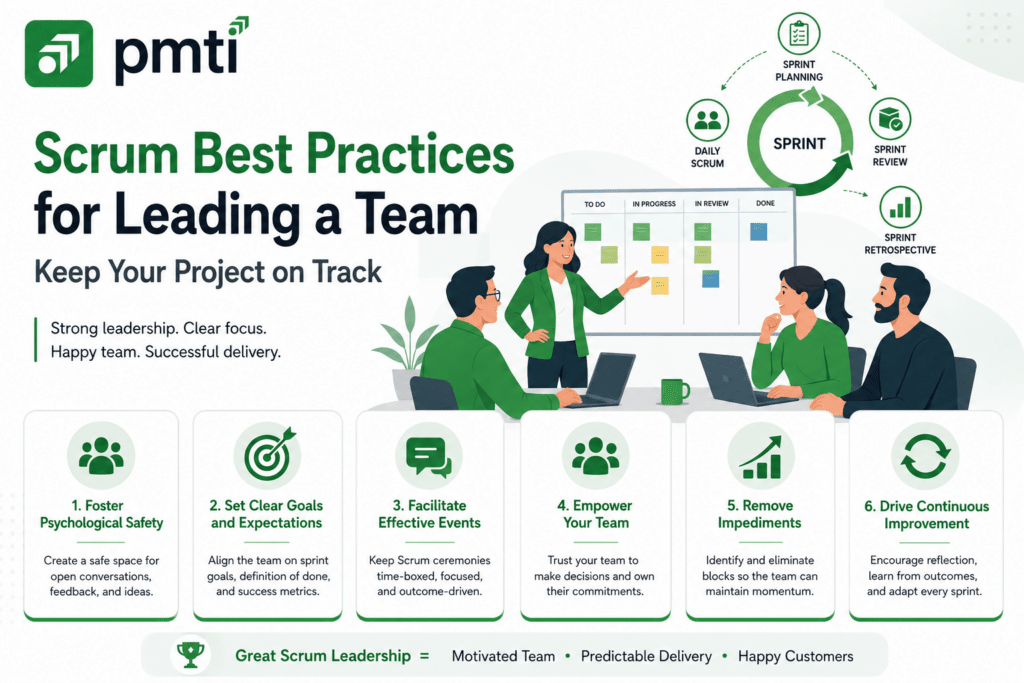
Leading a Scrum team comes down to five best practices that occur in a specific sequence across the sprint cycle. The product backlog informs what is chosen for each sprint. The sprint boundaries are protected, the Scrum board is visible, and work is tracked based on agreed-to velocity. All of this is supported by servant leadership.
The 5 Scrum Best Practices:
- Keep the product backlog visible, prioritized, and collaboratively refined
- Protect sprint boundaries and time-boxed events
- Maintain a visual Scrum board for transparency and alignment
- Maintain a consistent, sustainable velocity
- Practice servant leadership as the Scrum Master
Best Practice 1: Keep the Product Backlog Visible, Prioritized, and Collaboratively Refined

This means both building the backlog, and regularly reviewing/refining the backlog with customers, so items do not become obsolete or lose focus, and answering the question of what will most highly value customers. A common way scrum teams become busy is by maintaining an invisible backlog and losing project focus.
Three questions keep a backlog honest during refinement:
- What does the customer value most right now? — priorities shift, and the backlog should reflect the current answer, not the answer from three sprints ago.
- Does this specific work item still align with that value? — items that made sense earlier can lose relevance as understanding of the customer’s need evolves.
- Does the current backlog still match the project’s original chartered scope? — this check catches scope drift before it compounds into a project that no longer resembles what was originally approved.
Best Practice 2: Protect Sprint Boundaries and Time-Boxed Events
To protect the boundaries of the sprint, we must hold each individual Scrum event for its exact purpose and also avoid the temptation to make a mid-cycle change to the goal of the sprint, even while letting the time-box on the sprint slip. If we substitute additional unplanned meetings for the Scrum meetings that have built in events, or let scheduled meetings go longer than scheduled we lose the cadence and predictability that the framework intends to provide.
- Hold each ceremony for its intended purpose, without letting planning meetings turn into status updates or standups turn into problem-solving sessions.
- Resist mid-sprint scope changes once the team has committed to a sprint goal.
- Complete the current sprint’s commitments before pulling in new work, rather than blending sprints together.
Best Practice 3: Maintain a Visual Scrum Board for Transparency and Alignment
Scrum boards help everyone on the team be aligned because task status is made visible, as long as items are not treated as afterthoughts and are logged and updated regularly. An updated board is an important transparency tool. An unupdated board is an unhelpful and misleading stale artifact.
- Group items logically into clear stages — to-do, in progress, and done — so status is readable at a glance.
- Use color and labels to highlight priority items and approaching deadlines.
- Update the board continuously throughout the day, not just during the daily standup, so it reflects reality rather than yesterday’s status.
- Keep the board simple enough that any stakeholder can understand project status without needing it explained.
Best Practice 4: Maintain a Consistent, Sustainable Velocity
Being able to sustain a consistent velocity means having a level loaded work load for each sprint so the amount of work committed to each sprint is predictable and does not vary greatly throughout the length of the project. Maintaining a consistent commitment level reduces the sprints from being overcommitted or underutilized and improves the morale of the team and the predictability of forecasting, while creating a feeling of accomplishment.
A team with an established velocity of around 30 story points per sprint that suddenly commits to 50 points is signaling a planning problem, not unusual ambition — sustainable velocity means recognizing that pattern during the retrospective and adjusting the next sprint’s commitment back down before it produces burnout or a missed sprint goal.
Best Practice 5: Practice Servant Leadership as the Scrum Master
The philosophy behind servant leadership is that instead of the Scrum Master dictating the flow, the Scrum Master provides the necessary tools for the team to cross obstacles on their own, removes distractions, provides guidance in place of direction, and flips the traditional management structure of the predictive project. This is the guiding principle behind the other four best practices.
A backlog that is not collaboratively built and maintained also may indicate that the Scrum Master has devolved into a dictatorial style. Likewise, sprint boards that are dictatorially built and maintained may also be an indication that the Scrum Master has devolved into a dictatorial style. The same may also be an indication that the Scrum Master has devolved into a dictatorial style if the team’s velocity has begun to be used as a punishment.
How Do These Five Practices Work Together Across a Sprint Cycle?
The planning, execution, review, and retrospection of a Sprint occur in a cohesive manner as a result of the five practices, listed in the following order: backlog refinement, protected boundaries and an actively maintained board, executive sprint planning, velocity data collection, and the application of servant leadership. Servant leadership remains constant throughout the four stages, while the other four practices cycle in a linear fashion.
A team that has strong practices for the first four, but weak practice for the fifth, will consistently exhibit a failure pattern that is not only predictable, but also highly recognizable! For example, a team that has an excellent backlog and a highly visible board that is protected by well-defined boundaries will still experience issues if the Scrum Master engages in a directive leadership style, as that will ultimately begin to negatively impact the other four practices.
How Does This Appear on the PMP and PMI-ACP Exams?
Both exams test these Scrum practices through scenario questions asking what a Scrum Master or project manager should do when a sprint is at risk, a board has gone stale, a backlog has drifted, or team velocity has become unpredictable. Recognizing which of the five practices addresses a given scenario is the core skill these questions test.
Sample Question 1
Midway through a sprint, a stakeholder requests a significant new feature be added to the current sprint’s scope. What is the appropriate response? A) Add the feature immediately to satisfy the stakeholder B) Protect the current sprint’s commitment and route the new request to the backlog for future sprint consideration C) Extend the current sprint to accommodate the new work D) Cancel the current sprint and restart planning
Sample Question 2
A team’s Scrum board shows several tasks still marked “in progress” that were actually completed three days ago. What does this indicate? A) The board is functioning correctly B) The board has gone stale and is no longer providing accurate transparency C) The Scrum Master should discard the board entirely D) The team is ahead of schedule
Sample Question 3
A team’s velocity has swung between 15 and 50 story points over the last four sprints with no clear pattern. What does this most likely indicate? A) The team is highly adaptable and this is a strength B) A planning or estimation problem requiring attention to stabilize sustainable velocity C) The Scrum Master should immediately replace the team D) Nothing — velocity naturally varies without any need for adjustment
Sample Question 4
A Scrum Master directly assigns specific tasks to specific developers each morning rather than allowing the team to self-organize. What does this behavior indicate? A) Strong, effective Scrum Master leadership B) A departure from servant leadership toward command-and-control management C) The correct application of Scrum’s leadership model D) A necessary practice for all Scrum teams
Sample Question 5
A team has been completing sprint after sprint successfully, but a review reveals the current backlog no longer resembles the project’s originally chartered scope. What has most likely occurred? A) The team has been highly productive with no concerns B) Scope drift went unaddressed during backlog refinement C) The Scrum Master failed to hold daily standups D) The Product Owner should be replaced immediately
Answers: 1) B — protecting the current sprint’s commitment while routing new requests to the backlog preserves the team’s rhythm without ignoring the stakeholder’s request. 2) B — a board showing outdated status has stopped functioning as a transparency tool and needs immediate attention. 3) B — wide, inconsistent velocity swings signal an estimation or planning issue rather than healthy adaptability. 4) B — directly assigning tasks rather than enabling self-organization is a departure from the servant leadership model Scrum assumes. 5) B — consistently completing sprints doesn’t guarantee alignment with original scope; unaddressed scope drift during backlog refinement is the most likely explanation.
Frequently Asked Questions
Is the Scrum Master a Project Manager?
Scrum Masters don’t manage projects or team members the way that a traditional project manager does. Instead, Scrum Masters remove obstacles and facilitate Scrum meetings. Some companies combine the positions, but within Scrum, both roles are distinct.
How Long Should a Sprint Be?
A lot of teams align sprints within the range of 2-4 weeks, but Scrum doesn’t actually impose a particular length. As long as you maintain consistency, your sprint length should be whatever you find works best for your team. Predictability in sprint length is what makes velocity value estimations meaningful, and often changing a sprint length actually disrupts predictability more than running just a little longer or shorter sprints.
Does the Scrum Board Need to Be Digital?
A physical Scrum board is just as viable, and co-located teams may even like it more than a digital variant because of sticky notes. For remote teams or teams that often work with some degree of asynchronous collaboration, a digital Scrum board is likely better and may include Jira, Trello, Miro, Mural, etc.. The format of your Scrum board isn’t that important, but your team should update the board and use it to its full potential.
What Happens if the Team Can’t Complete the Sprint Backlog?
When a team fails to complete a backlog item, that item returns to the product backlog for reprioritization in an upcoming sprint. Pressuring a team to finish items by extending the current sprint runs counter to the goal of protecting the team’s cadence. Keeping the boundaries of the sprint intact also adds environmental factors that help measure the team’s progress, rather than unnaturally prolonging the sprint goal to reach an arbitrary completion target.
Can Scrum Best Practices Apply Outside Software Development?
Scrum’s core practices — a prioritized backlog, protected time-boxed cycles, a visible tracking board, sustainable pace, and servant leadership — apply to any team managing iterative work, not only software development. Marketing campaigns, sales cycles, and operational teams have all adapted these same underlying practices to their own context.


