


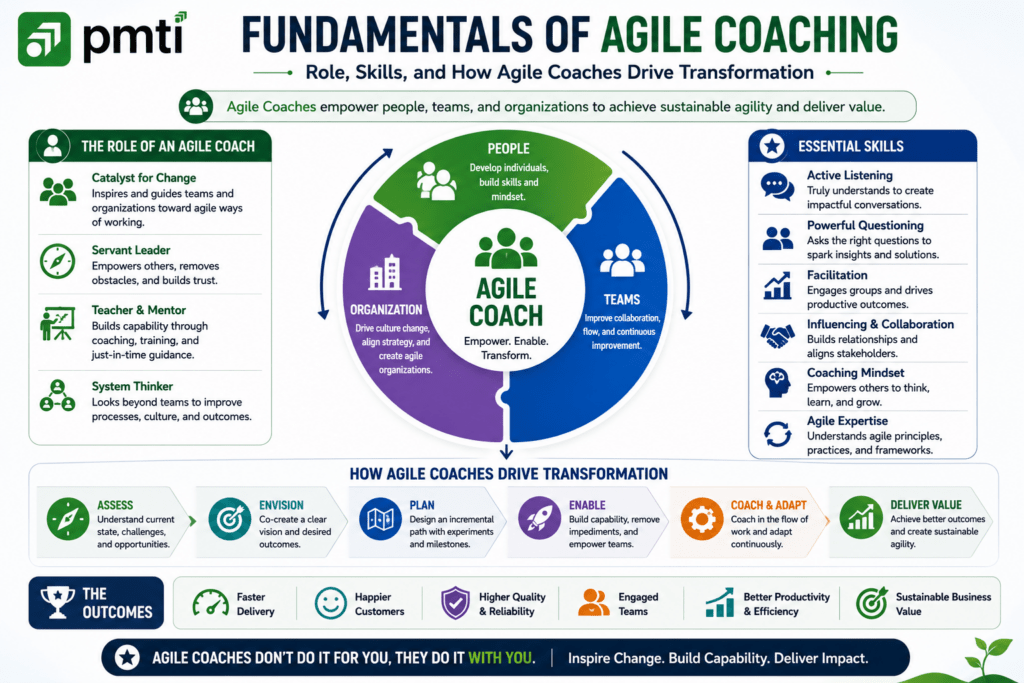
An Agile coach is responsible for creating an Agile mindset. This is different from providing life advice. For an Agile coach, life advice is outside of the scope of the role. An Agile coach works with values, behaviors, and structures. This level of change will affect the leadership, the processes and the culture on a substantial level. This is not just individual skill building.
What Is an Agile Coach?
An Agile coach is responsible for creating an Agile mindset. This is different from providing life advice. For an Agile coach, life advice is outside of the scope of the role. An Agile coach works with values, behaviors, and structures. This level of change will affect the leadership, the processes and the culture on a substantial level. This is not just individual skill building.
What Is the Difference Between an Agile Coach and a Scrum Master?

A Scrum Master is dedicated to a single team, and focuses on helping the team use Scrum, while an Agile coach works on a broader team or organizational level and is concerned with the adoption of Agile methods in general rather than a given methodology. During a company-wide transformation, a company may employ multiple Agile coaches, while supporting the changes, and a set of Scrum Masters focus on the facilitation of the transformation at the team level.
What Scrum Values Does an Agile Coach Help Teams Internalize?
Teams learn to practice each of the five values of Scrum commitment, courage, focus, openness, and respect, through the assistance of an Agile coach. Each of these values allows the three pillars of Scrum (transparency, inspection, and adaptation) to be implemented within the context of a working software system. According to the current Scrum Guide, teams learn the values through hands-on practice with the Scrum roles, events, and artifacts, not through a single training session.
- Commitment — team members genuinely dedicate themselves to the team’s shared goals.
- Courage — team members tackle difficult problems and speak honestly, even when it’s uncomfortable.
- Focus — attention stays on the current Sprint’s work and goals rather than splitting across competing priorities.
- Openness — the team and its stakeholders stay transparent about both progress and challenges.
- Respect — team members treat each other as capable, independent professionals.
How Does an Agile Coach Support a Waterfall-to-Agile Transition?
An Agile coach facilitates change in multiple, interconnected aspects of the organization when leading a Waterfall-to-Agile transition. These include moving from the command and control of heavy planning to being self-organized, introducing servant leadership, moving from hefty documentation to an emphasis on working software, and building a direct cooperation and trust-based partnership between the business and the delivery team. Because each of these elements affects a different part of the organization, such a transition can take considerably longer than a training session on the team’s Scrum rituals.
- Self-organization replaces top-down task assignment — the team decides, together, how to accomplish its committed work.
- Servant leadership replaces directive management, with leaders facilitating and removing obstacles rather than assigning and checking on tasks.
- Reduced documentation shifts emphasis toward working product over comprehensive paperwork, without eliminating documentation that genuinely supports the product long-term.
- Direct business collaboration replaces periodic status reporting, with product owners and stakeholders engaging the team regularly rather than at fixed checkpoints.
- Organizational trust has to extend all the way to senior management, who must let teams work at their own sustainable pace rather than pushing for artificial acceleration.
Does Agile Eliminate the Project Manager Role Entirely?
While elements of Scrum do not account for a project manager role, how this is implemented across the board varies. Some organizations may promote project managers to Scrum Master or Product Owner roles, and others may keep a project management role in a more hybrid capacity. This elimination of project management is also overly simplistic in nature. The absence of the traditional project management role in Scrum doesn’t mean every organization is going to adopt this practice.
What Makes the Transition From Project Manager to Scrum Master Difficult?
Directive instincts are the biggest challenge to transitioning from a project manager to a Scrum Master. This is demonstrated by a Scrum Master’s ability to sit back and observe the team while maintaining a drive for progress by identifying and removing obstacles to the team’s self-driving nature.
What Does an Agile Coach Actually Do During a Transformation?
The major role of an Agile coach during a transformation is to promote an Agile mindset throughout all levels of the organization. If a change is adopted at the team level while upper management and the middle level of the organization continue to think and operate in the old mode, it results in the change regressing to the previous behaviors. This addresses the reason behind the top-down and bottom-up engagement of the entire organization as opposed to the standard bottom-up engagement of a team level change implementation.
What Certifications Support Becoming an Agile Coach?
There are certifications in Agile coaching, such as the coaching credentials of ICAgile, as well as the PMI-ACP for overall knowledge of Agile frameworks. PMI’s Disciplined Agile pathway also offers an advanced certification as its earlier Disciplined Agile Coach (DAC) certification was integrated into the new Disciplined Agile Leadership course for 2025.
How Does This Appear on the PMP and PMI-ACP Exams?
The PMI-ACP focuses on Agile coaching aspects through facilitation, as well as leading through serving, among other concepts. The PMP incorporates these concepts as part of its focus on Agile and hybrid approaches. Candidates should be prepared to answer questions about situations that differentiate Agile coaching from directive and controlling management.
Sample Question 1
An Agile coach is brought in to support an organization’s transition from Waterfall to Agile. Which of the following best describes their primary function? A) Directly managing each project team’s daily task assignments B) Propagating the Agile mindset consistently across all levels of the organization C) Replacing the need for Scrum Masters on individual teams D) Focusing exclusively on individual team members’ personal development
Sample Question 2
A former project manager is struggling to transition into a Scrum Master role. What is the most likely underlying challenge? A) A lack of technical skill relevant to the product B) Difficulty letting go of directive, command-and-control instincts in favor of facilitation C) Insufficient knowledge of the product backlog D) The organization has not provided enough training on Scrum ceremonies
Sample Question 3
Which statement most accurately describes how Agile frameworks treat the traditional project manager role? A) Every organization eliminates the project manager role identically during Agile transformation B) Scrum’s framework defines no project manager role, but organizations vary in how they structure this transition in practice C) The project manager role becomes more powerful under Agile D) Agile requires maintaining the exact same project manager responsibilities as Waterfall
Sample Question 4
Why do Agile transformations that succeed only at the team level often regress back to old behavior? A) Team-level change is inherently unstable regardless of context B) Leadership and middle management continuing to operate under old assumptions undermines team-level change over time C) Scrum ceremonies naturally lose effectiveness after several months D) Regression is unavoidable regardless of how the transformation is managed
Answers: 1) B — an Agile coach’s core function is spreading the Agile mindset consistently across the organization, not directly managing tasks or replacing Scrum Masters. 2) B — this transition challenge centers on shifting from directive management to facilitation, not technical or process knowledge gaps. 3) B — Scrum itself defines no PM role, but real-world organizational transitions vary significantly in practice. 4) B — team-level change unsupported by consistent leadership behavior tends to regress, which is why transformation requires engagement at every organizational level.
Frequently Asked Questions
Is an Agile Coach the Same as a Scrum Master?
An Agile coach is not the same as a Scrum Master. A Scrum Master helps one specific team adopt the Scrum framework and an Agile coach generally works beyond one team, across many or the entire organization. Some people possess and move between the two types of expertise, depending on the scope of the engagement.
Do You Need Certification to Become an Agile Coach?
It isn’t necessary to have certification to take on the role of an Agile Coach, but many employers prefer to onboard candidates with training and credentialing including ICAgile Coaching Certifications or the PMI-ACP. Most hiring managers value practical experience gained from transformational coaching. While formal certification is important, so is your ability to provide experience gained from actually transforming teams.
Can an Agile Coach Work With Non-Scrum Teams?
Agile coaches do not restrict their work to Scrum frameworks. They usually work with teams that use Kanban, hybrid, or any other Agile framework. While most of the Agile frameworks share common principles, the main focus for Agile coaches is Agile mindset, not the mechanics of any particular framework.
What Is the Biggest Obstacle Agile Coaches Face During Transformation?
The most persistent obstacle Agile coaches face is inconsistent adoption across organizational levels — teams embracing new ways of working while middle management or senior leadership continues operating under old, command-and-control assumptions. This inconsistency is precisely why effective transformation requires engagement at every level simultaneously, not a team-by-team rollout alone.


