


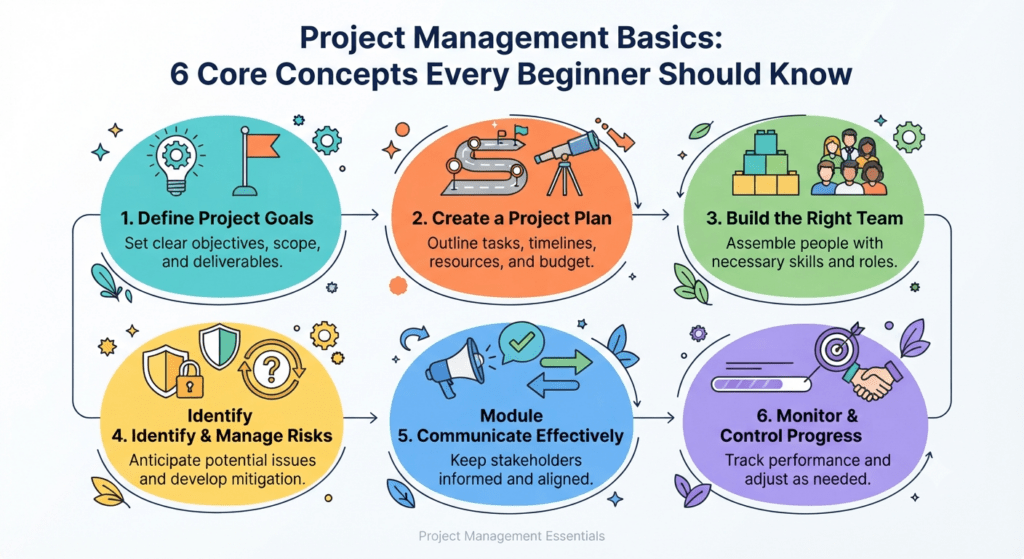
Project management is the application of specific knowledge, skills, tools, and techniques to deliver something of value within a defined timeframe and budget. Whether you’re deciding on a career path or just trying to run your first project well, six core concepts form the foundation everything else builds on: what a project actually is, what project management means, why it creates value, how work moves through phases, what a project manager does, and what tools make all of it manageable.
Concept 1: What Is a Project?
A project is a temporary endeavor undertaken to create a unique product, service, or result, distinguished from ongoing operations by having a defined start, a defined end, and a specific goal. Four elements define this concept precisely: a project is temporary (it has a start and end date), unique (its work differs from routine operational maintenance), resourced (it has an assigned team, budget, and schedule), and goal-bound (it concludes once its objectives are met).
Daily equipment maintenance in a factory is not a project — it’s ongoing operations. A time-boxed initiative to upgrade that same equipment by a specific date and within a defined budget is a project. There’s no minimum or maximum duration requirement; what matters is a clear start and a clear stop.
Concept 2: What Is Project Management?
Project management is the application of knowledge, skills, tools, and techniques to deliver specific project goals within a defined budget and timeframe, distinct from ongoing operational management, which has no fixed endpoint. Multiple formal methodologies exist — Agile, Waterfall, Scrum, Kanban, Lean, PRINCE2, and Six Sigma among them — each with its own terminology, phase structure, and often its own certifying body.
Project management and general management share real skill overlap — team leadership, conflict resolution, and trust-building matter in both — but project management operates within fixed time and budget boundaries, while ongoing management does not stop when any single initiative concludes.
Concept 3: What Is the Value of Project Management?
Project management delivers measurable organizational value: more consistent positive outcomes, stronger customer loyalty, better employee retention, more effective resource allocation, and clearer prioritization of high-value work. The discipline emerged as a formal field in the 1960s, as government and private organizations began managing more complex projects simultaneously and needed a standardized way to address inconsistent terminology, poor resource allocation, and unreliable goal achievement.
PMI’s own research frames the value plainly: organizations turn to project management to deliver results consistently, reduce costs, increase efficiency, and improve stakeholder satisfaction. Companies with a mature project management culture tend to see this value compound — cost savings, morale, and customer loyalty reinforce each other over time rather than operating as isolated benefits.
Concept 4: What Are the Project Management Phases?
Most traditional project management approaches organize work through five phases — Initiation, Planning, Execution, Monitoring and Controlling, and Closing — though the exact number and names of phases vary by methodology and organization. Waterfall approaches typically follow five sequential phases, some methodologies use seven, and Agile approaches track work through repeated increments like sprints rather than fixed sequential phases at all.
Concept 5: What Does a Project Manager Do?
A project manager is ultimately responsible for the project’s outcome, regardless of their specific job title, tasked with selecting the right methodology, developing the project plan, building and supporting the team, managing deliverables, and communicating with stakeholders throughout. Titles vary — Project Manager, Project Lead, Project Coordinator — but the underlying accountability for meeting project goals stays consistent across all of them.
The project team carries its own set of responsibilities alongside the project manager: contributing relevant skills, completing individual deliverables on schedule, providing subject matter expertise, documenting decisions and risks, and communicating consistently with the rest of the team.
Concept 6: What Tools Do Project Managers Use?

Project managers rely on a core set of tools to plan, track, and communicate project work: Gantt charts for scheduling, a work breakdown structure (WBS) for decomposing scope into manageable tasks, Kanban boards for visualizing work status, and dedicated project management software for centralizing all of it. Which specific tools a project uses depends heavily on the chosen methodology — a Waterfall project leans more heavily on detailed Gantt charts and a comprehensive WBS, while an Agile project relies more on a visual task board and a prioritized backlog.
- Gantt charts — visualize task sequencing, duration, and dependencies across the project timeline.
- Work breakdown structure (WBS) — decomposes the total project scope into progressively smaller, manageable work packages.
- Kanban boards — track task status visually, commonly used in Agile and flow-based work management.
- Project management software — centralizes scheduling, resource tracking, communication, and reporting in one platform.
What Common Project Management Methodologies Exist?
Beyond the traditional Waterfall approach, common methodologies include Agile, Scrum, Kanban, Lean, PRINCE2, and Six Sigma, each with different terminology, phase structures, and often a distinct certifying body. .
What Certifications Support a Project Management Career?
Common project management certifications include PMP and CAPM, both overseen by PMI, alongside Certified ScrumMaster (CSM) for Agile-focused roles and PRINCE2 for organizations using that specific methodology. Pursuing certification in one methodology doesn’t prevent building expertise in others — many project managers hold credentials across multiple frameworks over the course of a career.
How Does This Appear on the PMP Exam?
The current PMP exam is organized around three performance domains — People, Process, and Business Environment — rather than the traditional five process groups, following PMI’s 2021 restructuring of the exam content outline. Candidates should understand project phases and the project manager’s core responsibilities as foundational knowledge, but should study using the current domain structure rather than the older process-group framework when preparing specifically for the exam itself.
Frequently Asked Questions
Is Project Management the Same as Management?
Project management is not the same as general management — project management operates within a fixed timeframe, budget, and defined goal, while general management is ongoing and does not stop at a defined endpoint. The two disciplines share real skill overlap, particularly in leadership and team development, but differ fundamentally in scope and duration.
Do All Projects Have the Same Number of Phases?
Projects do not all have the same number of phases — the count and structure depend on the methodology and organization, with some approaches using five sequential phases and others using seven, while Agile approaches track work through iterative increments rather than fixed phases at all. PMI does not mandate a single universal phase structure.
What Is the Difference Between PMP and CAPM Certification?
PMP certification targets experienced project managers who meet PMI’s project management experience requirements, while CAPM certification serves as an entry-level credential for those newer to the field with less hands-on project experience. Both are overseen by PMI and can serve as complementary steps in a project management career.
Can Someone Learn Project Management Without Formal Certification?
Project management skills and principles can absolutely be learned and applied without formal certification, though certification demonstrates verified knowledge and often improves career opportunities and credibility with employers. Many people practice solid project management fundamentals in their roles long before pursuing a formal credential.


