


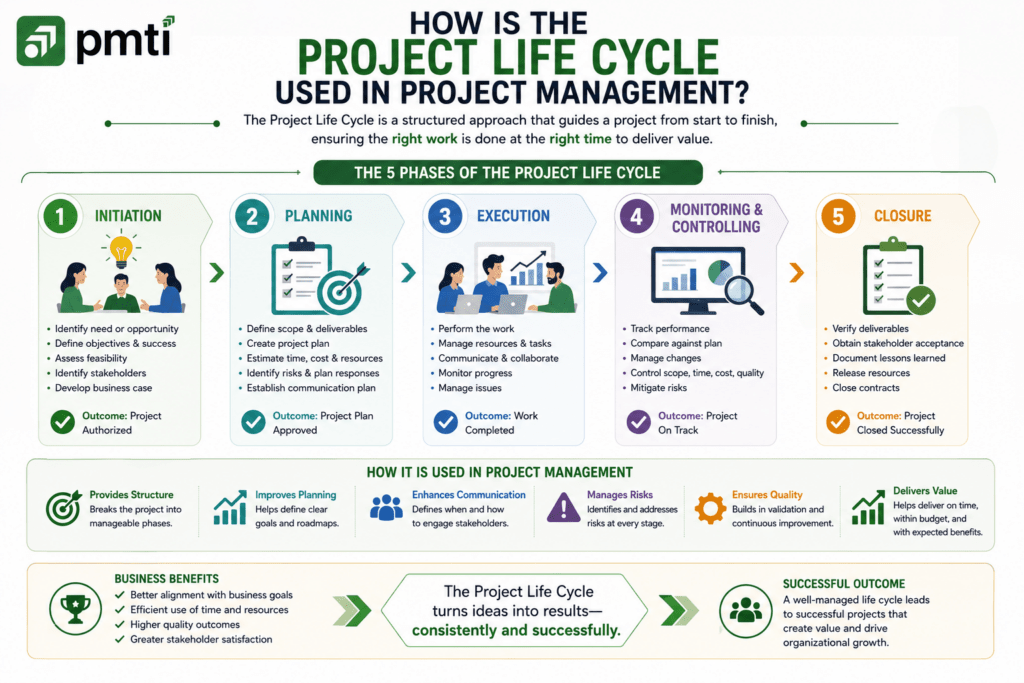

The project life cycle is the series of phases a project passes through from initiation to closure, giving the project team a structured framework for organizing work, sequencing deliverables, and tracking progress toward completion. Understanding how it connects to three related but distinct concepts — the project management life cycle, project phases, and development approach — is essential to applying it correctly.
What Is the Difference Between Project Life Cycle, Project Management Life Cycle, Project Phases, and Development Approach?

These four terms describe different layers of the same project: the project life cycle is the deliverable’s journey from start to finish, the project management life cycle is the five process groups used to manage that journey, a project phase is one specific stage within the life cycle, and the development approach determines whether work happens sequentially or iteratively. Confusing these terms is one of the most common sources of error for project managers and PMP candidates alike, since they overlap in everyday language far more than they overlap in actual meaning.
- Project Life Cycle — the full series of phases a specific project moves through, from initiation to closure.
- Project Management Life Cycle — the five process groups (Initiation, Planning, Execution, Monitoring and Controlling, Closure) applied to manage the work within and across those phases.
- Project Phase — one logically related collection of activities within the life cycle, culminating in a specific deliverable.
- Development Approach — the method used to create the deliverable itself: predictive, agile, or hybrid.
What Is the Project Life Cycle?
The project life cycle is the series of phases a project passes through from its start to its completion, providing the structural framework the project team uses to organize work and track progress. PMI does not mandate a fixed number of phases, a fixed duration, or fixed phase names — the life cycle is tailored to each project’s industry, scope, and organizational context.
What Is the Project Management Life Cycle?
The project management life cycle consists of five process groups — Initiation, Planning, Execution, Monitoring and Controlling, and Closure — that structure how a project manager oversees work regardless of which specific phases the project’s deliverable moves through. These process groups are not sequential phases of the deliverable itself; they represent categories of management activity that can recur within and across the project’s actual life cycle phases.
- Initiation — defines the project’s objectives, identifies stakeholders, and establishes initial scope, typically formalized in a project charter.
- Planning — develops the detailed schedule, budget, resource plan, and risk management approach the team will execute against.
- Execution — manages the team’s work, coordinates resources, and maintains stakeholder communication as deliverables get built.
- Monitoring and Controlling — tracks progress against the plan, identifies variances, and manages change requests and emerging risks throughout execution.
- Closure — finalizes deliverables, obtains formal acceptance, releases resources, and documents lessons learned for future projects.
How Does the Project Development Approach Shape the Life Cycle?
The development approach — predictive, agile, or hybrid — determines whether the project life cycle unfolds as a single linear sequence, a series of short iterations, or some combination of both, directly shaping how phases are structured and how change gets handled.
- Predictive (traditional/Waterfall) — work proceeds linearly through sequential phases, with the team following the initial plan closely; best suited to projects with well-defined, stable requirements.
- Agile (adaptive) — work proceeds through short, repeated iterations, with scope flexing each cycle based on feedback; best suited to projects involving significant innovation or evolving requirements.
- Hybrid — the project combines predictive and agile elements deliberately, often using predictive planning for stable, well-understood components while applying agile iteration to components with higher uncertainty; common on large projects where different workstreams carry different levels of requirement stability.
What Are Common Project Phases?
Common project phases include feasibility, design, build, test, deploy, and close, though PMI does not require a project to use these exact names or this exact sequence — phases are tailored to the specific deliverable and industry.
Consider a mobile app launch moving through these phases: Feasibility assesses whether the app idea is technically achievable and financially viable. Design translates requirements into wireframes, architecture, and a technical specification. Build develops the actual application code and features. Test verifies functionality, performance, and security before release. Deploy publishes the app to app stores and rolls out to users, including any necessary migration or change management. Close archives project documentation, finalizes vendor contracts, and releases the team to their next assignment.
How Does Organizational Structure Affect the Project Life Cycle?
Organizational structure directly shapes how much authority a project manager holds, how resources get allocated, and how quickly a project can move through its life cycle, varying significantly across functional, matrix, and projectized structures.
- Functional structure — employees remain siloed within functional departments, and project coordinators hold limited authority relative to functional managers, requiring frequent negotiation for shared resources.
- Weak matrix — functional managers retain more authority than project managers, with project work competing against departmental priorities.
- Balanced matrix — authority is shared roughly equally between project managers and functional managers.
- Strong matrix — project managers hold greater authority, often supported by a dedicated Project Management Office (PMO) providing administrative oversight.
- Projectized structure — the project manager and team focus exclusively on one project at a time, common in consulting environments where staffing scales directly with client engagements.
Large organizations frequently operate a mix of these structures across different departments simultaneously, which is why project managers moving between departments often need to reassess how much authority and resource flexibility they actually have before finalizing a project’s life cycle plan.
How Does This Appear on the PMP Exam?
The PMP exam tests the distinction between these four concepts directly, along with scenario questions requiring candidates to identify the appropriate development approach or organizational structure implication for a given situation. Confusing project phases with process groups is one of the most common sources of incorrect answers on this topic.
Sample Question 1
A project team is defining objectives, identifying stakeholders, and formalizing a project charter. Which project management process group does this describe? A) Planning B) Initiation C) Execution D) Monitoring and Controlling
Sample Question 2
A project has well-defined, stable requirements and a client expecting a fixed, linear delivery schedule. Which development approach is most appropriate? A) Agile B) Hybrid C) Predictive D) None of these approaches apply
Sample Question 3
In which organizational structure does the project manager typically hold the greatest authority, often supported by a dedicated PMO? A) Functional structure B) Weak matrix C) Balanced matrix D) Strong matrix
Sample Question 4
A project team completes feasibility, design, build, test, deploy, and close as part of their work. What are these best described as? A) Project management process groups B) Project phases specific to this project’s life cycle C) Development approaches D) Organizational structure types
Answers: 1) B — defining objectives, identifying stakeholders, and formalizing a charter are core Initiation activities. 2) C — stable, well-defined requirements with a fixed linear schedule expectation favor a predictive approach. 3) D — a strong matrix gives project managers the greatest authority among the matrix variants, typically supported by a PMO. 4) B — feasibility, design, build, test, deploy, and close are project phases specific to this project’s life cycle, distinct from the five process groups.
Frequently Asked Questions
Is the Project Life Cycle the Same as the Project Management Life Cycle?
The project life cycle and the project management life cycle are not the same — the project life cycle describes the deliverable’s actual phases, while the project management life cycle describes the five process groups used to manage work throughout those phases. A single project phase, such as “build,” can involve activity from all five process groups simultaneously.
How Many Phases Should a Project Have?
PMI does not specify a required number of phases — the right number depends on the project’s complexity, industry, and organizational context, and can range from a simple two- or three-phase structure to a much more granular breakdown for large, complex initiatives. What matters more than the exact count is that each phase produces a clear, verifiable deliverable.
Can a Project Use Both Predictive and Agile Approaches?
A project can combine both approaches through a hybrid development approach, applying predictive planning to well-understood, stable components while using agile iteration for components with higher uncertainty or evolving requirements. This is increasingly common on large, complex projects where different workstreams carry meaningfully different levels of requirement stability.
Which Organizational Structure Is Best for Project Management?
No single organizational structure is universally best — a strong matrix or projectized structure generally gives project managers more authority and resource control, while a functional structure suits organizations where deep departmental expertise matters more than cross-functional project speed. The right structure depends on the organization’s priorities, not a fixed rule about which structure produces better projects in every context.


