


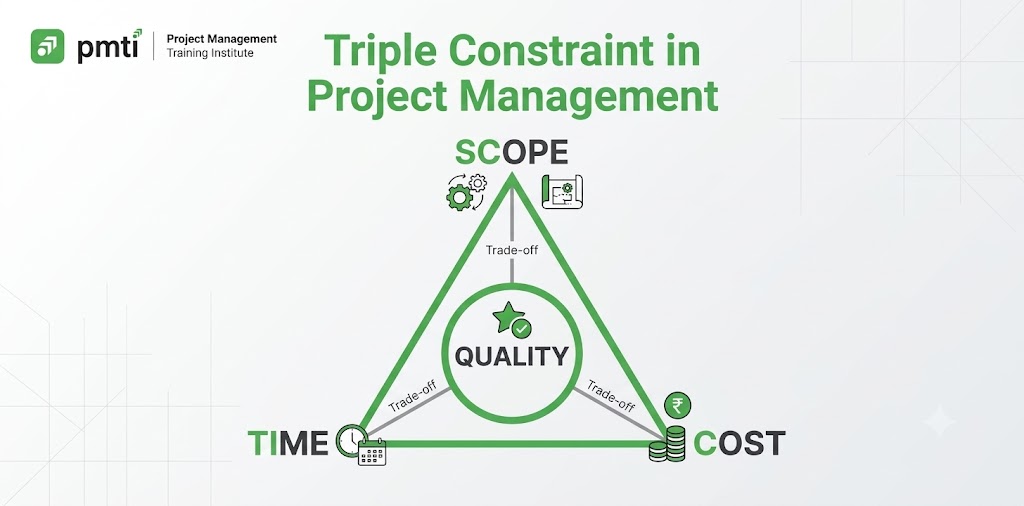

The triple constraint is the relationship between scope, time, and cost: a change in one constraint forces a change in at least one other. Quality sits at the center of the triangle. A project manager protects quality by making every trade-off visible before work starts.
What Is the Triple Constraint in Project Management?
The triple constraint is the fixed relationship between scope, time, and cost. Changing one constraint forces a change in at least one other. The model is also called the iron triangle or the project management triangle.
Each side of the triangle carries a baseline that the project manager controls:
| Constraint | Defines | Baseline Document | Typical Unit |
| Scope | Work and deliverables included in the project | Scope baseline (scope statement, WBS, WBS dictionary) | Features, deliverables, work packages |
| Time | Start date, end date, and milestones | Schedule baseline | Days, weeks, months |
| Cost | Approved budget for the work | Cost baseline | Currency |
The 3 constraints form a closed system. A project cannot hold all 3 fixed when conditions change. The 6 foundational ideas behind this model are laid out in Project Management Basics: 6 Core Concepts Every Beginner Must Know.
Who Created the Triple Constraint?
Martin Barnes, a British project management researcher, introduced the triangle in 1969 in a course titled “Time and Money in Contract Control.” The model began as a cost, time, and quality relationship and later became scope, time, and cost.
The model spread through the project management profession and entered PMI training material. PMI now frames the triangle as one view of a larger set of competing constraints.
What Do Scope, Time, and Cost Mean in the Triple Constraint?
Scope is the work the project delivers. Time is the schedule within which the project delivers it. Cost is the budget that pays for the work. Each constraint has a control method and a common failure mode.
| Constraint | Control Method | Common Failure Mode | Failure Signal |
| Scope | Scope statement, WBS, change control | Scope creep: added work without approval | Deliverables grow while the baseline stays unchanged |
| Time | Schedule baseline, critical path analysis | Delay on critical-path activities | Float on the critical path reaches 0 days |
| Cost | Cost baseline, budget reserves | Overrun from rework or underestimation | Actual cost exceeds planned cost at the same point |
Scope control starts with a written boundary. Techniques for defining and controlling that boundary are covered in Project Scope Management: Definition, Importance, Benefits, and How It Works.
Cost covers labor, materials, equipment, and contractors. Time is a separate constraint. Elapsed time converts to cost through labor rates, but the 2 constraints are measured in different units.
Where Does Quality Fit in the Triple Constraint?
Quality sits at the center of the triangle. Scope, time, and cost determine how much quality the project affords. PMBOK Guide 6th Edition lists 6 competing constraints: scope, schedule, cost, quality, resources, and risk.
| # | Constraint | Question It Answers |
| 1 | Scope | What does the project deliver? |
| 2 | Schedule | When does it finish? |
| 3 | Cost | What does it cost? |
| 4 | Quality | How well does the deliverable meet requirements? |
| 5 | Resources | Which people, equipment, and materials are available? |
| 6 | Risk | How much uncertainty does the project accept? |
Quality absorbs pressure when the other constraints tighten. A team that compresses the schedule by 20% without adding budget or cutting scope trades away testing time. Defects rise, and rework erases the saving.
How Do the Constraints Trade Off Against Each Other?
Each constraint trades against the other two. Expanding scope raises time or cost. Compressing time raises cost or cuts scope. Cutting cost cuts scope or extends time. No constraint moves without a visible effect elsewhere.
6 trade-off rules apply:
- Add scope: Time or cost rises, or both.
- Remove scope: Time or cost falls, or both.
- Compress the schedule: Cost rises (crashing) or risk rises (fast tracking), or scope shrinks.
- Extend the schedule: Cost rises through overhead, or scope grows through added features.
- Cut the budget: Scope shrinks or the schedule extends.
- Raise the budget: Scope expands, or the schedule compresses.
A worked example uses a baseline of 40 features, 10 months, and $800,000. The figures are illustrative.
| Option | Scope | Time | Cost | Consequence |
| Baseline | 40 features | 10 months | $800,000 | Original plan |
| A: Accelerate | 40 features | 8 months | $960,000 (+20%) | Contractors and overtime add cost; quality risk rises |
| B: Hold budget and date | 32 features (-20%) | 8 months | $800,000 | 8 features move to a later release |
| C: Hold scope and budget | 40 features | 10 months | $800,000 | No acceleration; launch date stays fixed |
The sponsor selects an option, and the decision is recorded through change control. A project fails when the team promises scope, time, and cost together and absorbs the gap silently.
How Do You Prioritize the Constraints?
Use a constraint priority matrix. The sponsor assigns each constraint one role: constrain (fixed), enhance (optimize), or accept (flexible). Only 1 constraint holds each role, so every trade-off has a default decision.
| Role | Meaning | Rule | Example |
| Constrain | Fixed; the project does not move it | Exactly 1 | Launch date fixed by a trade show |
| Enhance | Optimized if possible | Exactly 1 | Cost lowered where possible |
| Accept | Flexible; absorbs change | Exactly 1 | Scope trimmed to hold the date |
The matrix converts an abstract triangle into a decision rule. A scope request arrives, and the matrix states which constraint gives way. The sponsor signs the matrix in the project charter.
How Do You Measure Performance Against the Constraints?
Compare actual performance with 3 baselines: scope, schedule, and cost. The difference between baseline and actual is a variance. Track variances at fixed intervals, and escalate when a variance crosses a set threshold.
| Baseline | Variance Measured | Threshold Example |
| Scope baseline | Deliverables completed vs planned | 5% of deliverables behind plan |
| Schedule baseline | Days ahead or behind plan | 1 week on the critical path |
| Cost baseline | Spend above or below plan | 10% of budget |
Together the scope, schedule, and cost baselines form the performance measurement baseline. Governance rules define who approves a baseline change.
How Does Agile Change the Triple Constraint?
Agile reverses the triangle. Time and cost stay fixed, and scope varies. A team works in time-boxed iterations with a stable team, and the product backlog flexes to fit the available capacity.
| Approach | Fixed | Variable |
| Predictive (plan-driven) | Scope | Time and cost |
| Agile | Time and cost | Scope |
A 2-week sprint with 6 team members delivers a fixed capacity. The product owner reorders the backlog, and the lowest-priority items drop when capacity runs out. The model suits products where requirements change.
What Are Examples of Triple Constraint Trade-Offs?
Every industry applies the same rule. A fixed deadline forces scope cuts, a fixed scope forces budget growth, and a fixed budget forces schedule growth. The constraint the sponsor protects decides the outcome.
| Industry | Fixed Constraint | Trade-Off Decision |
| Event planning | Time (conference date) | Scope reduced: 3 speaker tracks instead of 5 |
| Construction | Scope (building specification) | Cost rises when materials spike in price |
| Software | Cost (funded budget) | Release delayed by 6 weeks to finish testing |
| Manufacturing | Quality (safety standard) | Schedule extends by 3 weeks for re-testing |
How Do the Constraints Map to PMBOK 8 Performance Domains?
PMBOK Guide 8th Edition organizes the constraints into performance domains. Scope maps to the Scope domain, time to the Schedule domain, and cost to the Finance domain. Quality maps to the Embed Quality principle.
| Constraint | PMBOK 6 Knowledge Area | PMBOK 8 Element |
| Scope | Project Scope Management | Scope performance domain |
| Time | Project Schedule Management | Schedule performance domain |
| Cost | Project Cost Management | Finance performance domain |
| Quality | Project Quality Management | Embed Quality principle |
| Resources | Project Resource Management | Resources performance domain |
| Risk | Project Risk Management | Risk performance domain |
FAQs About the Triple Constraint
Is the Triple Constraint Still Relevant?
Yes. The triple constraint remains the foundation of project trade-off decisions. Modern standards extend it with quality, resources, and risk, but scope, time, and cost still anchor every baseline.
Which Constraint Is Most Important?
The sponsor decides. No constraint is always most important. Importance depends on the project: a fixed event date makes time the priority, and a regulated specification makes scope or quality the priority.
Is Quality a Constraint?
Yes. Quality is a constraint in the 6-constraint model and the center of the triangle. Changes to scope, time, or cost move quality unless the project manager compensates.
What Happens When One Constraint Changes?
At least one other constraint changes. A scope increase adds time or cost. A schedule cut adds cost or removes scope. The project manager documents the effect through change control and gets sponsor approval.
What Method Measures Scope, Schedule, and Cost Together?
Earned value management (EVM) measures scope, schedule, and cost in one framework. EVM compares planned value, earned value, and actual cost to report schedule and cost performance in the same unit.
The Earned Value Management & Earned Schedule (24 PDUs) course from PMI Authorized Training Partner PMTI teaches how to apply EVM to track all 3 constraints on a live project.

