


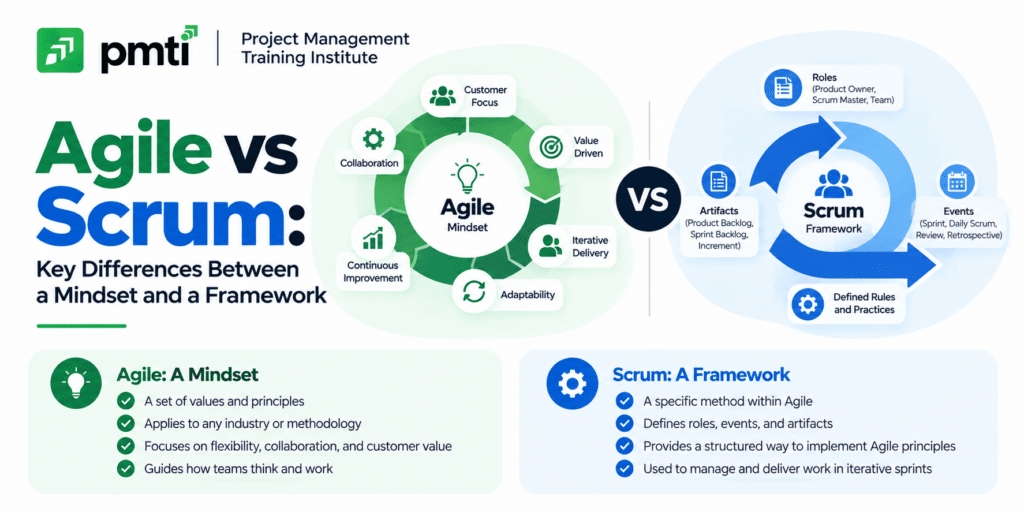
Agile vs Scrum: Key Differences Between a Mindset and a Framework
Agile is a mindset defined by 4 values and 12 principles. Scrum is a framework that applies those values through 3 accountabilities, 5 events, and 3 artifacts. Agile tells a team what to believe. Scrum tells a team what to do. Every Scrum team practices Agile, and not every Agile team uses Scrum.
Search results blur the 2 terms because they overlap. This article separates them by scope, structure, and prescription. It defines each, compares them across 10 attributes, lists 8 other Agile approaches, and gives a 6-step method for choosing Scrum or an alternative.
What is the difference between Agile and Scrum?

Agile is a broad philosophy for responding to change, with no required roles or meetings. Scrum is 1 specific way to practice Agile, with required roles, time-boxed events, and artifacts. Agile is the why. Scrum is the how.
The table below compares them across 10 attributes.
| Attribute | Agile | Scrum |
|---|---|---|
| Nature | Mindset and set of values | Framework |
| Origin | Agile Manifesto, 2001 | Scrum Guide, by Ken Schwaber and Jeff Sutherland (2020 edition) |
| Scope | Any team, any industry | Complex product work, mainly software |
| Prescription | None: principles only | Defined roles, events, artifacts |
| Roles | Not specified | Scrum Master, Product Owner, Developers |
| Iteration | Short iterations in general | Sprints of 1 month or less |
| Meetings | Not specified | 5 events, including the 15-minute Daily Scrum |
| Artifacts | Not specified | Product Backlog, Sprint Backlog, Increment |
| Adoption effort | Cultural change | New roles, new schedule, new events |
| Scaling | Through frameworks such as SAFe and LeSS | Single team of 10 or fewer people |
What is Agile?
Agile is an iterative, collaborative approach that delivers value in small increments and adapts to feedback. The Agile Manifesto (2001) states it through 4 value pairs and 12 principles. Agile prescribes no ceremonies, roles, or tools.
The 4 Manifesto values rank 1 side above the other:
- Individuals and interactions over processes and tools.
- Working software over comprehensive documentation.
- Customer collaboration over contract negotiation.
- Responding to change over following a plan.
The 12 principles turn the values into guidance: deliver working output frequently, welcome changing requirements, keep business people and developers in daily contact, and reflect on how to improve at regular intervals. Agile reaches beyond software into marketing, product launches, and operations.
What is Scrum?
Scrum is a lightweight framework that helps teams create value through adaptive solutions to complex problems. The 2020 Scrum Guide defines 1 Scrum Team, 5 events, 3 artifacts, and 5 values: commitment, focus, openness, respect, and courage.
Who is on a Scrum Team?
A Scrum Team has 3 accountabilities and 10 or fewer people. There are no sub-teams and no hierarchy.
- Product Owner: maximizes product value and manages the Product Backlog.
- Scrum Master: coaches the team, removes impediments, and protects the framework. Read how these roles compare in the guide to agile team roles.
- Developers: build a usable Increment every Sprint.
What are the 5 Scrum events?
Time-boxes below apply to a 1-month Sprint. Shorter Sprints shorten the events.
| Event | Time-box | Purpose |
|---|---|---|
| Sprint | 1 month or less | Container for all other events |
| Sprint Planning | Up to 8 hours | Select work and set the Sprint Goal |
| Daily Scrum | 15 minutes | Inspect progress toward the Sprint Goal |
| Sprint Review | Up to 4 hours | Inspect the Increment with stakeholders |
| Sprint Retrospective | Up to 3 hours | Improve the team’s process |
What are the 3 Scrum artifacts?
Each artifact carries 1 commitment.
| Artifact | Commitment | Meaning |
|---|---|---|
| Product Backlog | Product Goal | The ordered list of everything the product needs |
| Sprint Backlog | Sprint Goal | The work selected for the current Sprint |
| Increment | Definition of Done | A usable, verified step toward the Product Goal |
Is Scrum the same as Agile?
No. Scrum is a framework that implements Agile. Agile is the umbrella. The hierarchy runs from Agile values, to frameworks and methods such as Scrum, to practices such as daily stand-ups and burndown charts.
Think of 3 layers:
- Layer 1, mindset: the Agile Manifesto and its 4 values.
- Layer 2, frameworks and methods: Scrum, Kanban, Extreme Programming (XP), Lean, and others.
- Layer 3, practices: user stories, Sprint Planning, WIP limits, pair programming, and retrospectives.
A team uses Scrum events without agility when it runs every meeting and never acts on feedback. The ceremony exists and the adaptation does not. A team practices agility without Scrum when it works from a Kanban board and responds to change weekly. Both approaches sit on the adaptive side of the predictive-versus-adaptive divide.
What are the other Agile frameworks besides Scrum?
Agile has at least 8 recognized approaches besides Scrum-only teams: Kanban, Extreme Programming (XP), Lean, Feature-Driven Development (FDD), Dynamic Systems Development Method (DSDM), Crystal, the Adaptive Project Framework (APF), and scaling frameworks such as SAFe and LeSS.
| Approach | Defining feature |
|---|---|
| Kanban | Visual board with columns such as To Do, Doing, Done, and WIP limits |
| Extreme Programming (XP) | 12 engineering practices, including pair programming and test-driven development |
| Lean | 7 principles, from waste removal to whole-system optimization |
| Feature-Driven Development (FDD) | 5 activities: overall model, feature list, plan by feature, design by feature, build by feature |
| DSDM | 8 principles, including focus on business need and delivery on time |
| Crystal | A family of methods (Clear, Yellow, Orange, Red) sized by team and criticality |
| Adaptive Project Framework (APF) | Iterative cycles with frequent scope check-ins |
| SAFe and LeSS | Scale Agile and Scrum across many teams |
Large organizations scale Agile with the Scaled Agile Framework. The SAFe Scaled Agile Framework guide explains how Program Increments coordinate multiple Scrum teams.
How do you choose between Scrum and another Agile approach?
Choose Scrum when the work is complex, the team wants defined roles and rhythm, and a Sprint-based cadence fits. Choose Kanban for continuous flow, XP for engineering discipline, and SAFe or LeSS for many teams.
Follow these 6 steps:
- Classify the work. New product development with shifting requirements fits Scrum. Support and operations work with unpredictable arrivals fits Kanban.
- Check the team size. A team of 10 or fewer fits a single Scrum Team. Larger groups need SAFe or LeSS.
- Measure stakeholder availability. Scrum needs a Product Owner and a stakeholder review every Sprint.
- Assess the engineering maturity. A team without test automation benefits from XP practices first.
- Evaluate the appetite for change. Scrum adds new roles and events, and an organization that refuses both stays on a lighter method.
- Pilot 1 approach for 3 Sprints, then inspect the results in the Retrospective and adjust.
Most teams that start with Scrum add Kanban visuals and XP engineering practices over time. The approaches combine without conflict because all rest on the same 4 values.
How do Agile and Scrum appear on certification exams?
Exams test both. The PMP exam places about 60% of its 2026 questions in agile and hybrid contexts, and Scrum events and roles appear inside those scenarios. Scrum-specific credentials test the Scrum Guide directly.
The PMP exam asks candidates to pick the right agile response to a team scenario, such as how a Scrum Master handles an impediment. Scrum-specific certifications go deeper into roles, events, and artifacts. The Disciplined Agile Scrum Master credential combines Scrum mechanics with PMI’s Disciplined Agile toolkit. Build that depth with DASM certification training from Project Management Training Institute.


