


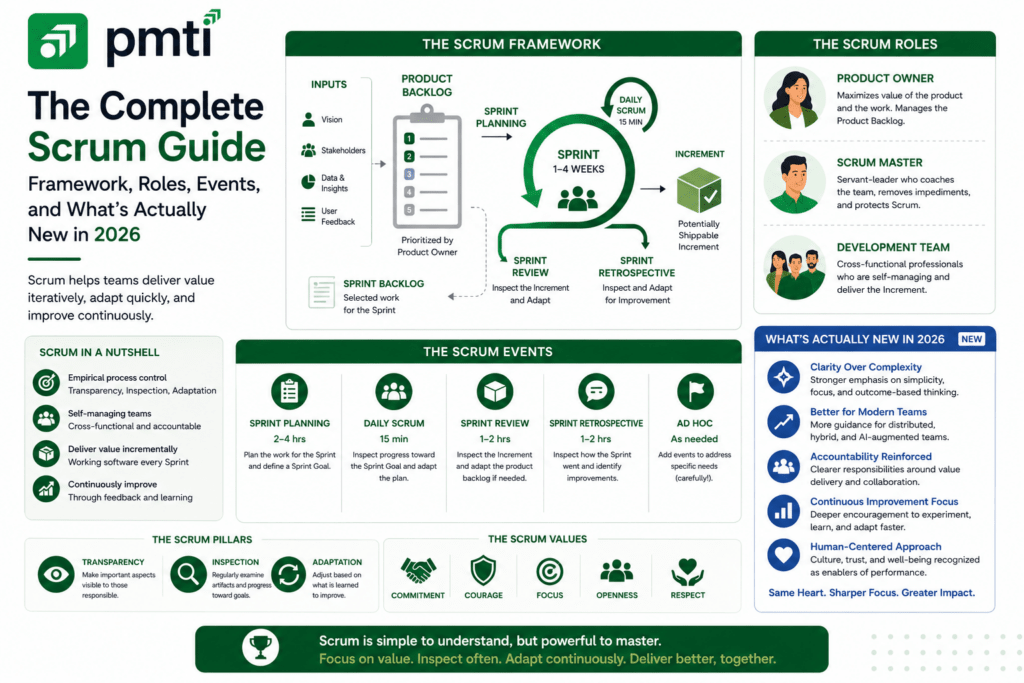
This version of the Guide has the latest updates and describes all elements of Scrum and the software development methodology, including the associated functions, events, roles, and artifacts. The Guide also clarifies a question that many of the 2026 articles avoid by explaining if the Guide has evolved in the past few years.
What Is Scrum?
Scrum is a lightweight framework that helps teams tackle complex work through short, time-boxed cycles called Sprints, built around three accountabilities, five events, and three artifacts, all connected by a small set of rules. It replaces long, fixed project timelines with a repeatable rhythm of planning, building, reviewing, and improving — giving teams a structure flexible enough to adapt without losing accountability.
What Are the Three Pillars of Scrum Theory?

The three main elements of Scrum are transparency, inspection, and adaptability. Of the three pillars, adaptability is the core of the framework, and represents the ability to change when the projects or goals require it. If any of these elements are missing from the framework, Scrum would lose effectiveness.
- Transparency — work, progress, and the definition of “done” stay visible to everyone involved, primarily through the Product Backlog, Sprint Backlog, and Daily Scrum.
- Inspection — the team checks progress and effectiveness continuously, not just at the end of a Sprint, through Daily Scrums, Sprint Reviews, and Retrospectives.
- Adaptation — when inspection reveals a problem, the team adjusts immediately rather than waiting for a more convenient moment.
What Are the Five Scrum Values?

Scrum is built upon five values — commitment, courage, focus, openness, and respect — which dictate how the entire team behaves on a given day and not just what ceremonies are executed. Scrum events, on their own, become pointless exercises without commitment to the values. They fail to produce steady, sustainable progress and trust.
- Commitment — dedication to the team’s goals and the current Sprint Goal, not to a fixed, unchangeable scope.
- Courage — the willingness to raise hard truths, challenge unrealistic deadlines, and try new approaches.
- Focus — concentrated attention on the Sprint Goal rather than splitting effort across competing priorities.
- Openness — transparency about both progress and setbacks, so problems get solved quickly rather than hidden.
- Respect — trust in teammates’ skills and judgment, especially when perspectives differ.
What Are the Three Scrum Accountabilities?

A Scrum Team, less than ten members, has three accountabilities, product owner, Scrum Master, and Developers, working as a single, unified team instead of three sub-teams. While these are accountabilities, not formal roles, in smaller frameworks one person may be required to take on two or more, however, this is often at the cost of greater tradeoffs.
- Product Owner — maximizes product value by managing and prioritizing the Product Backlog, acting as the voice of the customer and business within the team.
- Scrum Master — coaches the team, facilitates events, removes obstacles, and protects the team from distraction, functioning as a servant leader rather than a manager.
- Developers — the people who build the product, self-organizing to determine how to accomplish each Sprint Goal.
What Are the Five Scrum Events?
Scrum differentiates work through five events; Sprints, Sprint Planning, Daily Scrums, Sprint Reviews and, Sprint Retrospectives, each with a defined time and purpose to provide a predictable pattern to the team.
- The Sprint — a fixed one- to four-week container holding all other events, producing a usable product increment.
- Sprint Planning — the team selects backlog items and defines a Sprint Goal at the start of each Sprint.
- Daily Scrum — a 15-minute daily planning session where developers coordinate work and surface blockers, not a status report.
- Sprint Review — stakeholders see completed work and provide feedback that shapes future backlog priorities.
- Sprint Retrospective — the team reflects on how it worked together and commits to specific improvements for the next Sprint.
What Are the Three Scrum Artifacts?
Scrum’s three artifacts — the Product Backlog, the Sprint Backlog, and the Increment — each carry a commitment that gives them meaning: the Product Goal, the Sprint Goal, and the Definition of Done.
- Product Backlog — the complete, ever-evolving list of everything that might be needed in the product, ordered by value and guided by the Product Goal.
- Sprint Backlog — the specific items selected for the current Sprint plus the team’s plan for delivering them, owned and updated by the Developers.
- Increment — the sum of completed work meeting the team’s Definition of Done, potentially releasable at the end of every Sprint.
How Widely Is Scrum Used Today?
Industry surveys, including Digital.ai’s long-running State of Agile Report, consistently show that roughly 87% of Agile practitioners use Scrum, making it by far the most widely adopted Agile framework at the team level. That adoption rate has climbed sharply over the past several years, reflecting Scrum’s track record of delivering working product faster than traditional, fully-planned approaches.
How Do You Implement Scrum Successfully?
Successful Scrum implementation starts with assembling a small, cross-functional team, defining a clear product vision, building an initial backlog, and running the first few Sprints with discipline before expanding scope.
- Assemble a team of roughly three to nine people with the full range of skills needed to deliver working product.
- Define a product vision and measurable goals that guide backlog prioritization.
- Build an initial backlog of high-level items, refined into detailed user stories as they near the top of the priority list.
- Run the first Sprint with a realistic scope and a clearly stated Sprint Goal everyone understands.
- Reflect after every Sprint, committing to one or two concrete process changes rather than a long list of vague improvements.
What Common Challenges Do Teams Face When Adopting Scrum?
Adopting Scrum leads to a number of common challenges for teams that include: stakeholders’ demands for detailed upfront plans, scope changes that happen as a result of the Product Backlog, and the unpredictable nature of velocity. Fortunately, each of these challenges has its own answer that doesn’t rely on the team leaving Scrum behind altogether.
- Stakeholder resistance to iterative delivery eases as Sprint Reviews demonstrate real, working increments rather than status reports.
- Scope changes get absorbed through the Product Backlog rather than disrupting an active Sprint, with the Product Owner making tradeoffs visible.
- Velocity fluctuation matters less as a single-sprint number than as a multi-sprint trend, and persistent swings usually point to an underlying estimation or dependency problem worth investigating directly.
How Do Organizations Scale Scrum Across Multiple Teams?
Successful application of Scrum at different teams and different levels of an organization comes from the application of standard coordination mechanisms to avoid friction and include some form of portfolio level planning. It is important to note that overall, the intention is to align, and not control, in order to preserve the self-organizing nature of teams.
Is There a New Official Scrum Guide for 2026?
There is no new official Scrum Guide for 2026 — the most recent official revision, published by Ken Schwaber and Jeff Sutherland in November 2020, remains the current, authoritative version today. Content across the web dated “2026,” including comprehensive guides like this one, generally reflects a publish or update date on an evergreen resource, not an announcement of a new framework version. Unofficial community adaptations do exist — including a version aligned with the Large-Scale Scrum (LeSS) framework and an independently published Scrum Guide Expansion Pack — but neither represents an official Schwaber and Sutherland revision, and readers preparing for a certification exam should rely on the 2020 guide as the current standard.
How Does Scrum Compare to Agile and Waterfall?
Scrum is one specific, structured framework within the broader Agile philosophy, while Waterfall represents a fundamentally different, sequential approach — the three differ most sharply in how they handle planning, change, and delivery timing. Agile itself is not a framework but a set of values that Scrum, Kanban, and other specific approaches each implement differently.
- Planning — Scrum plans in fixed one- to four-week increments; Agile broadly plans continuously; Waterfall plans entirely upfront before work begins.
- Handling change — Scrum welcomes change at Sprint boundaries; Agile broadly embraces change at any time; Waterfall resists change once planning concludes.
- Delivery — Scrum delivers a working increment every Sprint; Agile broadly delivers in regular increments; Waterfall delivers one release at the project’s end.
How Does This Appear on the PMP and PMI-ACP Exams?
The PMI-ACP exam tests Scrum’s current terminology and structure directly, including the accountabilities framing and the Product Goal, while the PMP exam covers Scrum within its broader Agile and hybrid content. Candidates should expect scenario questions requiring them to apply Scrum’s events and artifacts to a specific situation, not just recall definitions.
Sample Question 1
What is the primary purpose of the Daily Scrum? A) To provide a status report to management B) To let developers plan their day and coordinate toward the Sprint Goal C) To formally review completed work with stakeholders D) To select items for the next Sprint
Sample Question 2
A team’s velocity has been inconsistent for several sprints in a row. What does Scrum guidance suggest is the best way to interpret this? A) A single sprint’s velocity number is the only figure that matters B) The multi-sprint trend matters more than any single sprint’s number, and persistent swings warrant investigating root causes C) Velocity is irrelevant to Scrum teams D) The team should be immediately restructured
Sample Question 3
According to the current Scrum Guide, what governs how a Scrum Team responds to a problem identified during inspection? A) Wait until the next Sprint Retrospective to make any changes B) Adapt immediately rather than waiting for a more convenient moment C) Escalate to executive leadership before taking any action D) Document the issue for future reference only
Sample Question 4
As of today, when was the most recent official Scrum Guide revision released? A) 2017 B) 2020 C) 2023 D) 2026
Answers: 1) B — the Daily Scrum is a planning and coordination session for developers, not a status report. 2) B — Scrum guidance treats the multi-sprint trend as more meaningful than any single data point, with persistent instability signaling a deeper issue to investigate. 3) B — adaptation means changing course as soon as inspection reveals a problem, not waiting for a scheduled checkpoint. 4) B — the most recent official revision was released in November 2020 and remains current.
Frequently Asked Questions
How Long Does It Take to Implement Scrum Successfully?
Most teams notice initial benefits within two to three sprints, but reaching full effectiveness typically takes three to six months of consistent practice and retrospective-driven improvement. Teams that skip retrospectives or treat them as optional tend to plateau well before reaching that full effectiveness.
Can Scrum Work for Non-Software Development Teams?
Scrum works well beyond software development, and the current Scrum Guide explicitly acknowledges its use across a wide range of domains.
What Scrum Master Certifications Should Professionals Pursue?
Professionals pursuing Scrum Master credentials commonly consider PMI-ACP for broad Agile framework knowledge alongside Scrum-specific certifications, depending on career goals and whether an organization has standardized on a particular certifying body. A full breakdown of Scrum Master preparation is available through the site’s dedicated Scrum Master guide.
What Is the Difference Between Scrum and Kanban?
Scrum organizes work into fixed-length Sprints with defined roles and events, while Kanban manages continuous work flow with WIP limits and no fixed iterations.
How Often Should Teams Update Their Scrum Practices?
Teams should revisit and refine their specific Scrum practices every Sprint through the Retrospective, rather than waiting for a major framework change to prompt improvement. The framework itself changes rarely — the team’s application of it should evolve constantly.


