



Starting small feels like the safest way to introduce a large organizational change, and that instinct is correct for most incremental improvements. But Agile transformation carries a specific risk pilot projects rarely expose: a pilot’s strong results often come from favorable staffing conditions that quietly disappear the moment the rollout expands, leaving organizations crediting Agile practices for outcomes that actually came from something else entirely.
Why Do Organizations Default to Pilot Projects for Agile Transformation?
Organizations default to pilot projects because starting small feels lower-risk, provides a controlled environment to test new practices, and mirrors the same incremental logic that works well for sprint-level experiments. That instinct is sound advice for testing a single practice change within an existing team — the problem emerges specifically when pilot results get generalized into a claim about how the whole organization will perform under Agile.
What Is the “Crossing the Chasm” Problem With Pilot Projects?
Pilot projects typically draw their participants from the stakeholders most receptive to change, so lessons learned don’t transfer cleanly to the broader population of stakeholders who are naturally more resistant to adopting new ways of working. This mirrors Geoffrey Moore’s technology adoption lifecycle, where early adopters embrace new approaches readily while the broader majority requires a fundamentally different kind of persuasion — a pilot staffed entirely with early adopters tells you very little about how the skeptical majority will respond.
Why Is It Harder to Remove Organizational Blockers at Scale?
Removing organizational blockers is manageable within the narrow scope of a single pilot project, but the same effort becomes disproportionately harder as the change expands to many concurrent projects competing for the same fixes. A pilot team might successfully negotiate one exception to a slow approval process; scaling that same fix across dozens of teams requires changing the underlying process itself, a far larger and more political undertaking.
Why Don’t Pilot Practices “Lift and Shift” Cleanly to Other Projects?
Practices proven successful within a pilot project’s specific context frequently fail to transfer directly to other projects, since different teams face different stakeholders, technical constraints, and working conditions the pilot never had to account for. Treating a pilot’s playbook as a universal template, rather than a starting point requiring real adaptation, is a common way transformation momentum stalls during rollout.
How Does Hidden Staffing Capacity Distort Pilot Project Results?
Pilot projects frequently succeed because skilled staff get pulled out of their normal roles to focus on the pilot without a backfill replacement, artificially removing the multitasking and capacity constraints that are the actual primary source of delivery uncertainty on most knowledge-work projects. When the pilot delivers strong outcomes, the organization often credits Agile practices for the improvement — when the real driver was simply that people finally got to focus on one thing instead of juggling their usual competing commitments.
This distortion has a real cost beyond a misleading success story. Pulling staff without backfilling their original roles strains the capacity of the teams they left, and rarely improves the relationship with those teams’ leaders. When the organization then tries to scale the pilot’s “success” across multiple projects without addressing how much concurrent work everyone is still carrying, results consistently disappoint — not because the Agile practices failed, but because the underlying capacity problem was never actually solved.
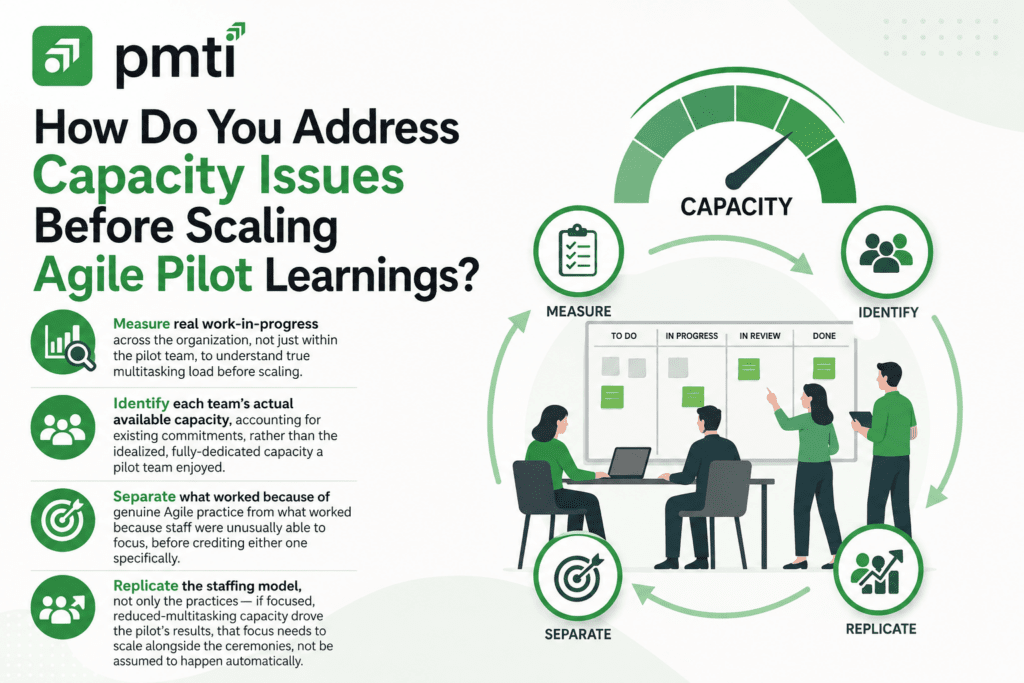
How Do You Address Capacity Issues Before Scaling Agile Pilot Learnings?
Before promoting a pilot’s results as proof of Agile transformation success, an organization needs to measure and address organization-wide work capacity, not just adopt the pilot’s specific ceremonies and artifacts more broadly.
- Measure real work-in-progress across the organization, not just within the pilot team, to understand true multitasking load before scaling.
- Identify each team’s actual available capacity, accounting for existing commitments, rather than the idealized, fully-dedicated capacity a pilot team enjoyed.
- Separate what worked because of genuine Agile practice from what worked because staff were unusually able to focus, before crediting either one specifically.
- Replicate the staffing model, not only the practices — if focused, reduced-multitasking capacity drove the pilot’s results, that focus needs to scale alongside the ceremonies, not be assumed to happen automatically.
Does This Mean You Should Avoid Pilot Projects Entirely?
Pilot projects remain a valuable way to test new practices in a controlled environment — the issue is not the pilot itself, but promoting its learnings as a scalable success story before confirming which parts of that success came from Agile practice versus favorable staffing conditions that won’t persist at scale. A pilot run with this distinction in mind, and paired with a genuine plan to address organization-wide capacity before expanding, remains a legitimate starting point for Agile transformation.
How Does This Topic Connect to Broader Agile Transformation Strategy?
This staffing and scaling risk is one specific mechanism behind the broader pattern of Agile transformations struggling to move past initial small-scale success, a challenge covered in full in the site’s complete transformation guide. .
How Does This Appear on the PMI-ACP Exam?
The PMI-ACP exam tests this concept through scenario questions asking candidates to identify why a successful pilot project failed to produce similar results when scaled to additional teams. Recognizing hidden staffing or capacity distortions as a root cause, rather than assuming the Agile practices themselves failed, is the key skill these questions test.
Sample Question 1
A pilot Agile team delivered strong results after key staff were pulled from their normal roles to work exclusively on the pilot, without backfill. When the organization scaled the same practices to five additional teams without addressing staffing, results were disappointing. What is the most likely root cause? A) The Agile practices themselves are flawed B) The pilot’s success depended on focused capacity that wasn’t replicated at scale C) Five teams is too many to scale to at once D) The additional teams needed more training
Sample Question 2
What does the “crossing the chasm” problem describe in the context of Agile pilot projects? A) A technical integration challenge between software systems B) The gap between early-adopter pilot participants and the more resistant broader stakeholder population C) A scheduling conflict between sprint cycles D) A budgeting shortfall during scale-up
Sample Question 3
Why does removing organizational blockers become disproportionately harder as an Agile transformation scales from one pilot project to many concurrent projects? A) It doesn’t — the difficulty remains constant regardless of scale B) Blockers can only be identified during pilot projects C) The same fixes now need to work across many teams’ competing needs, often requiring process-level change rather than one-off exceptions D) Scaling always eliminates existing blockers automatically
Sample Question 4
What should an organization do before promoting a successful pilot’s learnings for organization-wide rollout? A) Immediately replicate the exact pilot practices across every team B) Assess whether the pilot’s success depended on staffing conditions that won’t hold at scale C) Cancel the rollout entirely D) Add more ceremonies to the pilot team’s process
Answers: 1) B — unaddressed capacity and staffing differences, not the Agile practices, are the most likely explanation for the scaling shortfall. 2) B — this describes the gap between change-receptive pilot participants and a more resistant broader stakeholder population. 3) C — the same negotiation that worked for one pilot team’s blockers becomes a much larger, more political challenge once many teams require the same underlying process changes. 4) B — confirming whether staffing conditions drove the pilot’s success is essential before assuming the same results will scale.
Frequently Asked Questions
What Is the “Crossing the Chasm” Problem in Agile Transformation?
The “crossing the chasm” problem describes the gap between early-adopter stakeholders, who embrace new ways of working readily, and the broader, more resistant majority who require a different approach to win over. Pilot projects staffed primarily with early adopters risk mistaking that group’s enthusiasm for organization-wide readiness.
Should Pilot Projects Use Your Most Experienced Staff?
Pilot projects commonly use top-performing staff, but doing so without backfilling their original roles risks producing results driven by focused capacity rather than the Agile practices themselves, distorting what the pilot actually proves. A more representative pilot staffing approach produces results that generalize more reliably to the rest of the organization.
How Do You Know If Pilot Success Will Actually Scale?
Pilot success is more likely to scale if the organization can confirm the results came from genuine practice changes rather than temporary, artificially favorable staffing conditions that won’t persist once the rollout expands to more teams. Auditing the pilot’s actual staffing model against what will realistically be available at scale is the clearest way to test this before committing to a broader rollout.
What Is Work in Progress (WIP) at the Organizational Level?
Organizational-level work in progress refers to the total number of concurrent initiatives, projects, or commitments competing for the same pool of people’s time across the entire organization, not just within a single team’s board. Left unmeasured, high organizational WIP is frequently the hidden factor undermining Agile transformation rollouts that looked successful at the pilot stage.


