


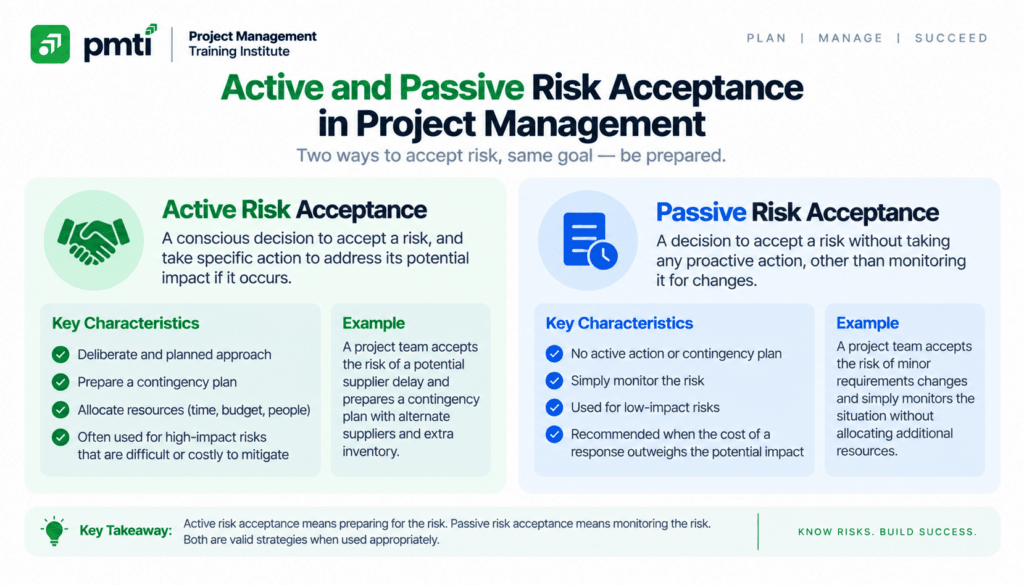
This guide defines both forms, shows when to use each, and explains how to size the reserve, document the decision, and monitor an accepted risk.
What Is Risk Acceptance in Project Management?
Risk acceptance is a response strategy that acknowledges a risk and takes no proactive action to change the project plan. The team records the risk, monitors it, and handles it when it occurs or funds a reserve. Acceptance applies to threats and opportunities.
The PMBOK Guide Sixth Edition lists accept as 1 of 5 threat responses, beside escalate, avoid, transfer, and mitigate. It also lists accept as 1 of 5 opportunity responses. Acceptance suits risks that the team cannot address, or cannot address at a reasonable cost.
Acceptance is a decision, and the decision has a record. A risk that nobody has assessed is unmanaged, not accepted.
What Is the Difference Between Active and Passive Risk Acceptance?

Passive acceptance takes no action beyond documenting the risk and reviewing it periodically. Active acceptance adds preparation: a contingency reserve or a contingency plan with a trigger. Both leave the project plan unchanged before the risk occurs.
| Attribute | Passive acceptance | Active acceptance |
| Action before the event | Document and review | Document, review, and prepare |
| Reserve | None | Contingency reserve of time, money, or resources |
| Contingency plan | None | Written plan with a trigger |
| Response when the risk occurs | The team decides on the spot | The team runs the prepared plan |
| Funding if the risk occurs | Request funds through the management reserve or change control | Draw on the contingency reserve |
| Best fit | Low-probability, low-impact risks | Unlikely but costly risks |
| Example | A minor supplier packaging change | A regulatory inspection failure |
The dividing line is preparation. Passive acceptance spends nothing before the event. Active acceptance spends time or money before the event so that the response is fast.
When Should You Accept a Risk?
Accept a risk when its exposure sits below the risk threshold, when the response costs more than the exposure, or when no feasible response exists. Low-probability, low-impact risks suit passive acceptance. Unlikely but costly risks suit active acceptance.
Apply 3 tests in order:
- Rating test. Plot the risk on the probability and impact matrix. PMTI’s guide PMP Risk Assessment Matrix: How to Create Probability and Impact Matrix in Project Management explains the grid. Low-probability, low-impact cells are candidates for acceptance.
- Cost test. Compare the cost of a response with the risk’s expected monetary value (EMV), which equals probability times impact. Accept when the response costs more than the exposure it removes.
- Threshold test. Compare the exposure with the risk threshold in the risk management plan. Above the threshold, the team must address the risk.
Example, with a $10,000 per-risk threshold:
| Risk | Probability | Impact | EMV | Response cost | Decision |
| R1 Supplier packaging change | 10% | $8,000 | $800 | $3,000 | Accept passively, since the response costs more than the exposure |
| R2 Regulatory inspection failure | 5% | $120,000 | $6,000 | Insurance premium of $9,000 | Accept actively with a $6,000 reserve |
| R3 Server price increase | 40% | $30,000 | $12,000 | $4,000 to cut probability to 10% | Do not accept: $12,000 exceeds the threshold, and the response saves $5,000 net |
R3 shows the cost test at work. The response cuts EMV from $12,000 to $3,000, a $9,000 reduction, for a $4,000 cost. The net benefit is $5,000.
How Does Acceptance Differ From Avoid, Transfer, and Mitigate?
Acceptance leaves the plan unchanged and the risk in place. Avoid removes the threat by changing the plan. Transfer shifts the impact to a third party. Mitigate lowers probability or impact. Only acceptance carries the full exposure inside the project.
| Strategy | Plan changes before the event | Spend before the event | What remains |
| Accept (passive) | No | None | The full exposure |
| Accept (active) | No | Reserve or plan | The full exposure, funded |
| Mitigate | Yes | Response cost | Residual risk |
| Transfer | Yes | Premium or contract price | Reduced exposure, plus the vendor’s risk |
| Avoid | Yes | Scope, schedule, or cost given up | Nothing, unless a secondary risk appears |
Accepting is not free. Passive acceptance costs the exposure if the risk occurs. Active acceptance costs the reserve up front.
How Do Risk Appetite, Tolerance, and Threshold Shape Acceptance?
Risk appetite is the degree of uncertainty an organization takes on for a reward. Risk tolerance is the amount of risk it will withstand. Risk threshold is the exposure level above which risks are addressed and below which they are eligible for acceptance.
| Term | What it sets | Measurable | Example |
| Risk appetite | How much uncertainty stakeholders seek for a reward | Mostly qualitative | High appetite for new technology, low appetite for safety risk |
| Risk tolerance | The range of acceptable variation from an objective | Yes | Budget variation of plus or minus 5% |
| Risk threshold | The exposure level that triggers a response | Yes | Any single risk with exposure above $10,000 |
Appetite is a tendency. Tolerance and threshold are numbers. The risk management plan records the numbers, and the team accepts only what sits below them. Low-tolerance stakeholders accept fewer risks than high-tolerance stakeholders.
Set thresholds for each objective, not just for cost. A project needs a cost threshold, a schedule threshold, and a quality threshold.
How Do You Size the Reserve for Active Acceptance?
Size the reserve for active acceptance by summing the expected monetary value of each actively accepted risk. Hold cost reserves in the cost baseline and time reserves in the schedule. Assign an owner and a trigger to every reserve draw.
| Risk | Basis | Reserve | Trigger |
| R2 Regulatory inspection failure | 5% × $120,000 | $6,000 | Inspector raises a major finding |
| R4 Contractor replacement | 15% × $20,000 | $3,000 | Contractor gives notice |
| R5 Permit delay | 20% × 5 days | 1 day of schedule reserve | Permit review passes day 10 with no response |
| Total | $9,000 and 1 day |
The project manager draws on this contingency reserve. The management reserve stays with the sponsor and covers unidentified risks. Add the cost reserve to the base estimate to form the cost baseline.
A reserve does not remove the risk. It pays for the response.
How Do You Document and Approve an Accepted Risk?
Document each accepted risk in the risk register with its rating, the reason for acceptance, the acceptance type, the reserve or plan, the trigger, the owner, and the approver. Exposure above the threshold needs sponsor sign-off before the team accepts it.
PMTI’s guide What is a Risk Register in Project Management? covers the register layout. Add the acceptance fields:
| Field | Entry |
| Risk | R2 Regulatory inspection failure |
| Rating | Probability 5%, impact $120,000, EMV $6,000 |
| Decision | Accept, active |
| Reason | Insurance premium of $9,000 exceeds the EMV |
| Reserve or plan | $6,000 contingency reserve, and a re-inspection plan |
| Trigger | Inspector raises a major finding |
| Owner | Quality lead |
| Approver | Project manager (below threshold) |
| Review date | Each phase gate |
Follow 5 steps to record the decision:
- Rate the risk, and calculate its exposure.
- Test it against the threshold.
- Choose passive or active acceptance, and state the reason.
- Assign an owner, and set the trigger for active acceptance.
- Obtain the approver’s sign-off, and set the review date.
The project manager approves acceptance below the threshold. The sponsor approves acceptance above it.
How Do You Monitor an Accepted Risk?
Review passive risks on a fixed schedule to confirm they have not changed. Watch the triggers on active risks. When probability or impact rises above the threshold, stop accepting the risk and choose avoid, transfer, mitigate, or escalate.
| Signal | Action |
| Probability or impact rises, exposure still below the threshold | Re-score, and move from passive to active acceptance |
| Exposure crosses the threshold | Stop accepting, and select a stronger response |
| A trigger fires on an active risk | Run the contingency plan, and draw the reserve |
| The exposure window closes | Close the risk, and release the reserve |
| The risk occurs with no plan (passive) | Open an issue, and request funds |
Re-score every accepted risk at each phase gate. A risk that was small at kickoff does not stay small by default.
How Does Acceptance Work for Opportunities?
Accepting an opportunity means the team takes no action to increase its probability or impact. The team captures the benefit if it occurs. Accept an opportunity when pursuing it costs more than it returns, or when it lies outside the project’s control.
Example: the market price of a component falls during the project. The team did not change the plan to encourage the drop. The team recorded the opportunity and adopts the lower price when it arrives. A team that pre-plans how to capture the benefit, such as pre-drafting the purchase order change, prepares in advance and treats the risk as an actively accepted opportunity.
The other opportunity responses are escalate, exploit, share, and enhance. Choose them when the benefit justifies action.
What Mistakes Turn Acceptance Into Ignoring Risk?
5 mistakes turn acceptance into ignoring: skipping documentation, leaving accepted risks without owners, never reviewing them, accepting exposure above the threshold without sign-off, and using passive acceptance for high-impact risks. Each mistake removes control the team needs.
| Mistake | Effect | Fix |
| Skipping documentation | The decision leaves no record | Log every accepted risk in the register |
| No owner | Nobody watches the trigger | Assign a named owner |
| Never reviewing | The rating goes stale | Set a review date at each phase gate |
| Accepting above the threshold without sign-off | Exposure the sponsor never approved | Escalate for approval |
| Passive acceptance of a high-impact risk | No funds or plan on the day it occurs | Use active acceptance with a reserve |
How Do Agile and Hybrid Teams Accept Risk?
Agile teams accept risk in the backlog. The product owner decides, the team tags the item as accepted, and the team holds sprint capacity or a release buffer as active acceptance. The team reviews accepted items at planning and at each retrospective.
- Tag accepted risks in the backlog, and record the reason.
- Hold spare sprint capacity or a release buffer for actively accepted risks.
- Review accepted items at sprint planning and at retrospectives.
- Escalate any item whose exposure crosses the team’s threshold.
Approximately 60% of the July 2026 PMP exam targets agile or hybrid approaches, so exam scenarios apply acceptance in both settings.
How Is Risk Acceptance Tested on the PMP Exam?
PMP questions test the match between the scenario and the acceptance type. No action until the risk occurs signals passive acceptance. A contingency reserve or plan signals active acceptance. Response cost above the impact signals acceptance.
| Scenario cue | Answer |
| The team documents the risk and takes no other action | Accept (passive) |
| The team sets aside a contingency reserve and takes no other action | Accept (active) |
| A response costs more than the risk’s impact | Accept |
| A low-probability, low-impact threat | Accept (passive) |
| The risk exceeds the project manager’s authority | Escalate, not accept |
| Risk remains after a mitigation | Residual risk, documented and usually accepted |
| A passively accepted risk occurs | Handle it as an issue, and request funds |
Read each option for preparation. If the team prepares something, the answer is active. If the team only records the risk, the answer is passive.
PMTI’s Project Risk Management Course (24 PDUs) covers project risk management in depth for middle and upper management. Max Wideman, a PMI Fellow who led the first PMBOK Guide effort, designed the course and delivers it online.
