


What Is the Difference Between an Agile Coach and a PMI-ACP Practitioner?

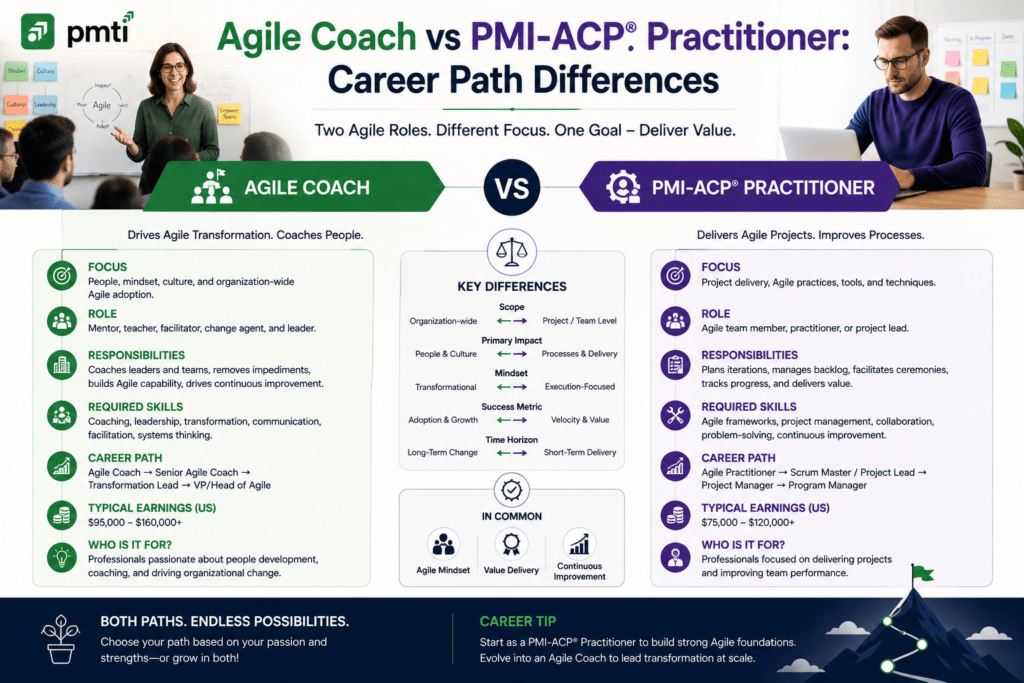
An Agile Coach is a role that guides teams and organizations through agile adoption, assessed through experience and coaching-specific credentials. A PMI-ACP practitioner holds a scored, exam-based PMI certification that validates broad agile knowledge across Scrum, Kanban, Lean, and XP.
| Agile Coach | PMI-ACP | What It Means | |
| Type of credential | Job title / role | PMI certification | A coach is hired for a role; a PMI-ACP holder passed an exam |
| Assessed by | Employer, coaching engagements, ICF/ICAgile bodies | PMI, via a scored 120-item exam | Coaching is judged by outcomes; PMI-ACP is judged by a test score |
| Renewal | Varies by credentialing body | 30 PDUs every 3 years | PMI-ACP has one fixed renewal cycle |
| Typical holder | Former Scrum Master or PM who moved into coaching | Practitioner on an agile team, of any role | PMI-ACP is broader; Agile Coach is a specific career destination |
The distinction matters for career planning. Studying for the PMI-ACP exam prepares a candidate to answer scenario-based questions about agile principles. It does not train the facilitation, mentoring, and organizational-change skills that an Agile Coach role requires day to day. A candidate can pass the PMI-ACP exam and still lack the coaching competencies employers expect from an Agile Coach job title.
What Does an Agile Coach Do?
An Agile Coach mentors teams and leadership through agile adoption, removes organizational impediments, and builds the facilitation and coaching capability that lets a team sustain agile practices without ongoing outside support. The role sits above a Scrum Master in scope.
A Scrum Master typically serves one team. An Agile Coach typically works across multiple teams, coaches leadership on organizational impediments, and owns the broader agile transformation. Enterprise Agile Coaches extend that scope to the entire organization, working directly with executives on strategy and culture change rather than team-level ceremonies.
What Certifications Do Agile Coaches Actually Hold?
Most Agile Coaches hold ICAgile’s ICP-ACC credential, which requires completing an accredited course rather than passing a written exam. Scrum Alliance’s more advanced coaching credentials, CTC and CEC, stopped accepting new applications on January 6, 2025, pending a replacement program.
| Certification | Issuing Body | Assessment Method | Current Status |
| ICP-ACC (Agile Coaching) | ICAgile | Course completion, instructor evaluation — no written exam | Open for enrollment |
| Certified Team Coach (CTC) | Scrum Alliance | Written application, 1,000+ documented coaching hours, peer review | Closed to new applicants since January 6, 2025 |
| Certified Enterprise Coach (CEC) | Scrum Alliance | Written application, 2,000+ documented coaching hours, peer review | Closed to new applicants since January 6, 2025 |
| PMI-ACP | PMI | 120-item scored exam | Open — not coaching-specific |
Scrum Alliance is developing a new Certified Agile Coach (CAC) credential to replace CTC and CEC, alongside a set of shorter agile coaching microcredentials. Coaches who earned CTC or CEC before the January 2025 cutoff keep their designation through the current renewal cycle. Candidates researching a coaching-specific credential today should confirm the CAC program’s launch status before enrolling, since it was still in development as of this writing.
PMI-ACP is not a coaching credential, but many working Agile Coaches hold it alongside a coaching-specific certification, since it demonstrates breadth across agile frameworks that a single-methodology credential does not. PMTI’s Agile Certifications Guide compares PMI-ACP against the full field of agile and Scrum credentials.
What Is the PMI-ACP Certification?
The PMI-ACP certifies broad agile knowledge across Scrum, Kanban, Lean, and XP through a 120-item scored exam. PMI designed it for any agile practitioner — product owners, Scrum Masters, and agile project managers — not specifically for coaches.
| Path | Requirement |
| Standard path | Secondary diploma + 21 hours of formal agile training + 2 years of agile experience within the past 5 years |
| GAC-accredited degree | 21 hours of training + 1 year of agile experience |
| Active 3rd-party agile certification | 21 hours of training + 1 year of agile experience (certification must be held 1+ year) |
| Active PMP holder | 21 hours of training; PMP experience counts toward the agile-experience requirement directly |
Certifications held for at least one year, such as CSM or PSM, credit 12 months toward the 2-year agile-experience requirement. Candidates who already hold an active PMP certification carry their agile and hybrid project experience directly into the PMI-ACP application without re-documenting it.
PMI-ACP Exam Format
The exam contains 120 total items: 100 scored and 20 unscored pretest items distributed randomly throughout. Candidates get 3 hours to complete it, with one 10-minute break after item 60.
| Exam Domain | Weight |
| Mindset | 28% |
| Leadership | 25% |
| Product | 19% |
| Delivery | 28% |
The exam fee is $435 for PMI members and $495 for non-members. Certified holders renew every 3 years by earning 30 professional development units (PDUs) through PMI’s Continuing Certification Requirements program.
How Do Agile Coach and PMI-ACP Salaries Compare?

Agile Coach salaries range widely by source and seniority, from roughly $95,000 at the team level to well above $180,000 for enterprise-level coaches at large employers. PMI-ACP holders without a coaching title report salaries in the $90,000 to $120,000 range.
The spread in Agile Coach salary data reflects title inconsistency across companies more than disagreement between sources: entry-level and team-level Agile Coach roles cluster near $95,000 to $115,000, while enterprise and lead-level coaching roles at large employers report medians above $170,000 in industries like telecommunications, financial services, and aerospace. A PMI-ACP credential alone, without a coaching title attached, tracks closer to standard agile practitioner pay rather than the coaching premium.
Which Path Should You Choose: Agile Coach or PMI-ACP?
Choose the PMI-ACP first if you want broad, exam-validated agile credibility that works across Scrum Master, product owner, or agile PM roles. Choose an Agile Coach path — ICP-ACC plus documented coaching hours — if your target role is coaching specifically.
- Pursue PMI-ACP if you hold or work toward a PMP and want one certification that covers both predictive and agile project environments.
- Pursue ICP-ACC and coaching experience if your current title is Scrum Master and your target title is Agile Coach.
- Pursue both if you are already coaching multiple teams and want a credential enterprise hiring managers recognize outside the agile-native world, since PMI-ACP carries more weight with traditional PM employers than agile-only coaching credentials.
Can You Be Both an Agile Coach and a PMI-ACP Holder?
Yes. The two credentials are complementary rather than competing: PMI-ACP validates cross-framework agile knowledge, while ICP-ACC or documented coaching hours validate the facilitation and mentoring skill an Agile Coach title requires.
Professionals moving from a project-management background into agile roles frequently hold PMP first, then add PMI-ACP for agile breadth, then build coaching-specific credentials once they move into an Agile Coach title. PMTI’s PMI-ACP vs PMP: Which Certification Is Right for You? guide compares the two starting points for that path.
Candidates preparing for the PMI-ACP exam itself, regardless of which career path they choose after certifying, can start with PMTI’s PMI-ACP Certification Practice Test.
Agile Coach vs PMI-ACP FAQs
Is PMI-ACP required to become an Agile Coach?
No. PMI-ACP is not a prerequisite for an Agile Coach role. Employers hiring for Agile Coach titles typically look for coaching-specific training such as ICP-ACC and documented coaching experience over a broad practitioner exam.
Can a PMI-ACP holder work as an Agile Coach?
Yes, but the PMI-ACP alone does not teach coaching, facilitation, or organizational-change skills. Most PMI-ACP holders who move into coaching roles add ICP-ACC or equivalent coaching-specific training first.
Are Scrum Alliance’s CTC and CEC coaching certifications still available?
No. Scrum Alliance stopped accepting new CTC and CEC applications on January 6, 2025. Coaches who held either certification before that date keep it through their current renewal cycle while Scrum Alliance develops a replacement Certified Agile Coach (CAC) program.


