


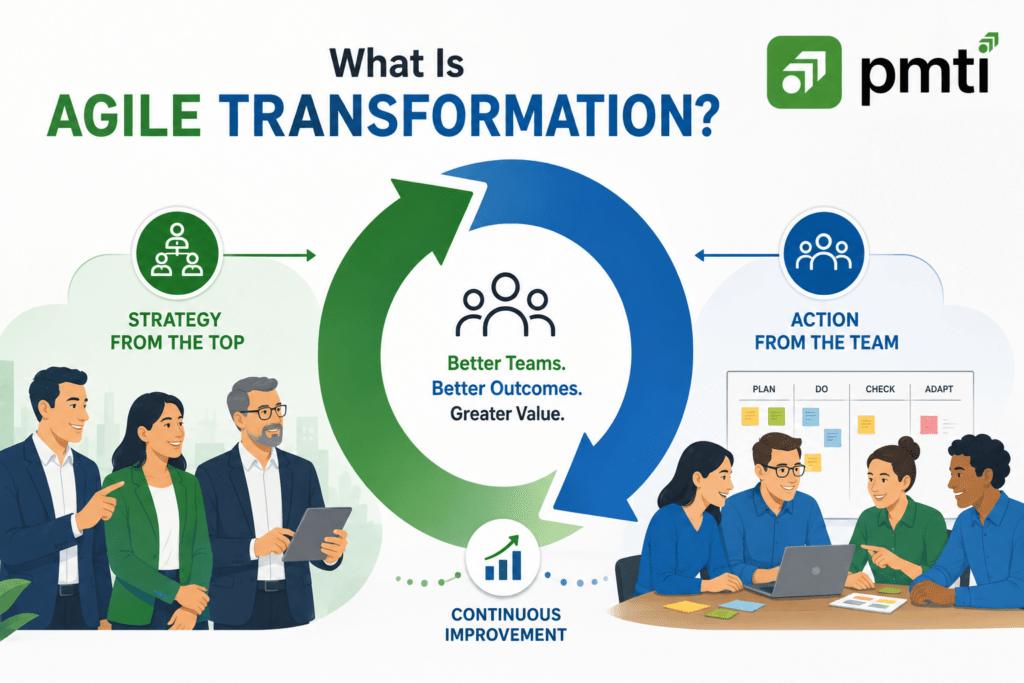
Agile transformation is a multiyear, company-wide strategy describing an organization’s commitment to the values and principles of the Agile Manifesto. Agile transformation goes beyond a few teams deploying Scrum. Companies that successfully undergo agile transformation are willing and able to restructure themselves in pursuit of the value-generating opportunities that arise in an ever-changing marketplace. Most companies that attempt agile transformation struggle to move beyond their first small-scale success.
What Is Agile Transformation?
Agile transformation describes a company-wide commitment to the values of the Agile Manifesto and prioritization of the principles of close customer collaboration, team coordination, and value maximization. Each organization’s definition of Agile transformation is unique, but every organization strives to build an Agile organization, capable of rapidly restructuring its strategy, structure, and processes, in contrast to a rigid annual plan, to capture real value.
How Is Agile Transformation Different From Individual Teams Using Agile Methods?
Not all companies that implement Agile methods across their teams are, in fact, Agile. Treating teams to Agile tools and ceremonies is neither a substitute for nor an indication of an Agile transformation. For an organization to be Agile, the values on which the tools are founded must permeate governance, funding, and performance management across the organization. This is the reason most transformations fail; a company may have numerous teams performing standups, performing sprints, and using other tools to no effect if the rest of the company’s systems (e.g., budgeting, performance management, contracts with outside providers, etc.) remain unchanged.
What Does the Agile Transformation Process Involve?

The Agile transformation process systematically examines an organization’s processes, technology, team mindset, and performance metrics for opportunities to apply Agile values, function by function rather than only within software delivery.
Consider a customer support department going through this process. Leadership examines how support tickets move through the team, the technology used to track and route them, the team’s mindset toward collaboration with product and engineering, and the metrics used to evaluate performance. The transformation shifts the team from measuring pure ticket-closure volume toward measuring customer outcome quality, restructures how support collaborates directly with product teams on recurring issues, and empowers frontline staff to make judgment calls previously escalated up a management chain. Resolution times improve, and so does staff engagement, because the team now has real input into how its own work is measured and structured.
How Long Does an Agile Transformation Take?
Agile transformation typically unfolds over one to several years depending on organizational size and maturity, with culture change as the foundational and most difficult part of the process. Progress rarely moves in a straight line — organizations should expect real strides forward alongside setbacks, and sustained leadership commitment across the full journey is what determines whether the culture change actually sticks.
What Is the Agile Transformation Strategy?
A structured agile transformation strategy has five major steps. The first major step in the strategy is defining the reason the business needs agile transformation. This reason should be a strong driver in the business. Step two is building a transformation roadmap. This step should focus on timing and milestones for process, metrics, and culture changes. Step three is the adoption of agile transformation and assessment of team readiness. Step four is creating new performance metrics and tracking the transformation progress.
Step 1: Define Why Your Organization Needs Agile Transformation
Every successful transformation starts with a clearly articulated, business-driven reason for the change, communicated consistently enough that everyone in the organization understands and believes it. An organization pursuing Agile transformation simply to say “we do Agile now” is not ready to begin — the motivation needs a real business driver, such as responding faster to customer needs, reducing bureaucratic overhead, or acting on competitive opportunities before they close.
Step 2: Build an Agile Transformation Roadmap
An Agile transformation roadmap lays out the timeframes, process-change milestones, metric-change milestones, and mindset and culture milestones that guide the organization through the transformation journey. The roadmap gives a multi-year, non-linear change effort concrete markers of progress, keeping teams and leadership focused on visible milestones instead of an undefined, open-ended journey.
- Timeframes — realistic windows for each major phase of the transformation, acknowledging that culture change moves slower than process change.
- Process-change milestones — specific workflow and structural changes, sequenced by dependency and organizational readiness.
- Metric-change milestones — the points at which old performance measures are formally replaced with value-focused ones.
- Mindset and culture milestones — qualitative markers, such as self-organizing team behavior or cross-functional collaboration, that are harder to measure but essential to track.
The size and complexity of the organization determines how many roadmaps are needed — a single department may need one roadmap, while a large enterprise may need several coordinated roadmaps across business units.
Step 3: Embrace Agile Methods and Assess Team Readiness
The values embedded in the Agile Manifesto should be adopted extensively across an organization, rather than mandating one specific method. For example, although Kanban, Scrum and other methods have different structures, they express the same values. When a particular method of organization is introduced to a team, it should be done alongside an assessment of the team’s readiness to adopt the method. It should be culturally aligned with the Agile values, and self-organization should be fostered, along with the recognition of team members who demonstrate the values.
Step 4: Invest in Training and Coaching
The team assessment helps identify the training and coaching needed, along with support for the growth mindset which is necessary for sustainable transformation, of which leadership coaching is the most impactful, as leaders who model the values become the most important change agents in the organization. Team training in itself fosters collaboration and establishes a foundation for working together to continue beyond the training.
Step 5: Establish and Monitor Agile Performance Metrics
Speed to market, customer satisfaction, quality, and employee culture are the metrics to be identified at the start of the journey and continuously monitored throughout as the transformation matures. The advantage of the metrics is that they can not only be used to track the progress of the transformation but can also be used to demonstrate the thinking and the behaviors of Agile overall. As metrics are revisited, and adapted, this is a higher level of Agile thinking goal at the enterprise level.
How Do Top-Down and Bottom-Up Efforts Fit Into the Transformation Roadmap?
Each phase of the transformation map requires concurrent top-down sponsorship with bottom-up engagement. Funding and authorizing of the milestones on the map is an executive level commitment. Without engagement of the teams, mindset and culture of the transformation will not be achieved.
What Are the Benefits of Agile Transformation?
There are increases in productivity, processes flow, and morale of teams as cultures evolve to value driven self-organization and empowerment. Following an Agile transformation, many organizations report that a culture of Agile has permeated their businesses. They have experienced trust and respect leading to an increase of opportunity for ongoing change and innovation due to the flexible, adaptable nature of Agile.
Why Do Most Agile Transformations Struggle?
Early success is often followed by failure to scale for most Agile transformations. The Harvard Business Review’s analysis of 112 organizations found that 90% of respondents had trouble scaling transformations company-wide, even if they had successfully scaled transformations as initial pilot projects.
There is a common mistake outlined in this research: specifically, focusing on constructing high-performing teams and placing them apart from the rest of the organization and creating teams that are isolated rather than placing a focus on infusing Agile practices across the organization as a part of the core operating practices. Similar findings from McKinsey’s research show that culture and ways of working are the top challenges encountered during Agile transformations, and this is followed by issues with leadership and talent and the difficulty of finding a clear and articulated vision.
- Lack of planning — attempting transformation without a defined roadmap or clear sequencing of milestones.
- Unclear “why” — pursuing transformation for its own sake rather than a specific, communicated business driver.
- Isolating agile teams — staffing agile pilots only with top talent and separating them from the rest of the organization, preventing practices from spreading naturally.
- Toxic or resistant culture — attempting transformation without addressing the underlying resistance to change at the management level.
How Does Agile Transformation Appear on the PMI-ACP Exam?
The PMI-ACP exam tests Agile transformation concepts through scenario questions asking why a transformation effort is stalling and which corrective action addresses the actual root cause, rather than testing rote recall of transformation steps. Recognizing the difference between a team-level Agile adoption problem and an organization-wide transformation problem is a common thread across these scenarios.
Sample Question 1
An organization has several teams successfully running Scrum ceremonies, but executive leadership still evaluates departments on utilization rather than value delivered, and the organization has no coordinated transformation roadmap. What best describes this organization’s current state? A) A completed Agile transformation B) Team-level Agile tool adoption without organizational transformation C) A failed transformation requiring the teams to abandon Scrum D) An advanced stage of Disciplined Agile maturity
Sample Question 2
Research on Agile transformation failure identifies a specific staffing mistake many organizations make with their pilot agile teams. What is that mistake? A) Assigning too few experienced staff to pilot teams B) Staffing pilot teams entirely with top performers and isolating them from the rest of the business C) Rotating team membership too frequently D) Involving too many departments in the pilot phase
Sample Question 3
What should an Agile transformation roadmap include, at minimum? A) Only a list of Agile ceremonies to adopt B) Timeframes, process-change milestones, metric-change milestones, and mindset/culture milestones C) A single company-wide deadline with no intermediate markers D) A list of software tools to purchase
Sample Question 4
According to HBR research covering 112 companies, what percentage reported struggling to roll out agile transformation organization-wide, even after early small-scale success? A) Roughly 25% B) Roughly 50% C) Nearly 90% D) Fewer than 10%
Answers: 1) B — running Agile ceremonies without corresponding changes to leadership evaluation criteria or a coordinated roadmap reflects team-level tool adoption, not organizational transformation. 2) B — the research specifically identified isolating top-performing staff into pilot teams, separated from the rest of the business, as a common and damaging staffing mistake. 3) B — a complete roadmap requires all four milestone categories, not ceremonies or tools alone. 4) C — nearly 90% of the 112 surveyed companies reported this struggle.
Frequently Asked Questions
Is Agile Transformation the Same as Adopting Scrum?
Agile transformation and Scrum are not the same. Transformation is the adjustment of values and structures toward a goal which often incorporates multiple, if not no, frameworks. An organization can use Scrum at all levels and not be able to achieve a transformation.
How Do You Measure Agile Transformation Success?
Success with Agile transformation is determined by a combination of speed to market, customer satisfaction, quality and culture of employees. These can be continuously monitored and altered to determine the maturity of the transformation, rather than being assessed once and being considered fixed.
Can a Small Company Undergo Agile Transformation?
Small companies can do Agile transformation easier than large companies. The fewer management layers and simple company funding structures lower the coordination issues that slow change at scale. Transformation at any company still has the same requirements, clear “why,” roadmap, and most importantly, genuine leadership.
What Role Does Disciplined Agile Play in Agile Transformation?
PMI’s Disciplined Agile toolkit provides structured, context-sensitive guidance for building a transformation roadmap suited to a specific organization, drawing on practices from multiple Agile frameworks rather than prescribing one fixed approach. A full breakdown of the toolkit and its current certification path is available in the site’s dedicated Disciplined Agile guide.


