


AI’s impact on project management does not diminish the importance of PMP certification. On the contrary, its impact is positive. As AI assumes the mechanical and the computational aspects of project management, organizations pay greater attention to the certified skills that AI cannot perform, such as judgment, stakeholder engagement, team and people management, and decision making in complex and uncertain situations—the skills that the PMP certification exam assesses in all three of its domains.
This article includes a comprehensive list of all existing project management AI tools, the full range of currently available AI tools, a salary survey of AI-competent project managers, the degree of AI tool acceptance in contemporary practice, and an analysis of the projected increase in 2026 for the demand of PMP certification.
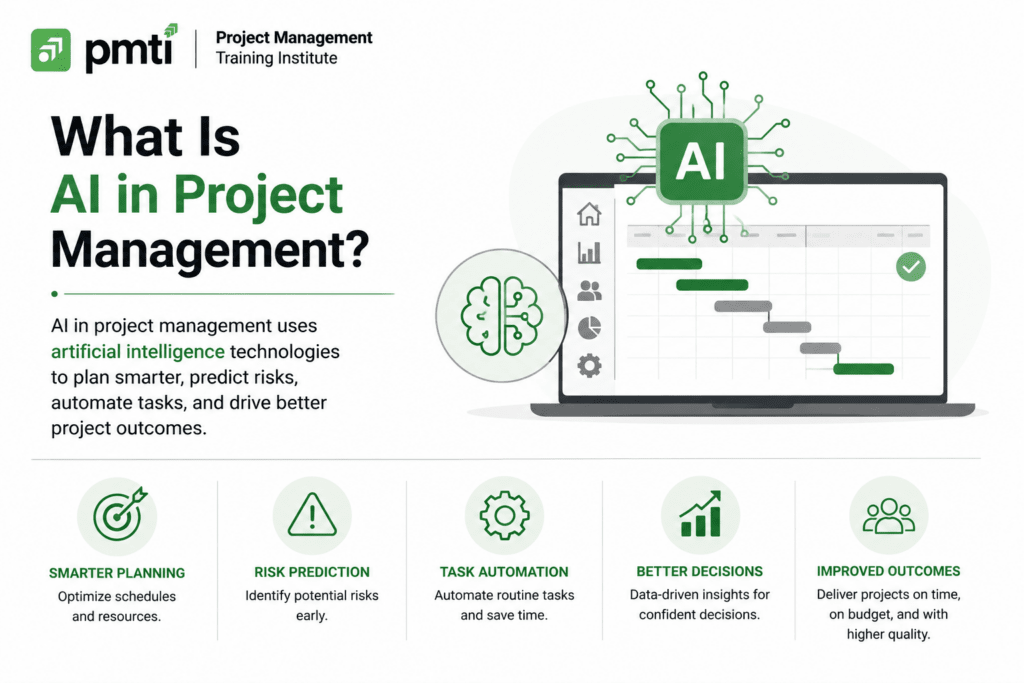
What Is AI in Project Management?

AI in project management refers to the use of machine learning, natural language processing, and predictive analytics with the aim of either speeding up, automating, or supplementing specific project management tasks such as initiating, planning, executing, monitoring and controlling, and closing. AI-based tools capture and process project related data such as drawings, schedules, budgets, resource and staff logs, risk registers, and records of communication, and then generate recommendations, alerts, drafts, or even actions that would be done automatically and would otherwise require an effort to be done manually by a project manager.
Three Levels of AI Capability in Project Management
Three levels of capability characterize tiered AI use in PM:
Level 1 — Unassisted: The PM has no active role in the task completion process. AI handles everything by itself. An example of this level would be AI creating a status report based on the information pulled from the project data, or AI creating a meeting transcript by pulling the meeting transcript and listing the action items, or the AI automatically adjusts the project schedule by factoring in the delays.
Level 2 — Assisted: AI generates a draft, recommendation, or a report for which the PM provides a review and final approval. An example would be an AI-generated report of a risk assessment for which the PM provides the review to validate the risk assessment in the context of the project, or an AI recommendation of resources which the PM adjusts based on relationship of stakeholders, or an AI-generated change request which the PM edits and sends.
Level 3 — Advanced: AI provides recommendations and insights in relation to the project and its data, which the PM is otherwise unable to do through a manual review. Examples are communications that show early signs of a project being out of the defined scope, or an AI recommendation of a budget balance that provides a historical view of project failures, or an AI assessment of a resource conflict that occurs six weeks before the resource is actually constrained.
All three levels are used in PM for the year 2026. Level 1 provides capacity. Level 2 provides a boost to the overall quality. Level 3 covers the PM work that is reactive and shifts it to a more proactive position.
What AI Tools Do Project Managers Utilize in 2026?
Ten tools using AI as the foundation form the active PM tech stack for the year 2026: Microsoft Copilot for Project, Asana Intelligence, Monday.com AI, Motion, ClickUp AI, Smartsheet AI, Wrike AI, Notion AI, Forecast.app, Jira, and Atlassian Intelligence. Each tool addresses a particular PM function and most of them feature integrations to work with the remaining tools within a common data framework.
Microsoft Copilot for Project
Main purpose: To speed up schedule creation, task population, and resource management within Microsoft Project and Microsoft 365.
Specific features: Takes a project brief and creates a complete project schedule, identifies and proposes solutions to scheduling issues, drafts status reports using Project Online, and responds to project performance inquiries in plain language (e.g. which tasks will have a resource conflict in the next three weeks and are on the critical path?).
Most applicable to: Large enterprise organizations that have adopted Microsoft 365 and need to manage large, complex, multi-phased projects.
Pricing: The Microsoft 365 Copilot plans add-on costs $30/user/month.
Asana Intelligence
Main purpose: To facilitate task automation, predict capacity, and identify project risks within Asana work management.
Specific features: Predicts team capacity overruns up to three weeks in advance, automatically creates task lists from plain language goals, and identifies projects and tasks that will be at risk, and summarizes status across 20+ fields into a single paragraph for stakeholder reporting.
Most applicable to: Product, marketing, and cross-functional teams that manage multiple concurrent workstreams.
Pricing: Included in Asana Business ($24.99/user/month) and Enterprise plans.
Monday.com AI
Main function: AI-powered automation, sentiment analysis, and document generation on the Monday.com Work OS.
Example capabilities: Uses natural language to create project plans from templates, sentiment analysis of stakeholder emails to identify risk in project communication, status update requests and consolidation are automated, generates project summaries and meeting agendas and briefs from board data.
Best for: Flexible workflow automation for Ops, HR, and cross-functional project teams.
Pricing tier: AI is available on Pro plan ($19/user/month) and above.
Motion
Main function: AI scheduling and priority management of tasks for project managers.
Example capabilities: Tasks get scheduled in calendar blocks based on deadlines and duration, tasks are prioritized by the order to be completed based on the time constraints and dependencies, and the schedule is adjusted in real time when tasks take longer than expected or when unexpected meetings are added.
Best for: Project managers, solopreneurs, or small project teams that have a large volume of tasks with tight deadlines.
Pricing tier: $19/user/month (individual) / $12/user/month (team).
ClickUp AI
Main function: Automation of tasks and document generation and project reporting within ClickUp.
Example capabilities: Generation of project briefs, scope documents, risk registers, and status reports, automated generation of subtasks by task decomposition, summaries of comments and meeting notes, and generation of RFI responses and stakeholder emails.
Best for: Document-heavy projects for agencies and software development and professional services teams.
Pricing tier: $7/user/month on top of existing ClickUp plans.
Smartsheet AI
Focus: Data analysis and reporting automation on Smartsheet’s grid-based project management tool.
Uses: Converts plain language into office automation and Smartsheet formulas, summarizes insights from extensive data ranges, auto-populates project data, constructs conditional formatting and dashboards.
Operative for: Operations project managers and construction program managers.
Pricing: Included in Smartsheet Business and up ($25/user/month).
Wrike AI
Focus: Project risk, workload, and work management automation on Wrike’s enterprise work management system.
Uses: Task project risk scoring, team burnout workload predictions for the next 2-4 weeks, automatic daily project health score updates, and work-based draft project output reports.
Operative for: Enterprise project teams and PMOs with 50+ active projects.
Pricing: Included in Wrike Business and up ($24.80/user/month).
Notion AI
Focus: Project work and requirement documentation on Notion’s workspace solution.
Uses: Action item list formations, requirement and charter documentation from bullet point-based stakeholder briefs, and project wiki and onboarding documentation auto-generation.
Operative for: Project managers, software, and documentation-intensive project teams.
Pricing: Notion AI ($10/user/month).
Forecast.app
Main function: Resource management and project financial forecasting using AI.
Specific features: Uses ML models on historical project data to predict estimated cost (final project cost at project completion), finds team members who are under-utilized or over-allocated across the whole set of projects, predicts phase-wise revenue recognition in projects, creates capacity plans for the next 12 weeks.
Intended for: Professional services firms, agencies, and consulting firms that maintain a portfolio of billable projects.
Pricing: From $29/seat/month.
Atlassian Intelligence (in Jira)
Main function: Agile delivery intelligence for Jira, backlog and sprint assistance.
Specific features: Summarizes threads and histories of issues and tickets, auto-generates acceptance criteria, finds duplicate tickets, responds to queries about sprint velocity, epic progress, and team capacity, and generates test case scenarios from requirements documents.
Intended for: Software development teams and PMs that use Agile delivery in Jira.
Pricing: Included in Jira Premium ($17.65/user/month) and above.
What Project Management Tasks Will AI Completely Automate?
AI is set to completely automate 6 categories of project management work (tasks that once took 30-40% of a PM’s time weekly) for 2026. These tasks will then be performed by AI systems with no manual effort at all.
Status Report Generation
In the PM platform, AI looks for and collects the completions of tasks, the actuals of the budget, milestones, and updates to the risk log. It then generates a formatted status report in under a minute. The status report is draft complete and ready for stakeholders. Time saved is 3-5 hours per week for PMs that have 3 or more projects active.
Transcribing Meetings and Extracting Action Items
Otter.ai, Fireflies.ai, and Microsoft Copilot in Teams, along with similar products, transpose conversations textually, detect action items, and assign owners. These tools integrate with PM software to create tasks using context from the conversation, eliminating any manual data entry. Save 2-4 hours weekly.
Impact and Resolution Evaluation
When a task is postponed, or a resource is eliminated, AI-based schedulers automatically assess the effect across the entire project and recommend a solution for the task(s) the PM would typically have to advance on the Gantt chart. Save 1-3 hours per change.
Stakeholder Updates
AI generates update drafts for PMs to review and refine with the stakeholder relationship in mind, and finally send. The PM may utilize local project data to help generate drafts for sprint summary and executive briefings. Updates take 2-3 hours to generate weekly.
Risk Logs
AI tools examine project communications, backlog tickets, and team messages, then detect relevant rising signals for risk and log them in the risk register with initial probability-impact scores. The identified risks are then classified by type. Save 1-2 hours weekly.
Resource Conflicts
AI tools compare availability and assignment calendars of team members against the project plan to automatically detect resource conflicts. Save 1-2 hours weekly.
Weekly time saved by full automation: 10–19 hours — translating to 25–47% of a 40-hour standard PM work week (time available for invaluable leadership and governance work).
What PM Tasks Does AI Assist With, Not Replace?
AI assists with 5 types of PM work. Here, AI makes recommendations, performs analyses, or creates drafts which are then subject to review and require human contextual judgment and relationship-based knowledge before actions are taken.
Risk Assessment and Mitigation Planning
AI will flag potential risks and develop a probability-impact matrix. Each risk will then be assessed by a PM considering context that AI does not know (corporate politics, client risk tolerance, contract scope, team ability, etc.). A mitigation plan will also require the collaboration of many stakeholders and will be far from fully automated.
Resource Allocation Decisions
AI will suggest which team members to optimize resource allocation. PMs must decide which resources to allocate based on as yet unmodelled factors by AI, including team member interpersonal dynamics, a developer’s desire to develop a specific skill, a client’s familiarity with certain team members, and the organizational politics surrounding the resource transfer.
Scope Change Impact Analysis
AI will assess the change to the schedule, budget, and the resources required for the modification of an impacted task to changes in scope. A PM will consider the strategic importance of the scope change relative to the client, the contract, the team, and the additional work to be undertaken. The analysis will be performed by AI, while the recommendation will be rendered by a human.
Budget Variance Forecasting
AI uses machine learning to analyze current rates of spend and the percentages of project phases that have been completed and provides a cost at completion forecast. A PM checks the forecast against other model-excluded factors, such as a one-time future expense, a scheduled future resource change, or a potential future reduction in client scope. The forecast serves as a baseline, and the PM adjusts the final number that is presented to the executive sponsor.
Vendor and Contractor Performance Analysis
AI uses delivery metrics, defect data, change order data, and responsiveness to communications to produce a vendor performance scorecard. A PM assesses the scorecard with respect to the specific vendor, the contract, other vendors, and the potential future value of the vendor partnership.
Which PM Tasks Will Remain Exclusively Human?
In 2026, AI will have no significant impact on 5 categories of project management work. These tasks are relational, political, or ethical in nature, or require a contextual understanding of a situation that cannot be derived or constructed from existing data.
Stakeholder Management and Politics
Managing a VP who has key resources but opposes project success, aligning two department heads with conflicting priorities, or coaching a project sponsor to support the project at a board level. These all involve relationship capital, emotional intelligence, and organizational power-mapping that no AI system can replicate or model.
Ethical Concerns and Decision Making Under Ambiguity
A PM exercising individual judgment regarding the potential fallout for the client relationship if a PM decides to flag the risk, disclose the under- performing member, and/or push back on the unreasonable executive order exhibits ethical courage, professional judgment, contextual wisdom, and accountability. These functions are human and cannot be assigned to an AI.
Cultivating Trust and Psychological Safety
Within a team, fostering an environment where members are encouraged to take initiative, raise concerns, and commit to the goal(s) of the team, is an interpersonal process. AI cannot build trust, recognize the lack of morale, be present and a coach for difficult conversations, and/or motivate the team during a crisis. Leadership is a human process.
Managing Change and Organizational Readiness
Once a new system, process, or structure is put in place, human resistance to change actively needs to be managed, a supportive coalition created, and the “why” explained in a way that touches different stakeholder values in order to sustain movement through the adoption curve. Change management is one of the most important PM skills that AI cannot replicate.
Unconventional Problem Solving
In the event that a project faces an unprecedented issue that is a failure mode with no historical precedent, a PM will be required to use their existing knowledge to create a solution that encompasses conflict resolution and technical constraints that validate the entire delivery plan. Within their training distribution, AI is unable to solve problems that fall outside of historical constraints.
These five categories directly correspond to the People domain in the PMP Exam Content Outline, which makes up 42% of the PMP Exam. This domain involves leading the team, working with stakeholders, resolving conflicts, and providing coaching. The PMP Exam gives special emphasis to these interpersonal skills because PMI expects that the majority of work related to project execution will become automated. Therefore, the work related to the leadership and governance of project management will become more important.
How Does AI Impact the Value of PMP Certification?
AI makes PMP certification more strategically valuable in 2026. AI manages the more calculative and logical aspects of PM, while certified PMP professionals manage people and suggest the best practices that AI cannot.
PMI’s 2024 Pulse of the Profession substantiates this. Companies that aggressively implement AI in PM the most are also seeing increased demand for PMP-certified professionals in order to manage and govern the AI’s output, assess the AI’s risks, and remain accountable for the projects AI PM Tools are managing.
Three Mechanisms Show Why AI Makes PMP Certification More Valuable
Mechanism 1: Governance for AI Solutions
Scheduling, risk management, and resource management design done by AI still need certified PMs to supervise and sanction these outputs. Companies using AI Solutions without certified governance oversight are exposed to the same risks as rule-based automated systems — mistakes multiply. The governance layer is filled by PMP-certified PMs.
Mechanism 2: Skill Scarcity in Human-Only Domains
The more artificial intelligence (AI) systems automate mechanical project management (PM) tasks, the more the skills that AI will never exhaust — stakeholder engagement, change management, ethical reasoning, and PM team leadership — will become scarce skills and the main factors that distinguish distinctive PMs from ordinary PMs. The Project Management Professional (PMP) certification is recognized as the primary means of demonstrating these skills.
Mechanism 3: Required Competencies for Strategic PM Roles
Senior PMs in companies that deploy AI systems and have roles such as Technical Program Manager (Google), Platform Delivery Lead (Amazon), and Transformation PM (McKinsey) are expected to have both AI skills and certified PM governance competencies. The PMP certification is the entry-level certification in PM, and AI skills are the differentiating competency.
To demonstrate how PMP certification aligns with career prospects from an AI-augmented economy, the PMP Jobs & Career Paths article outlines the 10 types of PM roles, their salary levels, and the potential career progression for PMP-certified professionals.
What Are the Most Significant AI Trends in Project Management in 2026?
There are 5 main AI Trends that will influence Project Management (PM) in 2026: agentic project management, predictive project intelligence, natural language PM interface, autonomous risk monitoring, and AI benefits realization tracking.
Trend 1 — Agentic Project Management
With the ability to fully automate multi-step tasks, AI agents are beginning to take over the maintenance of routine tasks in project management. An example of an agentic PM system is one that, when given the instruction to “manage the weekly status report process,” assembles the team’s inputs, generates the report, sends it to the stakeholders for approval, and saves the report, completing the task automatically on a weekly basis. PMs are now able to implement and configure these systems as a result of the AI agent frameworks, AutoGPT, Anthropic Claude agents, and Microsoft Copilot Studio. It is projected that by 2026, the systems will be adopted by 15–20% of enterprise PM teams and grow at an annual rate of 40%.
Trend 2 — Predictive Project Intelligence
For the first time, machine learning models that have been trained using thousands of completed projects and their associated variables and outputs, are being used to assess the likelihood of success for a newly initiated project at each of its phase gates with 70–85% accuracy. Predictive project intelligence tools, such as Forecast.app and other emergent PMO analytics, offer project health scores that are updated daily and, in an optimal scenario, would alert PMs to adverse project conditions four to eight weeks prior to the project entering a critical state. Predictive project intelligence is altering PM work from a reactive state to a governance prevention model.
Trend 3 — Natural Language PM Interfaces
There is a heightened demand among users to control the entirety of a project management workflow via natural language command. Tools like MS Copilot for Project, Asana Intelligence, and Monday.com AI permit users to say, “add a 2-week testing phase after the development milestone, reassign Ali to that phase, and update the stakeholder report” to achieve the same effect. Traditional project management tools require time-intensive training for their users. Interfaces that rely on natural language drastically reduce the amount of training required for a specific tool to a few short hours. They also remove the need for project managers to interpret and present project data for stakeholders that would never use a traditional project management tool.
Trend 4 — Autonomous Risk Monitoring
New enterprise PM tools are incorporating AI systems that continuously monitor project data for emails, Jira tickets, Slack messages, and other communications to scan for emerging risks. These systems reduce the time it takes to respond to a risk by surfacing an alert even before a project manager would identify the risk through a manual data review. The first organizations to adopt these tools have experienced reduced project cost overruns due to the delayed identification of project risks by 28%.
Trend 5 — AI-Powered Benefits Realization Tracking
Project managers care about the extent the business objectives of project close, e.g. an increase in revenue, a decrease in operational costs, etc. These objectives have traditionally neglected to focus on whether the project investment has delivered any value to the organization after project closure. Project managers can use AI tools to track the metrics of project outcomes which deviate from the objectives set and recorded in a benefits realization register. These tools of project governance help enable the focus on the objectives of project closure.
What Is the Impact of AI Tools on PM Salaries?
Glassdoor’s 2026 Technology Skills Premium data shows that PMs skilled in AI tools receive compensation that is 12–18% higher than their contemporaries without AI tools, with equivalent work experience and certifications. The AI skills salary premium is in addition to the premium for PMP certification — PMs who are PMP-certified and skilled in AI tools receive the highest salary of all PMs.
| PM Role | Salary for PMP Only | Salary for PMP + AI Proficiency | AI Proficiency Premium |
| Project Manager | $115,000 | $128,000 | +$13,000 (11%) |
| Senior Project Manager | $138,000 | $158,000 | +$20,000 (14%) |
| Technical Program Manager | $160,000 | $185,000 | +$25,000 (16%) |
| PMO Director | $168,000 | $195,000 | +$27,000 (16%) |
The Premium for AI Proficiency Is a Salary Premium for Three Leading Indicators
Productivity multiplier: PMs skilled in AI tools and AI PM tools govern more project work than nonskilled peers. Certified PMs using AI tools can govern 40%–60% more project work than certified PMs not using AI.
Governance of tools: Many organizations need PMs skilled in AI tools to help govern the AI tools. For example, AI PM tools might need PMs skilled in AI tools to validate or edit the AI PM tools. This skill has more value than PMs skilled in AI tools and governance of tools alone.
To see a full salary breakdown by profession, geography, and certification, visit PMP Certification Salary: What to Expect.
What Industries Will Most Harshly Implement AI Project Management?
Five industries will most likely lead 2026’s AI adoption in project management: Information Technology, Financial Services, Pharmaceuticals & Life Sciences, Defense & Aerospace, and Professional Services. In these industries, costs incurred from project failures will compel the use of AI.
Information Technology
Of all industries, IT will be most likely to adopt AI PM tools. In 2026, 78% of enterprise IT project teams will deploy at least one AI-driven PM tool (Gartner’s Project Management Hype Cycle, 2025). Since developing software, migrating to the cloud, and launching products creates the structured data PM tools require, they can use AI to improve risk and scheduling forecasts.
Financial Services
In Financial Services, AI is being used in the management of transformation projects and programs aimed at meeting rapidly changing regulatory requirements, where the cost of missing a compliance deadline could be in excess of $10 million. Overruns in compliance programs are said to reduce by 35% with AI risk tools, when the tools are adopted to a sufficient extent.
Pharmaceuticals & Life Sciences
To better manage clinical trials, AI is being used to predict problems with recruitment, site readiness, and the impact of changing study protocols on when results will be available. Predicting outcomes with AI carries a strong business case for investment, particularly when delays in new product approvals can cost between $50M and $500M.
Defense & Aerospace
U.S. defense contractors leverage AI for cost and schedule risk assessments for programs with cost overrun penalties. AI models for cost-at-completion and schedule-at-completion draw from Earned Value Management (EVM) data, the federal contract reporting requirement, and are more accurate than EVM trend analysis.
Professional Services
Consultancies and project management service firms leverage AI to maximize billable utilization, forecast engagement profitability, and automate status reports for all clients. AI also analyzes communication patterns to determine the likelihood of each client relationship failing. Resource management enabled by AI has resulted in a 12-15% increase in billable utilization, the main metric for profitability in professional services.
What Skills Do PMs Need to Work With AI Tools?
To effectively use AI tools for project management, PMs need five skill competencies, including prompt engineering for project management, critical evaluation of AI output, data interpretation with AI, and automation of workflows. Additionally, PMs require the competency to assess the impact of AI on project decision-making.
Prompt Engineering for PM
To optimize AI tools for project management, PMs must provide AI with contextual project information and concretize desired outputs; otherwise, the AI outputs will be irrelevant and generic. PMs writing precise prompts, like the risk assessment request above, will yield far superior results from the AI tools than their counterparts using vague requests.
Critical AI Output Evaluation
Errors and recommendations in AI-generated assessments, schedules, and resource plans that an experienced PM would catch before taking action still plague many AI systems. The ability to critically evaluate AI output is identifying the limits of what the model does not and cannot know, what historical patterns it is most likely misapplying to this new, unusual case, and where its suggestions are most likely to conflict with the actual intelligence of the project. Of all the overlays we can apply to AI, this is the most valuable.
AI-Augmented Data Interpretation
The data insights that AI tools can reveal about a project, and that are largely absent from the traditional PM dashboards, include a whole new category of predictive analytics, anomaly and trend detections. PMs must be data literate enough to interpret those outputs. For instance, they must be able to interpret the meaning of a confidence interval, identify when a prediction is operating outside the model’s training distribution, and correctly identify a statistically significant trend versus noise from a small sample of data.
Workflow Automation Design
The ability to design an automated PM workflow, including the logic for which triggers result in which actions, and what exceptions require human addition, is a completely new skill not evident in the ability to employ the AI features that are built for you. PMs with the ability to design truly custom automations, using tools such as Make (previously Integromat), Zapier, or the automation builders native to the platforms, are able to extend the boundaries of what is possible to automate and AI to handle far beyond the built-for-you features.
AI Governance and Ethics
PMP training develops governance and ethics competencies to help PMs decide when to ignore an AI suggestion and when and how to inform clients of the PM’s use of AI tools. PMP training also instructs PMs how to govern the data that AI systems access, as well as how to ensure that the use of AI tools in project work does not eliminate human accountability for project work. Organizations that use AI PM tools want certified PMs to govern the use of AI tools as part of their PM practice.
AI skills complement the project management skills framework that defines PM professional competency. AI governance skills have an overlay of AI skills.
What Is the Future of AI in Project Management?
The future of AI in project management (2026–2029) consists of 3 phases: broad automation of routine tasks (2026, current), AI-assisted strategic governance (2027–2028), and partially autonomous program management (2028–2029).
Phase 1 — Broad Task Automation (2026)
The current phase: AI performs 25–30% of PM tasks (status updates, schedule creation, transcribing, data entry, etc.). PMs are operators of AI tools — they deploy and supervise AI tools within their workflows. Adoption is uneven; however, the average rate of adoption is 35–40% per year.
Phase 2 — AI-Assisted Strategic Governance (2027–2028)
For the first time, AI systems will provide portfolio-level predictive insights. AI systems will suggest the strategic value of projects, as well as the optimal timing for project start and stop decisions, given resource and benefits realization constraints. PMs and portfolio managers will be able to make better-informed and more timely portfolio decisions using AI systems. The focus of PMs will shift from data collection to decision-making, with AI serving as the primary data source.
Phase 3 — Partial Program Autonomy (2028–2029)
AI agents will execute workflows for programs that are highly structured and easily repeated (e.g., the implementation of regulatory compliance, standardized infrastructure rollouts, and technology refresh programs). Human program managers will govern the agent system and will have the following responsibilities: approval of deviations, stakeholder relationship management, and handling new and novel situations that are beyond the operational limits of the agents. This does not signify the end of the program managers’ roles, but rather represents the elevation of their roles to a governance and oversight function above the execution layer.
For every one of the phases, the skills that enhance the value of program managers who work at the highest levels (stakeholder influence, management of ethical dilemmas, organization change management, and high-level decision-making) will become more critical as AI takes over more of the execution elements that are routine and mechanical.
How to Prepare for the Project Management Profession in an AI World?
Adoption of AI in project management requires a tripartite investment on the part of the individual: 1) PMP Certification, 2) active proficiency in 2 to 3 AI PM tools, and 3) a high degree of data literacy.
Investment 1 – PMP Certification
The PMP Certification demonstrates an individual’s competencies in leadership, governance, risk management, and strategic alignment – areas where AI will be of assistance, but cannot and will not perform. Organizations that will use AI PM tools will need certified program managers to govern the AI systems that make recommendations. Certifying PMs and augmenting their skills with AI tools will result in them obtaining the most highly compensated roles in the PM job market of 2026.
The first step to receiving a PMP certification is completing 35 PM education contact hours. PMTI’s PMP Certification Training covers all 35 hours during a 4-day boot camp. This boot camp is offered in multiple locations throughout the United States and Canada, in both an online and in-person format. For candidates that finish the program, PMTI offers a money-back guarantee.
Investment 2 — Active AI Tool Proficiency
Select 2-3 AI PM tools that are listed above. Use the tools in active projects and practice proficiency for the next 90 days. Focus on tools that serve the greatest time-cost PM tasks. For instance, if reporting status takes 5 hours or more in a week, consider using Asana Intelligence or MS Copilot for Project. If tools are needed to help re-adjust the schedule after more than 3 hours are spent on that task per instance, consider using either Motion or Wrike AI.
Investment 3 — Data Literacy Development
Complete a course on data analytics that take a structured approach to an introduction to data theory, descriptive statistics, and probability. These concepts are the basis for AI and predictive algorithms. The Google Data Analytics course on Coursera, LinkedIn Learning’s Data Literacy for Business, and the courses available on PMI’s digital learning catalog are excellent examples. Completion of these courses takes 40-60 hours, and provides data skills that are foundational in PM roles with AI tools and automation.
Frequently Asked Questions: AI in Project Management
Will the rise of AI mean that project managers will no longer be needed?
AI won’t usurp project managers; it’ll change their jobs. Project managers have status reports, schedules, and meetings handled by AI learn tools that do the repetitive elements of their jobs. These only account for about 25-30% of their jobs. The remaining tasks (stakeholder governance, team leadership, etc.) are human elements that AI can’t do. PMI’s 2024 research states that as more organizations adopt AI PM tools, they increase their PMP certification PM role requirements instead of abolishing the role.
What are the best AI PM tools for construction project management?
As of 2026, Smartsheet AI and the Procore AI tools are the most construction project management-specific AI tools. Smartsheet AI efficiently manages the construction program’s level of capital program tracking. Procore integrates construction-specific AI for suggested RFI responses, automates submittal, and daily reports from field data. The construction programs run at the $100M+ level also utilize Palantir’s AIP platform for construction program cost and schedule estimating. This level of AI tool integration alongside CCM certification attracts a combined 25-35% salary premium over project managers that don’t use AI tools.
Is AI knowledge tested in the PMP exam?
Currently, knowledge of AI is not tested in the PMP exam, but PMI is working on a new version of the exam scheduled to be released between 2026 and 2027 and knowledge of AI, as well as digital tools and Managed Business Decisions Based on Data, are expected to become knowledge areas of the Business Environment domain. For now, using AI tools as part of PMP certification professional practice will not be tested. You can check the PMP Certification Guide for more information about the current domains of the exam.
How can AI be used in PMP exam preparation?
AI can be used in three specific ways to assist in PMP exam preparation: generation of exam practice questions for specific domains, provision of explanations and answers to PM related questions in a Socratic format, and creation of adaptive quizzes to help identify and target gaps in knowledge. ChatGPT-4o, Claude, and PMP prep specific tools integrated with AI, including PMI’s own learning platform, can be used for these purposes. AI exam preparation tools can be used as a supplement to a structured PMP training course, but cannot substitute a course with live instructors, which provides the highest guarantee of students passing the exam.
How much time saving do project managers expect from AI?
AI tools save project managers between 10 and 19 hours per week for six automated task categories. These categories include status updates (3 to 5 hours), meeting transcriptions (2 to 4 hours), schedule adjustments (1 to 3 hours), drafting stakeholder updates (2 to 3 hours), filling in the risk log (1 to 2 hours), and identifying resource conflicts (1 to 2 hours). Time savings greatly depend on the team size, the complexity of the project, and the number of AI tools in use. For managers of large programs (10+) who get reports that go to executives, time savings of 15 hours is the norm.
Build the Human Skills AI Cannot Replace
Managers who combine governance competencies with certified project management skills such as AI tool proficiency thrive in the AI-augmented environment. AI tools cover the computational and mechanical parts of project delivery. PMP-certified project managers fill the gaps that AI recommendation tools leave with their skills in judgment, leadership, and accountability.
PMTI is a PMI Authorized Training Partner (ATP) that provides PMP Certification Training across the United States and Canada. The 4-day Boot Camp offers 35 contact hours, a simulated 200-question exam, PMI application assistance, and a money-back guarantee for passing.
In an age where AI is transforming project delivery, PMP Certification provides a competitive advantage.


