

What Are the Benefits of the Agile Methodology?
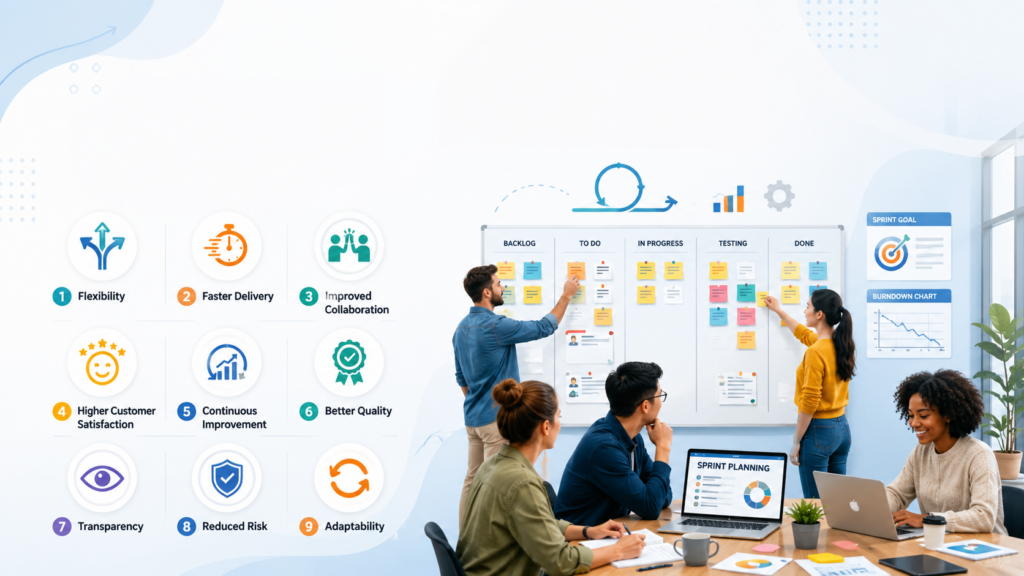
The Agile Methodology generates nine benefits for four segments of stakeholders that result in increased satisfaction for customers, decreased risk, and enhanced ROI. Vendors gain increased quality and better visibility. Project managers experience better alignment and prioritization. Development teams enjoy better morale. At the heart of these benefits is a mechanism of delivering value in a series of short iterations, as opposed to a lengthy project, to surface issues and provide visibility well before the completion of the project.
How Does Agile Improve Customer Satisfaction?
In traditional project management practices, customers gain little to no visibility until the project is delivered. Agile project management stands in stark contrast to this as it delivers segments of functionality to customers throughout the project. This continuous visibility provides customers with multiple opportunities to influence the outcome of the project before it is ultimately completed. Rather than waiting for a delivery at the tail end of the project to learn of any potential deficiencies, customers are given the opportunity to view project progress and provide feedback repeatedly.
How Does Agile Reduce Project Risk for Customers?
Agile shortens the feedback cycle and risks misalignment occurring after one sprint versus at the end of the entire project. Traditional methods collect all requirements upfront, resulting in the client finding out their investment went to total project completion for a product that misses the requirements.
How Does Agile Deliver Faster ROI for Customers?
Agile delivers a faster roi by prioritizing the release of the features that carry the most value. Clients can begin to derive value for their investment with a functional version of the product after just a few iterations, instead of waiting for the first complete version.
How Does Agile Improve Product Quality for Vendors?
Agile improves product quality through continuous testing within every iteration, catching defects during development rather than only after the full project is complete. Regular sprint retrospectives add a structured improvement loop on top of that testing discipline, so each iteration runs more effectively than the one before it.
How Does Agile Increase Project Visibility and Control?
Agile makes work progress and items planned visible to the entire team through daily stand-ups and structured tracking artifacts. This helps teams and management constantly assess the status of the project and provides immediate visibility of problems that are easily manageable versus issues that contribute to significant delays.
How Does Agile Strengthen Customer Alignment for Project Managers?
Agile strengthens customer alignment by requiring frequent, structured touchpoints with the customer throughout the project rather than only at the beginning and end. A project manager working in an Agile framework has a continuously updated understanding of what the customer actually wants, reducing the risk of building the wrong thing based on outdated requirements.
How Does Agile Improve Task Prioritization for Project Managers?
Agile changes the way tasks are prioritized by the Sprint teams. Instead of prioritizing tasks by setting goals that are a couple of months in the future, teams prioritize by focusing the Sprint on the item that is the most important for the business at the time.
How Does Agile Optimize Organizational Tracking Capabilities?
Agile optimizes tracking through artifacts like the burndown chart, which shows remaining work at a glance and gives project managers granular, real-time insight into team capacity and progress. This level of tracking detail is difficult to replicate in a traditional approach that only reports status at scheduled milestones.
How Does Agile Improve Morale and Sustainable Pace for Development Teams?
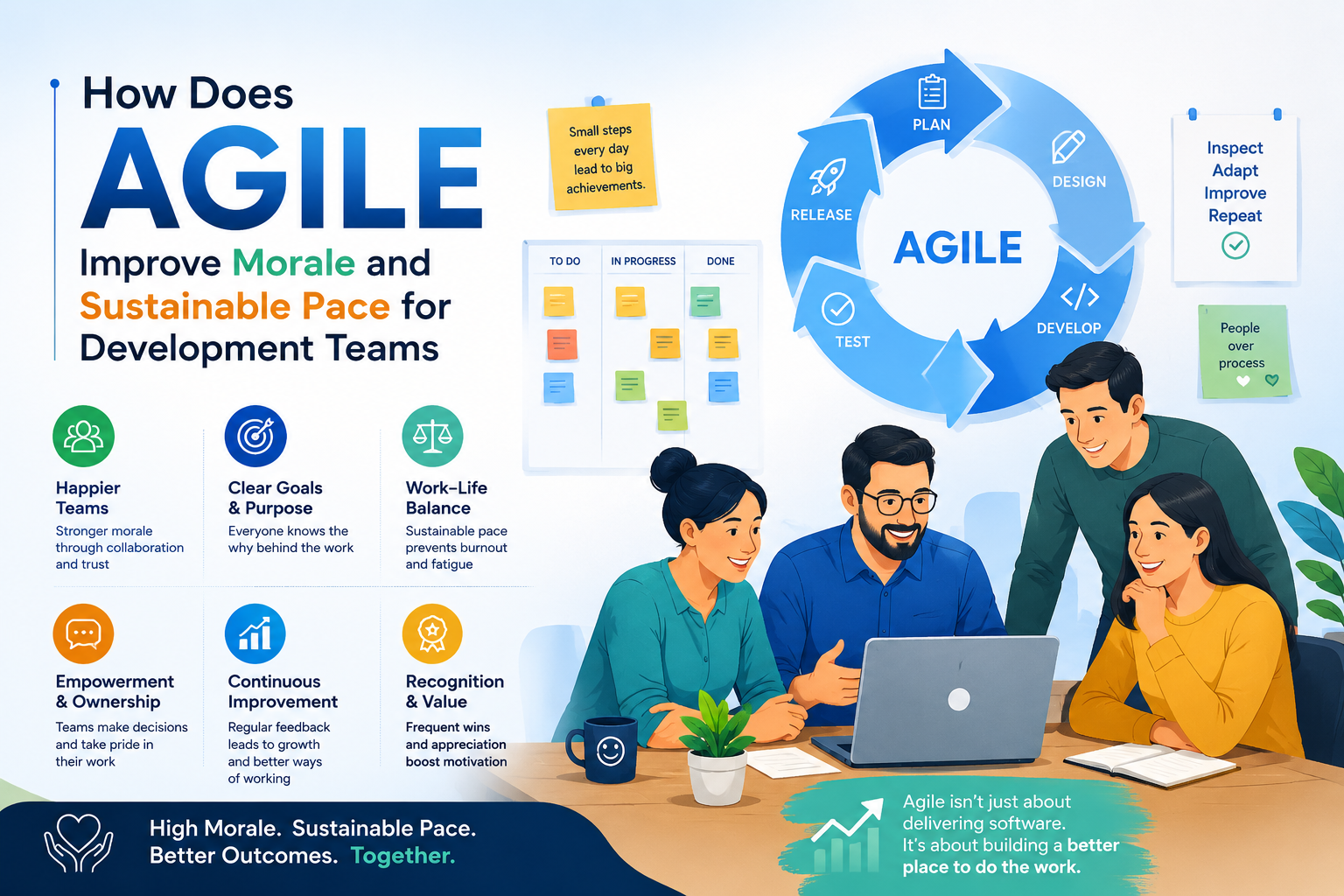
Agile improves team morale by giving development teams autonomy over how they organize their own work and by building sustainable pace directly into the framework through fixed-length sprints and regular retrospectives. Self-organizing teams who have a structured voice in process improvement, through retrospectives, report higher engagement than teams working under a rigidly imposed plan with no input into how the work gets done.
How Do These Benefits Appear on the PMP Exam?
The PMP exam asks candidates to identify the most fitting approach (Agile, predictive, or hybrid) for a particular project based on the level of project risks, overall requirements clarity, and level of stakeholder engagement. Knowing what Agile benefit applies to a given circumstance is typically how the candidate identifies the correct answer.
Sample Question 1
A project has highly uncertain, evolving requirements and a customer who wants frequent input into development. Which Agile benefit most directly addresses this situation? A) Faster ROI B) Enhanced customer alignment through frequent touchpoints C) Optimized organizational tracking D) Improved team morale
Sample Question 2
A development team reports declining morale under a traditional, fully-planned project structure with no input into their own workflow. Which Agile characteristic would most directly address this? A) Daily stand-up meetings B) Sustainable pace and self-organizing team autonomy C) A release burndown chart D) Customer collaboration
Sample Question 3
A stakeholder wants real-time visibility into project progress rather than periodic status reports. Which Agile practice best delivers this? A) Sprint retrospectives B) Product vision statement C) Daily stand-ups and continuously updated tracking artifacts D) Fixed release dates
Sample Question 4
A vendor wants to catch defects as early as possible rather than discovering them only after a project is fully complete. Which Agile practice most directly supports this goal? A) Continuous testing within each iteration B) A single final quality review at project close C) Reducing the number of sprints D) Extending the planning phase
Answers: 1) B — frequent stakeholder touchpoints directly address evolving requirements and the customer’s need for ongoing input. 2) B — sustainable pace and team autonomy are core Agile mechanisms for improving morale, distinct from customer-facing practices. 3) C — daily stand-ups and continuously updated artifacts provide the real-time visibility being requested. 4) A — continuous testing within each iteration catches defects during development rather than after project completion.
Frequently Asked Questions
Does Agile Guarantee Project Success?
Agile does not always work. It operates by addressing project issues early on and therefore is appropriate for the majority of projects, but it still requires focus and customer participation for the project to be a success. Poorly managed Agile can produce the same failures that can occur in traditional project management.
Are These Benefits Exclusive to Software Projects?
Agile does not exist in a Software Dev vacuume. The benefits are applicable to projects that include stakeholder feedback on an evolving project such as marketing campaigns, software projects, and business shifts. Software projects are the most common yet when compared to other projects, Software development projects are most aligned to the software.
What Are the Trade-Offs of Using Agile?
Agile projects sacrifice detail in the beginning to allow for project flexibility. If your project requirements are fixed and understood with low flexibility and high cost for changing requirements, Agile may not your best option. Agile also requires stakeholder participation throughout the entirety of the project, which not all customers are in a position to commit to.
Is PMI-ACP Certification Required to Apply These Benefits?
PMI-ACP certification is not required to apply Agile benefits on a project, but it does provide structured, validated training in the practices — sprint planning, backlog management, retrospectives — that produce these benefits consistently. Teams can realize Agile benefits without formal certification, though certified practitioners bring a demonstrated depth of practice to leading that work.