


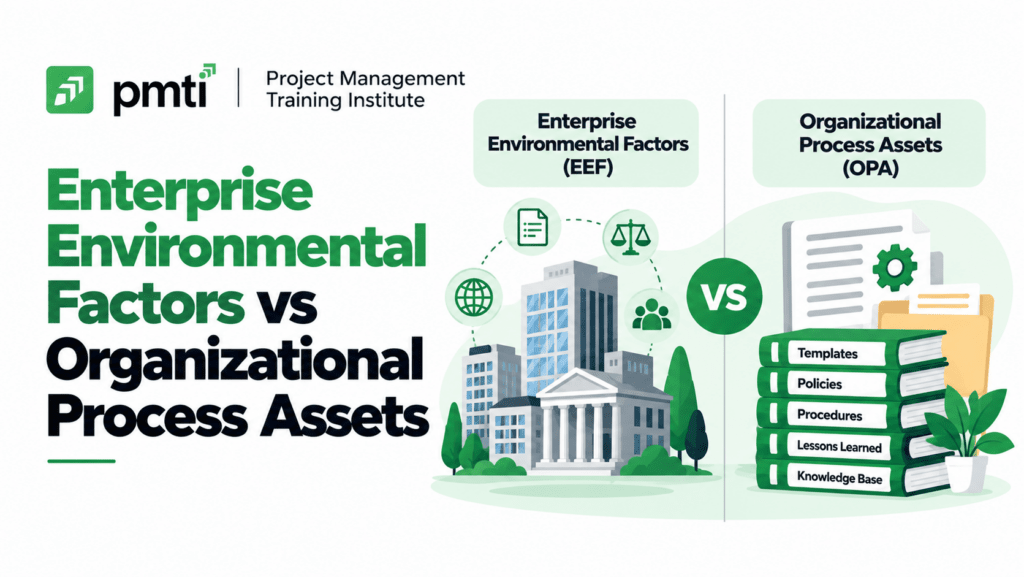
Enterprise Environmental Factors vs Organizational Process Assets
Enterprise environmental factors (EEFs) are conditions outside the project team’s control that influence, constrain, or direct a project. Organizational process assets (OPAs) are the plans, processes, policies, procedures, and knowledge bases that the performing organization owns and the team uses. PMBOK Guide 6th Edition defines EEFs in Section 2.2 and OPAs in Section 2.3.
The two terms appear as inputs across the 49 PMBOK processes. Confusing them costs marks on PMP situational questions and costs time on real projects. This article separates them by origin, control, categories, examples, and update rules.
What is the difference between enterprise environmental factors and organizational process assets?

EEFs are the environment a project operates inside, and the team cannot change them. OPAs are the organization’s own assets that the team uses and improves. EEFs constrain the project. OPAs equip the project.
The table below compares the 2 concepts across 9 attributes.
| Attribute | Enterprise Environmental Factors (EEF) | Organizational Process Assets (OPA) |
|---|---|---|
| Definition | Conditions not under the immediate control of the team | Plans, processes, policies, procedures, and knowledge bases of the performing organization |
| PMBOK 6th Edition section | 2.2 | 2.3 |
| Origin | Inside or outside the organization | Inside the organization only |
| Team control | None | Full use, with rights to update |
| Categories | 2: internal and external | 2: processes, policies, and procedures; organizational knowledge bases |
| Typical examples | Organizational culture, government regulations, market conditions, PMIS software | Templates, change control procedures, lessons learned, historical estimates |
| Effect on the project | Positive or negative | Positive or negative |
| Updated during the project | No | Yes, mainly the knowledge bases |
| Relationship to the team | The team operates within them | The team draws on them and adds to them |
What are enterprise environmental factors in project management?
Enterprise environmental factors are internal and external conditions that influence, constrain, or direct a project without being under the team’s immediate control. EEFs split into 2 groups: internal factors from inside the organization and external factors from the outside world.
PMBOK Guide 6th Edition describes EEFs as conditions that can raise or lower the odds of project success. A strict data privacy law is an external EEF that limits how a team stores customer records. A weak resource pool is an internal EEF that limits how fast a team staffs a schedule.
What are examples of internal EEFs?
Internal EEFs come from the performing organization. The 6 most cited internal factors are:
- Organizational culture, structure, and governance: vision, mission, reporting lines, and decision rights set how fast approvals move.
- Geographic distribution of facilities and resources: distributed sites decide whether teams meet in person or online.
- Infrastructure: buildings, equipment, and communication networks such as email and video conferencing.
- Information technology software: the project management information system (PMIS), scheduling tools, configuration management systems, and time-tracking portals.
- Resource availability and capability: headcount, skill levels, and contracted expertise.
- Organizational structure: functional, matrix, or projectized structures decide how much authority a project manager holds.
What are examples of external EEFs?
External EEFs come from outside the organization. The 6 most cited external factors are:
- Marketplace conditions: competitors, competitive intensity, and market growth rate.
- Social and cultural influences: team members’ religious holidays, local working customs, and language.
- Legal restrictions: data privacy laws, labor laws, and contract regulations.
- Government and industry standards: environmental, health and safety, fair trade, and technological standards.
- Financial conditions: economic climate, interest rates, and currency exchange rates.
- Physical environment: extreme weather, seismic zones, and site access.
What are organizational process assets?
Organizational process assets are the plans, processes, policies, procedures, and knowledge bases specific to the performing organization. OPAs fall into 2 categories: processes, policies, and procedures; and organizational knowledge bases. The project starts with them and adds to them.
OPAs hold the accumulated experience of every earlier project. A team that starts from a proven risk template and a historical estimate database skips weeks of rework. The project management office (PMO) usually owns and maintains these assets.
What are processes, policies, and procedures in OPAs?
This category covers the formal and informal rules a project follows. The team rarely changes them during the project. Examples include:
- Standard guidelines and criteria: tailoring rules for the organization’s standard processes.
- Templates: project plan, risk register, contract, and work breakdown structure (WBS) templates.
- Change control procedures: the steps for submitting, approving, and tracking a change request.
- Financial controls: time reporting, expenditure review, accounting codes, and standard contract provisions.
- Issue and defect management procedures: defect controls, identification, resolution, and action item tracking.
- Communication requirements: approved media, record retention policies, and security requirements.
- Project closure guidelines: final audits, evaluations, deliverable acceptance, and handover criteria.
- Preapproved supplier lists: vetted vendors with standard contractual agreements.
What are organizational knowledge bases in OPAs?
This category covers stored information. The team reads from it at the start and writes to it throughout the project. Examples include:
- Lessons learned repositories: records of what worked and failed on earlier projects.
- Historical information: past cost, schedule, and risk data used for estimating.
- Issue and defect databases: past problems with their resolutions.
- Configuration management knowledge bases: versions and baselines of standards, policies, and project documents.
- Process measurement databases: metrics collected from earlier work, such as defect counts.
- Financial databases: labor hours, incurred costs, budgets, and cost overruns.
- Project files: scope, cost, schedule, and risk documents from completed projects.
How do you tell an EEF from an OPA on the PMP exam?

Apply 1 test: ask whether the item is a condition the organization sets or a tool the organization built for projects. Conditions, systems, and anything external are EEFs. Processes, procedures, templates, and stored project data are OPAs.
Use these 6 rules to classify an item:
- Classify a process, procedure, or policy as an OPA.
- Classify a project artifact such as a plan, report, or file as an OPA.
- Classify structure, culture, facilities, systems, and staff capability as EEFs.
- Classify anything from outside the organization as an EEF, including market conditions and legal restrictions.
- Classify a system as an EEF and the repository of data inside it as an OPA.
- Classify an organization-developed template as an OPA and an industry-standard template as an EEF.
The pairs below trip up candidates most often. Each pair splits the container from the content.
| Item | EEF side | OPA side |
|---|---|---|
| Suppliers | Preapproved supplier relationships | Procurement policies and contract templates |
| Risk | Commercial risk databases | Organization-defined risk categories and the risk register |
| Work authorization | Work authorization system | Work authorization procedures |
| Information technology | IT systems and software | Issue and defect data stored in the systems |
| People | Human resources and staff skills | HR policies and hiring procedures |
| Configuration | Configuration management system | Configuration management knowledge base |
| Environmental topics | Environmental regulations | Environmental policies of the company |
The last row confirms the rule: a company’s own environmental policy is an OPA despite the word “environmental.”
Where do EEFs and OPAs appear in the 49 PMBOK processes?
EEFs and OPAs both appear as inputs across PMBOK Guide 6th Edition’s 49 processes, 5 process groups, and 10 knowledge areas. EEFs appear as an input in at least 40 of the 49 processes. OPAs appear in all 10 knowledge areas.
Four processes show the pattern:
- Develop Project Charter (Initiating): takes EEFs such as market conditions and OPAs such as templates and historical information.
- Develop Project Management Plan (Planning): takes EEFs such as governmental standards and OPAs such as the organization’s standard processes.
- Plan Risk Management (Planning): takes EEFs such as risk attitudes and OPAs such as risk categories and templates.
- Close Project or Phase (Closing): outputs the final report and OPA updates such as lessons learned and archived project files.
Planning processes use EEFs and OPAs most heavily. The pattern is consistent: EEFs set the limits, and OPAs supply the method. The project management process groups show where each input enters the work.
How do project teams update organizational process assets?
Project teams update OPAs throughout the project, not only at closure. The 5 update steps are capturing lessons learned, recording actual costs and durations, refining templates, archiving project files, and handing assets to the PMO for storage.
Follow these 5 steps:
- Capture lessons learned at every phase end and after major issues.
- Record actual cost, effort, and duration against the original estimates.
- Refine templates and checklists when the team finds a gap, such as a reporting format that missed a stakeholder need.
- Archive project files, baselines, and closure documents in the knowledge base.
- Transfer the updated assets to the PMO so later projects find them.
Every process in PMBOK Guide 6th Edition that lists OPA updates as an output follows this logic. EEFs do not follow it. A team cannot update a government regulation or a market condition.
How do PMBOK 7th and 8th Editions treat EEFs and OPAs?
PMBOK Guide 7th Edition (2021) groups EEFs and OPAs under the project environment, which has an internal and an external component. PMBOK Guide 8th Edition, released in late 2025, adds 5 Focus Areas containing 40 processes.
The 6th Edition remains the source for the formal EEF and OPA definitions. The 7th Edition describes the internal environment as organizational culture, structure, governance, facilities, resource availability, and process assets. It describes the external environment as market conditions, legal restrictions, social influences, and standards.
The 8th Edition uses 6 principles, 7 performance domains, and 5 Focus Areas: Initiating, Planning, Executing, Monitoring and Controlling, and Closing. The structure reintroduces process-level guidance that the 7th Edition dropped. Read the PMBOK Guide editions side by side to see which terms each edition keeps.
How do you identify EEFs on a real project?
Identify EEFs by scanning 6 PESTLE dimensions against the project scope. The 6 dimensions are political, economic, social, technological, legal, and environmental. Record every factor, rate its effect, and feed it into the project management plan.
Follow these 6 steps:
- List the internal factors: culture, structure, governance, tools, and resource pool.
- Scan the external environment with the 6 PESTLE dimensions.
- Interview the sponsor, PMO, and functional managers about unwritten rules.
- Rate each factor as a constraint, a risk, or an opportunity.
- Record the factors in the assumption log and risk register.
- Review the list at each phase gate, because market conditions and regulations change mid-project.
Run this scan before every planning kickoff. A missed regulation surfaces as rework after the baseline is approved, which makes the scan a planning-stage task. Plan the response to each factor inside the project management plan.
Why does the EEF vs OPA distinction matter for PMP candidates?
The distinction decides how a candidate reads situational questions. EEF scenarios test whether the manager adapts to fixed constraints. OPA scenarios test whether the manager reuses existing templates, lessons learned, and procedures. The 2026 PMP exam weights Business Environment at 26%.
The 2026 PMP exam content outline weights the 3 domains at People 33%, Process 41%, and Business Environment 26%. EEF thinking runs through the Business Environment domain: compliance, external change, and organizational context. OPA thinking runs through the Process domain: templates, procedures, and lessons learned.
Build this fluency with structured instruction. The PMP certification training from Project Management Training Institute covers EEF and OPA scenarios. PMTI has been a PMI Premier Authorized Training Partner since 2003.


