


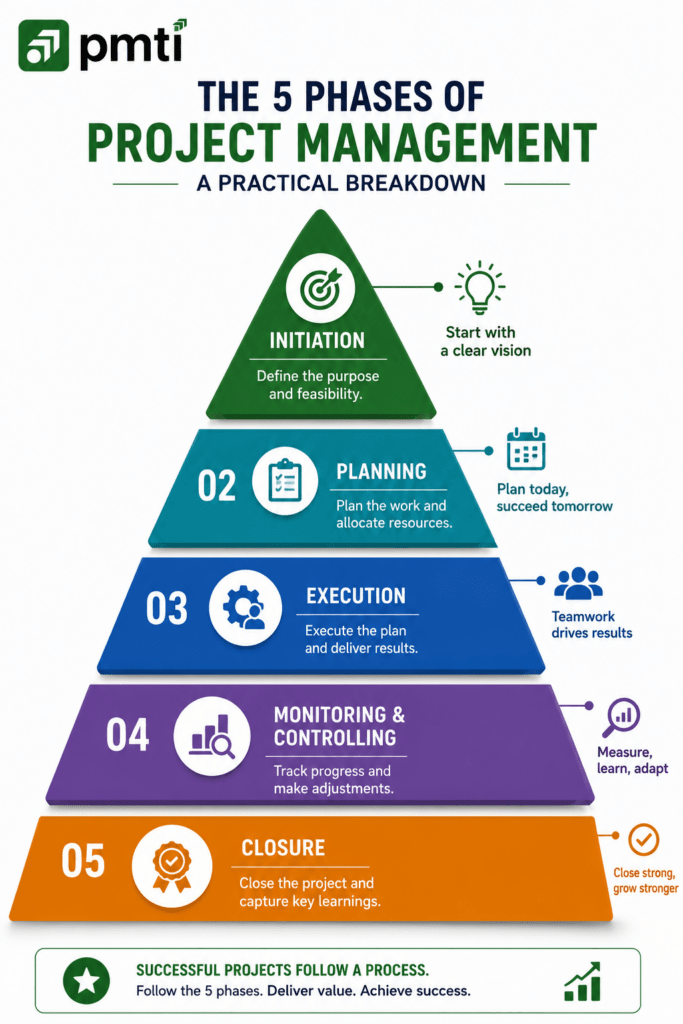

Regardless of industry or methodology, every project is broken down into five phases: Initiation, Planning, Execution, Monitoring and Controlling, and Closing. Every phase has both goals that when achieved indicate successful completion of the phase, and warning signs that indicate failure to achieve those goals when done in a rushed manner or skipped entirely. Being able to identify the positive goals that need to be achieved in order to progress a project and being able to identify warning signs and what constitutes rushing or skipping a phase completely are what helps turn the understanding of each phase into a workable framework.
What Are the 5 Phases of Project Management?
There are five phases within the framework of project management which are: Initiation, Planning, Execution, Monitoring and Controlling, and Closing. Each phase makes progress beyond passive work. Failing to complete any one phase results in a predictable failure in the later stages of the project.
Phase 1: Initiation

Initiation provides the reasoning behind the project, establishes project sponsorship, and sets objective criteria for determining the success of the project. Failing to complete this phase results in different stakeholders defining success differently, leading to teams completing different, uncoordinated work.
Deliverables:
- A project charter stating purpose, objectives, and the assigned sponsor.
- A stakeholder register identifying who’s involved and their level of influence.
- Success criteria written in specific, measurable terms.
- An early risk and feasibility assessment.
Common failure mode: Teams achieve zero progress when they complete no work on the project charter and begin working. Without a project charter in place, stakeholders begin measuring success against different, implicit standards. This gap is made apparent to the team when project deliverables are reviewed.
Phase 2: Planning
Goals set during initiation become a foundation for developing a plan and a roadmap to be executed by the team and trusted by the stakeholders. A planning phase that is too abbreviated yields a ‘fake’ schedule that was never going to be executed in the first place.
Deliverables:
- A work breakdown structure detailing tasks and dependencies.
- A budget and schedule built from realistic, team-validated inputs.
- A risk register with assigned owners for each identified risk.
- A communication plan defining cadence and stakeholder touchpoints.
- A responsibility matrix clarifying task ownership.
A common failure mode: Without work validation efforts, estimates are made in isolation. The result is a schedule and budget that look impressive to stakeholders, but quickly fail when executed.
Phase 3: Execution
Execution is the planning of activities and the delivery of planned outcomes with clear roles and visible tracking to monitor the execution process in the presence of controlled change. Execution may appear busy and active, but without visible tracking, scope may drift and blurred responsibilities may be performed unnoticed by stakeholders for a long period of time.
Deliverables:
- Deliverables reviewed regularly against the defined scope.
- Status updates that keep progress genuinely visible, not just reported.
- A central issue and action log with clear ownership.
- A controlled process for evaluating and approving scope changes.
Common failure mode: The team stays busy with multiple tasks, but stays unfocused. Role boundaries become blurred, small changes creep into the scope and unexpected issues get hidden in unproductive communication. The result is effort that does not deliver expected outcomes.
Phase 4: Monitoring and Controlling
Monitoring and Controlling is responsible for evaluating performance in relation to the baseline for cost, time, scope, and quality. If results do not meet the baseline, this phase is responsible for introducing corrective actions. Many view this phase as optional, but this is where small, insignificant risks can grow to become significant issues and betting deadlines.
Deliverables:
- Regular performance and variance reports measured against the baseline.
- A continuously updated risk register.
- A change request log tracking scope decisions.
- Stakeholder updates focused on decisions and action, not just status.
Common failure mode: Inadequate or irregular Monitoring and Controls result in work product being delivered after a deadline, instead of course corrections being applied in a timely manner.
Phase 5: Closing

This phase provides closure to the project. This provides confirmation that the work is complete and resources are released. Dr. Pritchett Skips this phase of closure and leaves the products of the project still incomplete. This creates unnecessary resource tie-ups and improper ownership of work products.
Deliverables:
- Final stakeholder acceptance and a closing report.
- Documented and shared lessons learned.
- Formally closed contracts.
- Archived project materials for future reference.
Common failure modes: After shipping the deliverable, the team moves to the next initiative without doing formal closure. Contracts remain open, resources are still used for the project, and the knowledge gained is lost.
Do Agile and Hybrid Projects Still Use These 5 Phases?
Agile and hybrid projects have compressed all five phases into each sprint or iteration compared to traditional projects. The initiation and planning phase of a project is compressed into the sprint planning stage. The daily execution and monitoring stage occurs during the iteration. The closing stage is performed during the sprint retrospective.
How Does This Appear on the PMP Exam?
Phase knoweldge is tested in the PMP exam including scenario questions where the exam taker is asked to identify which phase a given activity falls under. Another style of question asks the examinee to identify the impact of skipping a particular phase. Knowledge of the artifacts and/or failures associated with each phase is usually the quickest path to the correct answer in the range of possible answer choices.
Sample Question 1
A project team has been continuing work without a documented charter, sponsor, or agreed success criteria. What is the most likely outcome of this? A) The project will continue with little issue, as execution does not require initiation deliverables. B) Stakeholders will develop their own (and potentially conflicting) measures of success. C) The project will move at a consistently higher speed. D) Once execution starts, there will be a need for planning.
Sample Question 2
The project manager has built the project schedule and budget, exclusively, with no input from the work completing team members. What challenge will this likely create? A) This will have no impact, as project managers are in the best position to develop independent estimates. B) A schedule will be produced that appears logical and rational, but will be difficult to achieve. C) There will be a positive impact with improved team planning. D) There will be greater satisfaction among team members with reduced involvement.
Sample Question 3
A team has been reporting variance data on an inconsistent basis, and it is only after the deadline that a large slip in the schedule is uncovered. What phase was most likely neglected? A) Initiation B) Planning C) Monitoring and Controlling D) Closing
Sample Question 4
The final deliverable of a project has been shipped, no lessons learned session was conducted, and open contracts with vendors remain. What was neglected? A) Execution. B) Monitoring and Controlling. C) Closing. D) Initiation.
Answers: 1) B – Since the criteria that define success are missing, stakeholders will rely on their own, potentially conflicting standards.
- B — schedules constructed without the workforce’s input tend to appear unrealistic even though they may seem logical on the surface. 3) C — a slip in schedule that is uncovered only after the deadline has been missed reflects a completely neglected Monitoring and Controlling phase. 4) C — unconducted lessons-learned sessions and outstanding contracts are indicative of a skipped Closing phase.
Frequently Asked Questions
What Is the Most Commonly Skipped Phase in Project Management?
Closing is often the phase that gets skipped or rushed the most. When teams have their first opportunity to take a step back after delivering a project, they tend to move right on to the next project without providing a formal opportunity to capture lessons learned, close contracts, and formally close out resources. This results in an ongoing cost since the same mistakes tend to happen over and over again across different projects.
Can Phases Overlap?
Phases can and often do overlap in practice — planning for a later phase frequently begins while an earlier phase is still finishing, particularly on larger or more complex projects. The five phases represent a logical progression of activity, not necessarily five hard, sequential boundaries with no overlap.
Is Monitoring and Controlling One Phase or Two?
Monitoring and Controlling tend to be one unified phase in the PMI process groups. This is because monitoring (or tracking) and controlling (responding or adjusting) tend to be two aspects that occur simultaneously. While some organizations distinguish the two in their internal language, PMI does not.
How Long Does Each Phase Typically Take?
Phase duration varies enormously by project size and complexity, with no fixed proportion PMI mandates across Initiation, Planning, Execution, Monitoring and Controlling, and Closing. Execution typically consumes the largest share of overall project time on most projects, but the right balance depends entirely on the specific project’s risk profile and complexity.


