


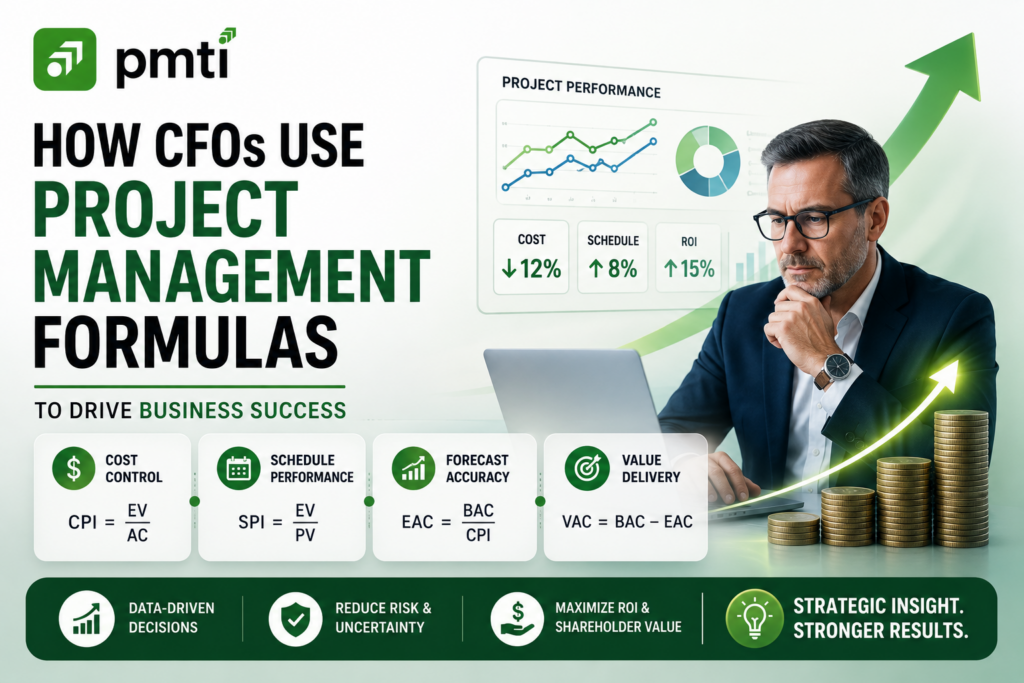
Why Do CFOs and Project Managers Rely on the Same Financial Formulas?
CFOs and project managers rely on the same financial formulas because both have the same underlying accountability to the business value at different levels of coverage — the CFO across the entire investment portfolio, and the project manager across a single project execution. If the project manager understands the CFO’s viewpoint on these formulas, that project manager communicates the status and updates the business in a language that is understandable, as opposed to using terminology that is understood only by project managers and requires a translation.
How Do CFOs and PMs Use Present Value (PV)?
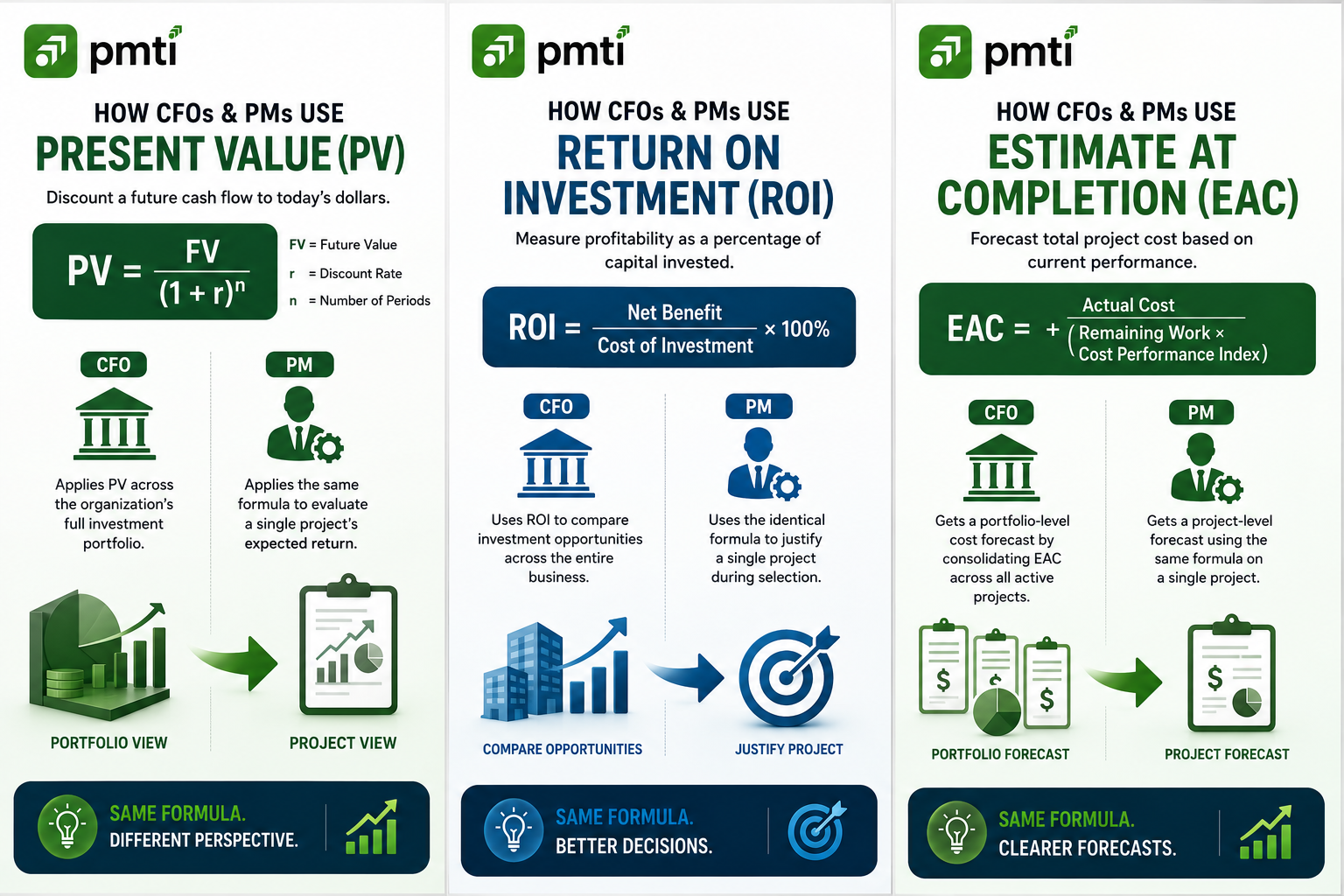
Both roles use Present Value to discount a future cash flow to today’s dollars, using the formula PV = FV / (1 + r)ⁿ, where FV is the future cash flow, r is the discount rate, and n is the number of periods. A CFO applies PV across the organization’s full investment portfolio; a project manager applies the same formula to evaluate a single project’s expected return.
How Do CFOs and PMs Use Return on Investment (ROI)?
Both roles use ROI to measure profitability as a percentage of capital invested, and both apply it to justify whether continued investment in a project or initiative is warranted. A CFO uses ROI to compare investment opportunities across the entire business; a project manager uses the identical formula to justify a single project during selection.
How Do CFOs and PMs Use Estimate at Completion (EAC)?
Both roles use EAC to forecast total project cost based on current performance, giving the CFO a portfolio-level cost forecast and the project manager a project-level one built from the same underlying formula. A CFO consolidating EAC figures across dozens of active projects is performing the same calculation a project manager performs on a single project, just aggregated to a higher level.
How Do CFOs and PMs Use Expected Monetary Value (EMV) to Quantify Risk?
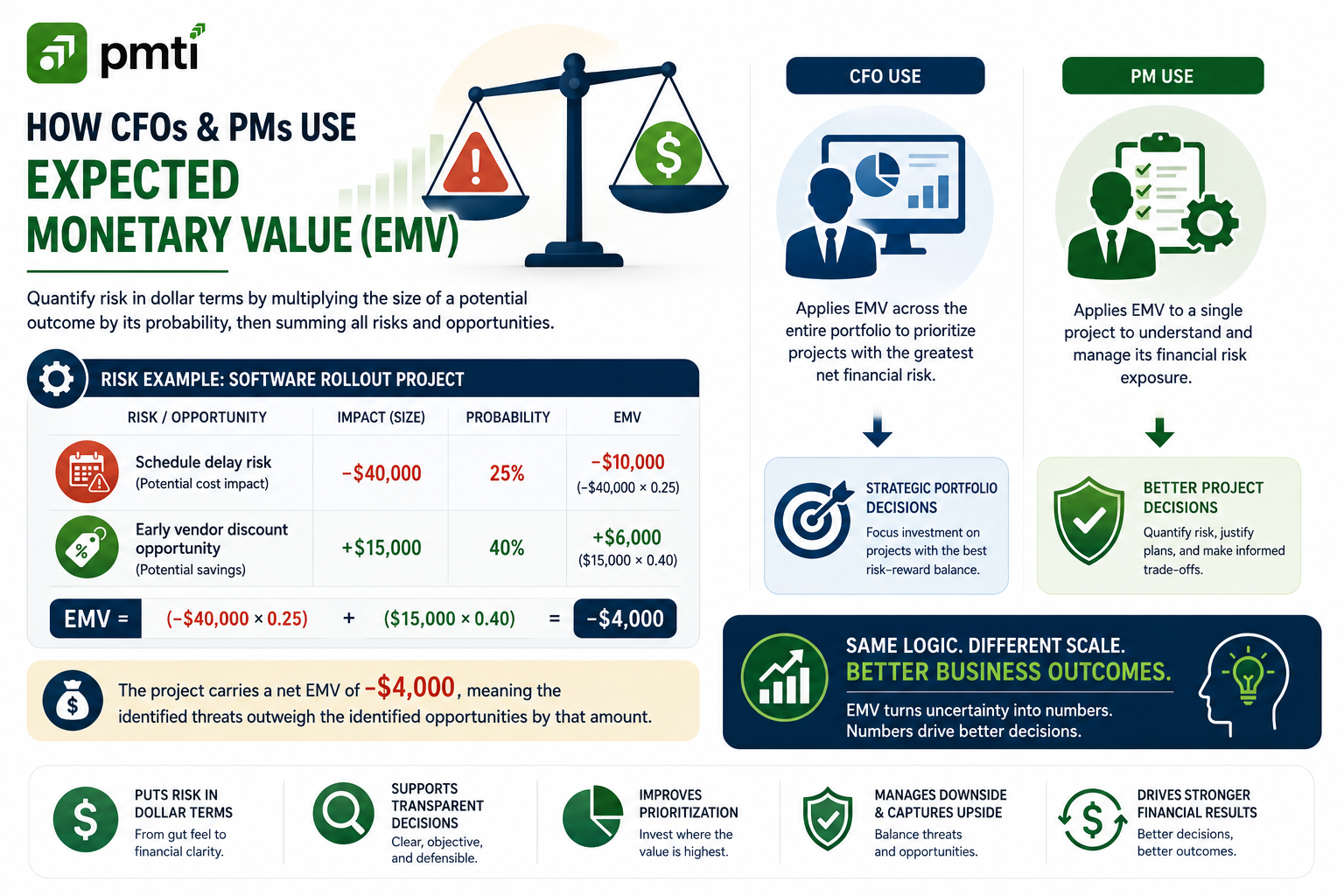
Risk can be assigned a dollar value by multiplying the size of a potential outcome by its probability of occurrence, and summing all the risks to a single net value. CFOs and project managers use expected monetary value (EMV) to quantify the exposure to risk in dollars, as opposed to stating a qualitative description of risk exposure, such as high or low.
A software rollout project identifies two risks:
- Schedule delay risk: a potential $40,000 cost impact with a 25% probability of occurring.
- Early vendor discount opportunity: a potential $15,000 savings with a 40% probability of occurring.
EMV = (−$40,000 × 0.25) + ($15,000 × 0.40) EMV = −$10,000 + $6,000 EMV = −$4,000
The project carries a net EMV of −$4,000, meaning the identified threats outweigh the identified opportunities by that amount. A CFO reviewing this figure across an entire portfolio applies the same logic to prioritize which projects carry the greatest net financial risk exposure.
Why Does This Shared Formula Set Matter for Business Alignment?
If project managers and CFOs employ the same financial formulas, benefits tracking becomes part of the project execution process thus automatically bridging the void that appears as disparate teams begin to log schedule, scope, and finance teams track ROI and cash flow respectively. Finance and project teams track their own metrics and as such, if a project manager commands a working knowledge of the formulas, they can enter a budget review and converse in financial terms with the CFO, where previously they may have had to employ a translator.
Key Takeaway for PMP Candidates
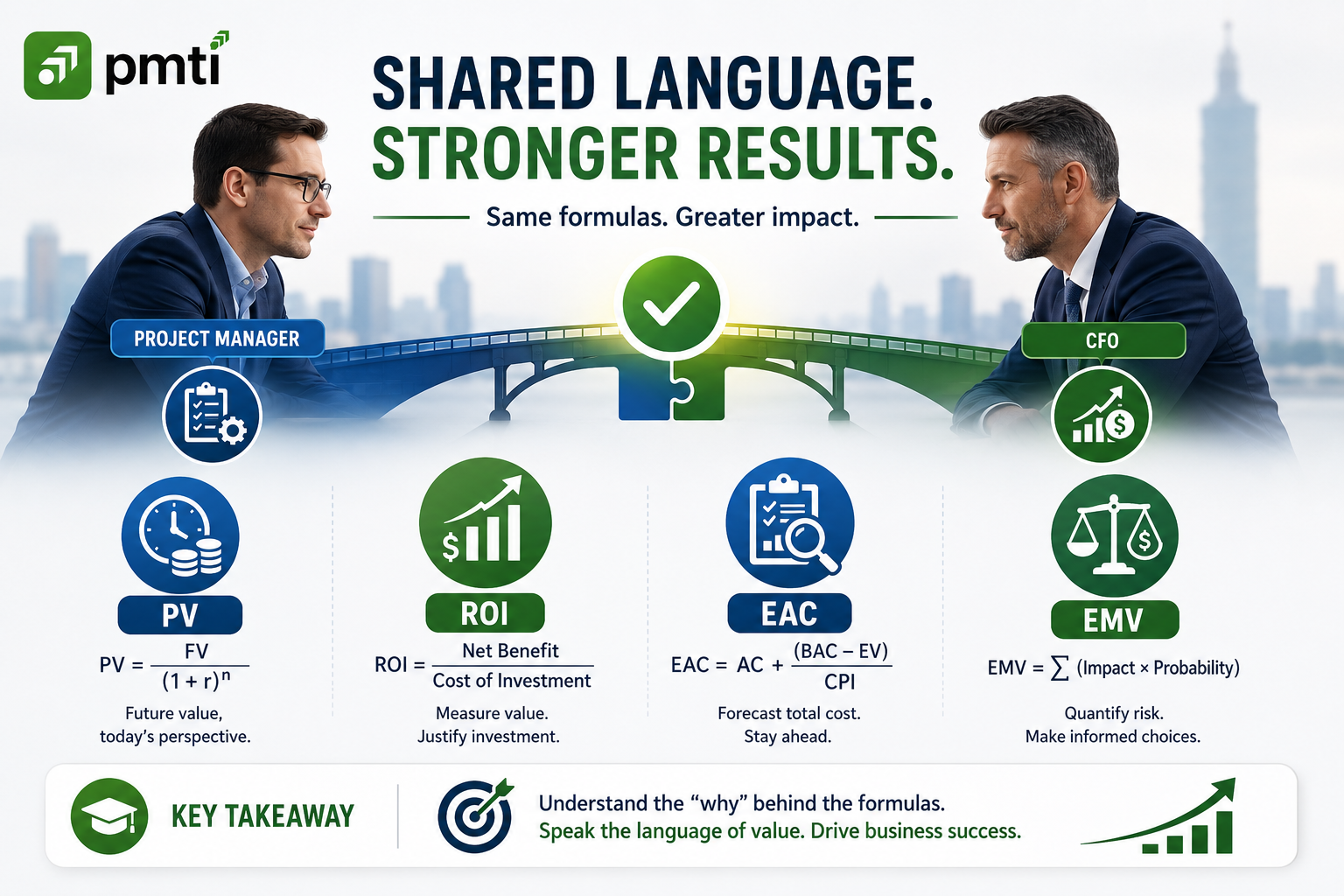
PMP candidates benefit from understanding these formulas as shared business language, not just as isolated calculations to memorize, since the exam’s Business Environment domain tests exactly this kind of project-to-organizational-value connection. Framing PV, ROI, EAC, and EMV in terms of what a CFO needs from them, not only what a project manager calculates, deepens the conceptual understanding the exam rewards.
Frequently Asked Questions
Do PMP Candidates Need to Know EMV for the Exam?
PMP aspirants must be conversant with EMV. Given that EMV is a PMI-endorsed risk assessment framework and it features in the exam’s risk management segment, a thorough treatment of the framework with sample questions is provided in the dedicated EMV Guide.
Is Present Value the Same Formula for CFOs and PMs?
Present Value uses the identical formula for both roles — PV = FV / (1 + r)ⁿ — with the only difference being the scale at which each role applies it, portfolio-wide for a CFO versus project-specific for a project manager. Neither role uses a modified or simplified version of the calculation.
Why Do Project Managers Need to Understand Financial Formulas Beyond Schedule and Scope?
Project managers who understand financial formulas communicate project status in terms that resonate directly with executive stakeholders, connecting day-to-day execution decisions to the business value those decisions are meant to produce. A project manager who can only report schedule and scope status leaves the financial story of the project for someone else to translate.
How Does Benefits Realization Connect Project Management and Finance Formulas?
Benefits realization tracks whether a project’s completed work actually delivers the financial value originally projected, directly connecting project-level formulas like ROI and EAC to the CFO’s portfolio-level view of return on investment. Without this connection, a project can report as “on schedule and on budget” while still failing to deliver the business value that justified funding it in the first place.