


PMP Exam Format: What You’re Actually Up Against

The PMP exam contains 180 total questions — 170 scored and 10 unscored pretest items — administered over 240 minutes through Pearson VUE. Effective July 9, 2026, PMI restructured three performance domains: People 33%, Process 41%, and Business Environment 26%.
The updated exam adds 10 minutes to the previous 230-minute format to accommodate 2 new question types: case study sets and graphic-based questions. Candidates sit the exam at a Pearson VUE test center or via online proctored delivery. Two optional 10-minute breaks occur at Question 60 and Question 120.
The 10 unscored pretest items are not labeled during the exam. Candidates cannot identify which questions are unscored, and PMI includes them for statistical calibration of future exam versions — they carry no scoring penalty and do not affect a candidate’s result. Every question receives full effort.
PMI supports 6 question formats on the updated exam:
- Multiple-choice single response — select the single best answer
- Multiple response — select all that apply; no partial credit
- Enhanced matching — drag-and-drop classification of concepts onto a visual or category
- Point and click hotspot — select a specific element on an image or diagram
- Pull-down / fill-in-the-blank — choose from a drop-down to complete a statement
- Case study sets — multiple questions tied to a single shared project scenario
Graphic-based questions appear across multiple formats — candidates interpret burndown charts, risk registers, responsibility assignment matrices, and project dashboards as the basis for their answers. Candidates who prepare exclusively with multiple-choice practice banks encounter these formats for the first time under real exam conditions.
Domain performance replaces a numeric passing score. PMI reports results as Above Target, Target, Below Target, or Needs Improvement for each of the 3 domains separately. No minimum answer count is published, and candidates cannot reverse-engineer a passing threshold.
What Makes the PMP Exam Hard: Situational Questions
The PMP exam’s primary difficulty is situational judgment across 170 scored questions where all 4 answer options describe reasonable actions. PMI tests prioritization, sequencing, and professional responsibility — not term definitions. Agile and hybrid scenarios account for approximately 60% of the updated exam content.
Roughly 80% or more of exam items present a real project scenario and ask what the project manager does next, first, or best. Candidates cannot eliminate answers for being obviously wrong — all four options frequently represent legitimate project management responses. PMI’s correct answer reflects the action that best aligns with the Examination Content Outline, PMI’s Code of Ethics, and the project manager’s defined governance role.
The Business Environment domain intensifies this challenge for candidates who prepared under the pre-2026 ECO. Business Environment rises from 8% to 26% of exam content — roughly 47 of 170 scored questions. This domain covers strategy alignment, benefits realization, organizational governance, AI in project management, sustainability, compliance, and change management. Candidates who allocated minimal study time to this domain under the old 8% weighting enter the updated exam with a significant coverage gap across more than a quarter of the scored questions.
Case study sets add a structural difficulty that isolated multiple-choice practice does not prepare candidates for. A shared project scenario presents across several linked questions in sequence — candidates must maintain situational context across all linked items rather than answering each question independently.
Earned Value Management (EVM) formula questions add a quantitative layer within the Process domain. CPI, SPI, EAC, and VAC calculations appear in scored questions. Missing the entire formula subset due to under-preparation affects a borderline result. Candidates can use PMP Formulas and Calculations to cover every EVM calculation tested on the exam.
PMP Pass Rate: How Many People Actually Pass?
PMI does not officially publish a first-attempt pass rate, but industry estimates — based on aggregated candidate reports and training provider data — consistently place the first-attempt pass rate at approximately 50 to 55%. That means roughly one in two candidates who sit the exam do not pass on their first attempt.
This figure is significant for several reasons. The PMP is not designed to be a straightforward credentialing exercise. PMI actively validates the exam’s difficulty through psychometric analysis to ensure it differentiates between project managers who are exam-ready and those who are not. The credential’s market value is directly tied to its rigor.
Retake policy: candidates who do not pass have three attempts within their one-year eligibility period. A failed attempt does not require re-application, but each retake requires a separate exam fee. After three failed attempts within the eligibility year, the candidate must wait one year before reapplying.
Candidates who invest in structured, instructor-led PMP boot camp training — rather than self-study alone — show measurably higher first-attempt pass rates. PMTI’s live instructor-led training is built specifically to close the gap between what candidates read in study materials and what PMI actually tests in situational scenarios.
PMP Difficulty Compared to Similar Certifications
Compared to its credentialing peers, the PMP sits at the higher end of the difficulty spectrum for project management and adjacent professional certifications.
CAPM (Certified Associate in Project Management): The CAPM is PMI’s entry-level credential. It covers the same PMBOK Guide framework but tests knowledge and comprehension rather than applied judgment. The CAPM exam contains 150 questions in 3 hours and does not require professional experience. Most candidates with focused study pass the CAPM significantly more easily than the PMP.
PMI-ACP (PMI Agile Certified Practitioner): The PMI-ACP is narrower in scope — focused exclusively on agile practices — but requires 21 contact hours of agile training and 12 months of agile project experience. Candidates who are already agile practitioners often find the PMI-ACP more accessible than the PMP, while those with a traditional project management background may find it conceptually harder than expected.
Six Sigma (Green Belt / Black Belt): Six Sigma certifications are heavily quantitative and process-focused. The analytical rigor of a Black Belt exam is comparable to the PMP in difficulty but draws on a different knowledge base (statistical methods, DMAIC, process control). The two credentials serve different roles and are not direct substitutes.
PRINCE2 Practitioner: Popular in the UK and Europe, PRINCE2 Practitioner is a scenario-based exam like the PMP but is tied to a proprietary methodology rather than the broad competency framework PMI tests. Candidates with PRINCE2 experience often find the PMP’s agile and hybrid weighting unfamiliar.
Among these, the PMP remains the most globally recognized and broadly tested project management credential. Its difficulty reflects its position as the professional standard in the field.
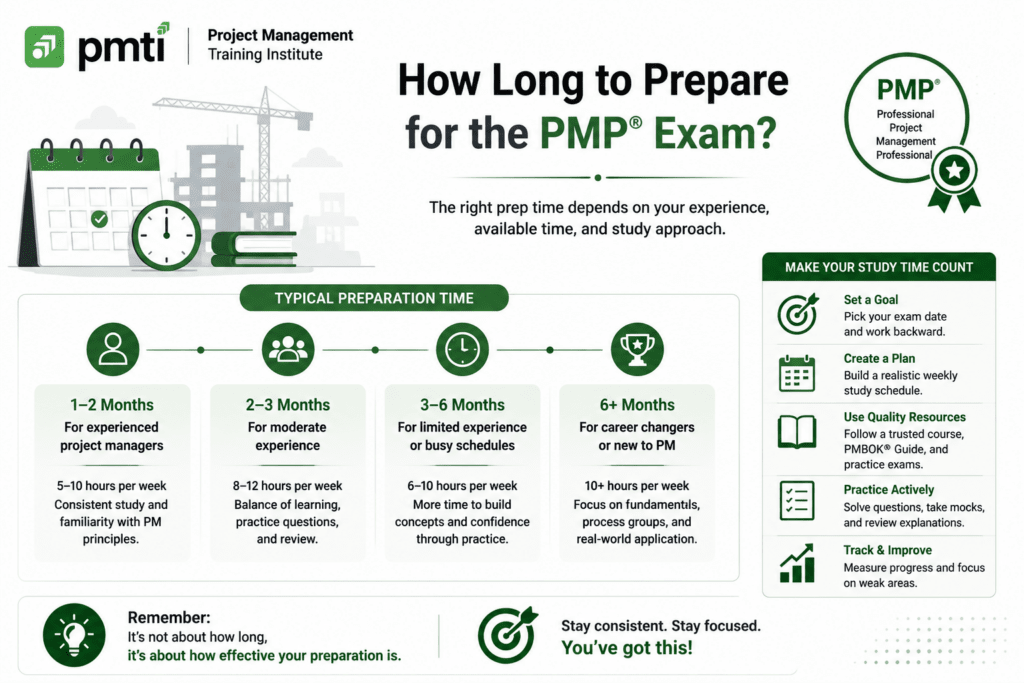
How Long Does It Take to Prepare for the PMP Exam?
Most candidates require 3 to 6 months of focused preparation to reach exam readiness, though this range varies significantly based on experience level and study method.
PMI’s eligibility requirements set a baseline: you must have completed 35 contact hours of formal project management education before you can sit the exam. This requirement does not automatically prepare you for the exam — it establishes the floor for eligibility. Beyond that, effective preparation typically involves:
- PMBOK Guide 8th Edition review (plus the ECO 2026)
- Agile and hybrid practice — Scrum, Kanban, SAFe basics
- Scenario-based question practice — 1,500 to 2,000+ practice questions is a common benchmark
- Review of weak domains — using domain-specific practice sets to identify gaps
Candidates with 10+ years of project management experience sometimes compress preparation to 6–8 weeks of intensive study. Candidates newer to formal PM methodologies typically need the full 4–6 month window.
PMTI’s PMP application guidance helps candidates align their experience documentation to PMI’s requirements before they begin the exam preparation phase, which removes a common source of delay.
The most efficient path for many candidates is a structured boot camp that covers the 35 contact hours requirement and exam preparation simultaneously. PMTI’s PMP certification training delivers both in a live, instructor-led format — meaning candidates complete their education requirement and their exam preparation in the same engagement rather than sequencing them separately.
- Key Facts Table
| Attribute | Detail |
| Number of questions | 180 |
| Time allowed | 230 minutes (plus two 10-minute breaks) |
| Delivery | Pearson VUE — test center or online proctored |
| Exam domains | People (42%), Process (50%), Business Environment (8%) |
| Agile/hybrid weighting | ~50% of questions |
| Question formats | Multiple choice, multiple response, matching, hotspot, fill-in-the-blank |
| Passing score published? | No — results reported as Above Target / Target / Below Target / Needs Improvement |
| Estimated first-attempt pass rate | ~50–55% |
| Retake attempts allowed | 3 within a 1-year eligibility period |
| Education requirement | 35 contact hours of formal PM education |
| Experience requirement | 60 months leading projects within last 10 years |
| Governing document | PMI Examination Content Outline (ECO) |
| Administered by | PMI (Project Management Institute) |
FAQ Section
Q1: What is the PMP exam pass rate? PMI does not publish an official pass rate. Based on aggregated candidate data and training provider reporting tracked over multiple years, the first-attempt pass rate is estimated at approximately 40 to 45%. Candidates who complete structured, instructor-led preparation programs consistently pass at rates above 70%.
Q2: How many questions are on the PMP exam, and how long is it? The PMP exam contains 180 total questions — 170 scored and 10 unscored pretest items — to be completed in 240 minutes. PMI embeds 2 optional 10-minute breaks at Question 60 and Question 120. Question formats include multiple-choice, multiple response, enhanced matching, point and click, pull-down, and case study sets. The unscored pretest items are not labeled and carry no scoring penalty.
Q3: Is the PMP exam harder than the CAPM? Yes, significantly. The CAPM tests knowledge and comprehension of the PMBOK framework across 150 questions with no professional experience required. The PMP tests applied situational judgment across 180 questions, requires 36 months (with a four-year degree) or 60 months (with a secondary diploma) of qualified project management experience, and weights Agile and hybrid delivery at approximately 60% of exam content.
Q4: What score do you need to pass the PMP exam? PMI does not publish a minimum passing score. Performance is reported by domain — People, Process, and Business Environment — across 4 levels: Above Target, Target, Below Target, and Needs Improvement. Scoring above 70% consistently on full-length practice exams is a widely used readiness benchmark, though PMI does not confirm this as the official threshold.
Q5: How long should I study for the PMP exam? Most candidates require 3 to 6 months of focused preparation. Candidates with 10 or more years of project management experience can be ready in 6 to 8 weeks of intensive study. Effective preparation includes ECO 2026 domain alignment, completing 900 to 1,000 scenario-based practice questions organized by domain weight, and building fluency across predictive, Agile, and hybrid methodologies.
Q6: Can I retake the PMP exam if I fail? Yes. PMI allows up to 3 exam attempts within a 1-year eligibility period. Each retake requires a separate exam fee. Candidates who exhaust all 3 attempts without passing wait 1 full year before submitting a new application. PMI provides domain-level performance feedback after each failed attempt to guide targeted preparation for retakes.
Q7: What makes PMP exam questions so difficult? The difficulty lies in PMI’s use of situational questions where all 4 answer choices describe reasonable project management actions, but only 1 reflects the correct prioritization, sequence, or professional judgment according to the Examination Content Outline and PMI’s Code of Ethics. Rote memorization of terms and definitions does not build this reasoning capacity — scenario-based practice across all 6 question formats is what closes the gap.
Q8: Does the PMP exam include math or formula questions? Yes. Earned Value Management calculations — Schedule Performance Index (SPI), Cost Performance Index (CPI), Estimate at Completion (EAC), and Variance at Completion (VAC) — appear within the Process domain. Formula questions represent a smaller portion of the exam, but missing them entirely affects a borderline result.
Q9: Should I take the PMP exam before or after July 9, 2026? Candidates who have completed preparation aligned to the pre-2026 ECO and can schedule before July 8, 2026 sit for the current exam format. Candidates starting preparation now study the updated ECO 2026 from the outset — Business Environment at 26%, Agile and hybrid at 60%, and all 6 updated question formats. The PMP certificate is identical regardless of which version a candidate passes. The version is not specified on the certificate.
Q10: What are the PMP eligibility requirements under the 2026 update? Two eligibility pathways apply. Candidates with a four-year degree need 36 months of project leadership experience within the last 10 years. Candidates with a secondary diploma need 60 months within the last 10 years. Both pathways require 35 contact hours of formal project management education or an active CAPM certification. The qualifying experience window expanded from 8 years to 10 years effective July 9, 2026. Full details are available on the PMP Certification Requirements page.
Q11: How much does the PMP exam cost? Through July 2026: PMI members pay $405 and non-members pay $555. Starting August 2026, fees increase — PMI members pay $445 and non-members pay $675. Candidates who sit for the updated exam in July lock in the current fee rate before the August increase.
PMTI’s PMP Certification Training prepares candidates for the ECO 2026 exam through live, instructor-led sessions that cover the revised domain weightings, all 6 question formats, and the 35 contact hours required for eligibility — in a single engagement


