


What Is Iteration-Based Agile?

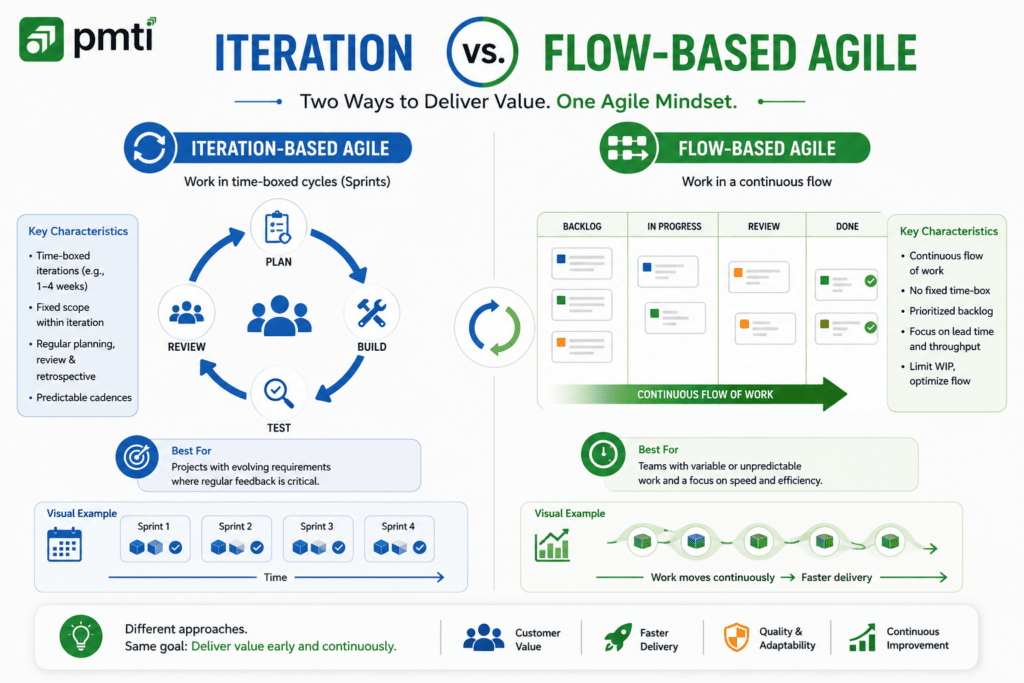
Iteration-based Agile breaks work into fixed iterations (typically 1 or 2 weeks) and requires teams to align on goals for the iteration and to produce a potential review increment at the end of the iteration. The Scrum methodology is the most popular iteration-based methodology, and feedback is aligned at sprint boundaries during sprint review and retrospective.
What Is Flow-Based Agile?
Rather than fixed iterations, work is pulled in a flow-based model based on capacity. This limits work in progress and aligns delivery of work increments as each item on the work stream is completed, as opposed to a batch-model of delivery. The primary methodology for this model is Kanban.
Flow-based agile does still use feedback loops — the difference from iteration-based agile is timing, not presence. Feedback arrives continuously and ad hoc as work completes, rather than concentrated at fixed sprint boundaries.
What Are the Key Differences Between Iteration-Based and Flow-Based Agile?
Iteration-based and flow-based agile differ primarily in time structure, feedback timing, and planning cadence, though both share the same underlying Agile values of collaboration and responsiveness to change.
- Time structure: iteration-based uses fixed-length sprints; flow-based uses continuous, capacity-driven work.
- Feedback timing: iteration-based concentrates feedback at sprint boundaries; flow-based delivers feedback continuously as work completes.
- Planning cadence: iteration-based commits to a batch of work per sprint; flow-based pulls new work item-by-item as capacity allows.
- Best fit: iteration-based suits projects with a fixed deadline and defined scope; flow-based suits projects with flexible timing and variable priorities.
When Should You Use Iteration-Based Agile?
Type of project best suited to iteration based agile is one with a deadline that is defined and vision that is clear where delivery of work in boxes of time is preferred over maintaining continuous flexibility.
- Defined product vision with clear, scopeable goals per iteration.
- Specific deadline or milestone, such as a scheduled product launch or demo.
- Regular feedback checkpoints needed to validate direction before continuing further work.
When Should You Use Flow-Based Agile?
Projects that do not have defined deadlines and schedules best fit flow-based agile. Teams can prioritize based on capacity and respond to demands and value shifts without waiting for the next sprint.
- Flexible or ongoing timeline, without a single hard deadline driving the schedule.
- Frequent priority shifts, where waiting for the next sprint to reprioritize would slow the team down.
- Cross-team or support-style work, such as maintenance, operations, or ongoing feature requests.
Can Iteration-Based and Flow-Based Agile Be Combined?
Hybrid methods that use combinations of iteration based and flow based agile are commonly referred to as Scrumban. Scrumban combines Scrums defined roles and ceremonies with Kanban’s continuous flow and WIP limits. Combining the two methods provide more flexibility and is most useful when a team wants the structure of Scrum but does not want the rigid cruise boundaries of scrum sprints when the work to be completed is unpredictable. An example might be a product team delivering work that includes planned feature work and unpredictable support work.
How Does This Topic Appear on the PMP and PMI-ACP Exams?
Both exams determine a candidate’s understanding of iteration-based and flow-based agile through evaluation of case-based questions that describe characteristics of a project (goal, deadline, work, etc.) and how the candidate selects the appropriate agile method. It is more important to understand situational analysis (fixed deadline vs flexible, batch vs continuous pull) than to understand the models individually.
Sample Question 1
A team is building a product with a fixed launch date and a clearly defined feature set. Which agile approach is most appropriate? A) Flow-based agile B) Iteration-based agile C) Neither approach applies to defined-scope projects D) Waterfall is required for fixed deadlines
Sample Question 2
A support team handles an unpredictable stream of incoming requests with no fixed deadline and highly variable daily priorities. Which agile approach fits best? A) Iteration-based agile B) Flow-based agile C) A six-month fixed release cycle D) No agile approach is suitable for support work
Sample Question 3
A team wants Scrum’s defined roles and ceremonies but finds fixed two-week sprint boundaries too rigid for their unpredictable workflow. What should they consider? A) Abandoning Agile entirely B) A Scrumban hybrid combining Scrum structure with Kanban’s continuous flow C) Extending sprints to six months D) Removing all roles and ceremonies
Sample Question 4
In flow-based agile, when does the team primarily receive customer feedback? A) Only at the end of the entire project B) Continuously and ad hoc, as each work item completes C) Only during a fixed sprint review ceremony D) Flow-based agile does not incorporate feedback
Answers: 1) B — a fixed deadline and defined scope favor iteration-based agile’s predictable, time-boxed delivery. 2) B — unpredictable, continuous work with no fixed deadline is the classic use case for flow-based agile. 3) B — Scrumban directly addresses this need, blending Scrum’s structure with Kanban’s flexibility. 4) B — flow-based agile delivers feedback continuously as work completes, not only at fixed boundaries.
Frequently Asked Questions
Is Flow-Based Agile the Same as Kanban?
Flow-based agile and Kanban are closely linked — Kanban is the most common practical implementation of the flow-based model, using WIP limits and visual boards to manage continuous work. Other flow-based approaches exist, but Kanban is by far the most widely adopted.
Does Flow-Based Agile Have Deadlines?
Flow-based agile can accommodate deadlines, but it is not organized around them the way iteration-based agile is — the team manages flow and capacity continuously rather than committing to a fixed batch of work per time-boxed sprint. A team can still work toward a target date within a flow-based model; the structure simply doesn’t require it.
Which Approach Is Easier for New Agile Teams to Adopt?
Iteration-based agile is generally easier for teams new to Agile, since its fixed structure, defined roles, and regular ceremonies provide more built-in guidance than flow-based agile’s more fluid, self-managed model. Teams often start with Scrum’s iteration-based structure before transitioning to a flow-based or hybrid approach as they mature.
What Is Scrumban?
Scrumban is a hybrid Agile approach that combines Scrum’s defined roles and ceremonies with Kanban’s continuous flow and WIP limits, giving teams structure without the rigidity of fixed sprint boundaries. It suits teams that want Scrum’s discipline but face a workflow too unpredictable for strict sprint commitments.


