


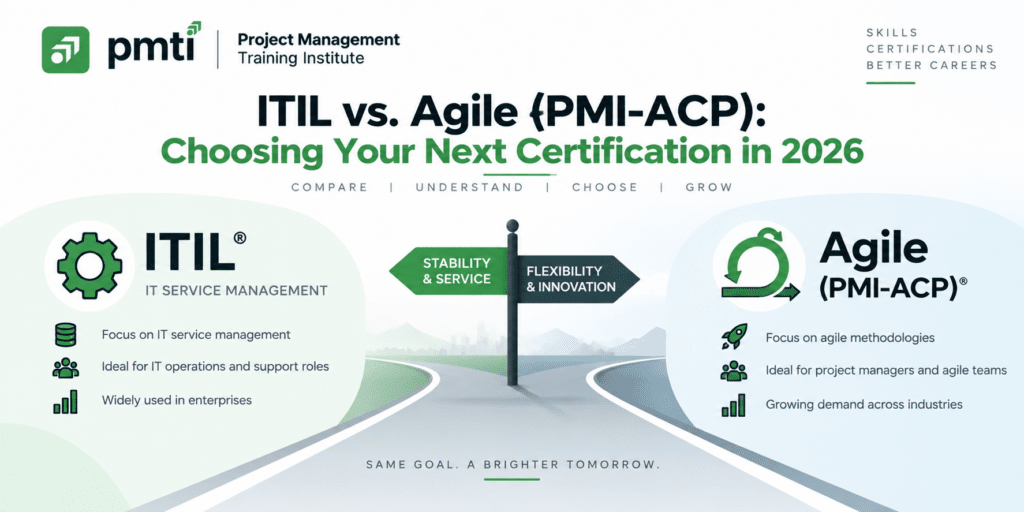
ITIL vs. Agile: Choosing Your Next Certification
ITIL and PMI-ACP serve different professional tracks: ITIL certifies IT service management skills, while PMI-ACP certifies agile project delivery skills. Project managers choose ITIL to advance in IT service operations and infrastructure roles, and choose PMI-ACP to lead agile teams across software, product, and cross-functional delivery work. Many professionals pursue both certifications as complementary credentials after earning a PMP.
What Is the Difference Between ITIL and Agile Certification?
ITIL certifies IT service management practices; PMI-ACP certifies agile project delivery practices across multiple frameworks. ITIL structures how organizations design, deliver, and improve IT services. PMI-ACP validates a practitioner’s ability to apply Scrum, Kanban, Lean, and Extreme Programming across any industry, not only IT.
| Attribute | ITIL | PMI-ACP |
| Governing body | PeopleCert (owner of the ITIL trademark) | Project Management Institute (PMI) |
| Current framework version | ITIL (Version 5), launched February 2026 | Enterprise Agility exam content outline |
| Primary focus | IT service management and digital product delivery | Cross-framework agile project delivery |
| Industry scope | Primarily IT operations and digital services | Any industry using agile delivery |
What Are the ITIL Certification Levels in 2026?

ITIL (Version 5), released by PeopleCert on February 12, 2026, replaced ITIL 4 as the current certification scheme and introduced a product-centric lifecycle model with a dedicated AI governance qualification. Existing ITIL 4 certifications remain valid, and PeopleCert accepts ITIL 4 credentials toward ITIL 5 renewal, but new candidates now enter the framework through the updated scheme rather than the older ITIL 4 structure.
ITIL (Version 5) progresses through 4 levels:
- Foundation — the entry-level qualification covering ITIL’s core concepts, with no prerequisites.
- Practice Manager — builds practical skills in managing specific ITIL practices such as Incident Management and Change Enablement.
- Managing Professional / Strategic Leader — advanced tracks focused on running IT-enabled services or shaping digital and IT business strategy.
- Master — the highest designation, awarded based on demonstrated real-world experience rather than a standalone exam.
What Are the PMI-ACP Eligibility Requirements?
PMI-ACP eligibility requires a secondary degree, agile project experience, and 21 contact hours of formal agile training from an authorized training provider. Candidates who hold an active PMP or PgMP certification satisfy the general project experience requirement automatically. Full eligibility details, including current agile-experience thresholds, are confirmed on PMTI’s PMI-ACP certification requirements page.
What Are the Advantages of Each Certification?
ITIL builds IT service management credibility; PMI-ACP builds agile leadership credibility. Each certification delivers distinct career value depending on the role.
ITIL certification delivers 3 core advantages:
- Structures IT service delivery around a documented framework organizations recognize globally.
- Aligns IT services with business goals, improving how technical teams communicate value to leadership.
- Signals ITSM expertise to employers hiring for service desk, infrastructure, or IT operations leadership roles.
PMI-ACP certification delivers 3 core advantages:
- Validates cross-framework agile competence across Scrum, Kanban, Lean, and Extreme Programming, rather than a single methodology.
- Prepares practitioners to lead agile teams through iterative delivery, stakeholder engagement, and continuous improvement.
- Signals enterprise agility skill to employers scaling agile practices beyond a single software team.
Which Certification Should You Choose: ITIL or PMI-ACP?
Choose ITIL if your role centers on IT service delivery, infrastructure, or digital product operations; choose PMI-ACP if your role centers on leading agile project teams across any industry. 3 scenarios clarify the decision:
- IT service management professionals managing service desks, incident response, or IT infrastructure fit the ITIL path.
- Project managers leading agile software or product teams fit the PMI-ACP path, especially if scaling agile practices across departments.
- Hybrid professionals working across IT strategy and agile delivery benefit from pursuing both certifications sequentially, since ITIL’s service management structure and PMI-ACP’s delivery practices address different parts of the same organization.
How Do These Certifications Complement a PMP Certification?
A PMP certification establishes a baseline of project management skills that both ITIL and PMI-ACP build on directly. PMP holders already meet part of the PMI-ACP experience requirement, and PMP-trained tools like scope, schedule, and risk management transfer directly into ITIL-based IT projects even though ITIL was not originally built as a project management framework.
Project managers building an agile specialization after PMP typically pursue PMI-ACP certification training, which covers the cross-framework agile knowledge required for the exam alongside the same agile project management foundations used throughout this comparison.


