


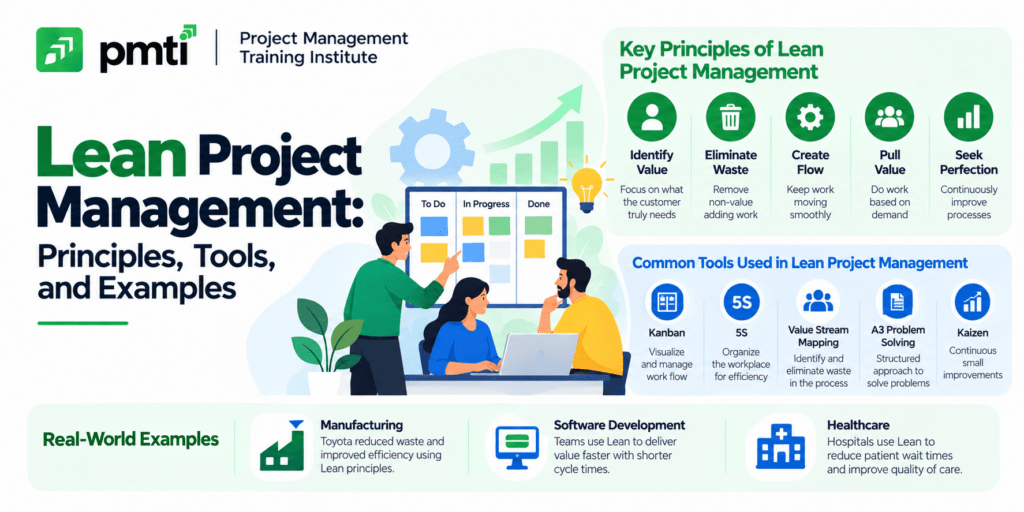
Lean Project Management: Principles, Tools, and Examples
Lean project management applies lean thinking to projects: define what the customer values, remove every step that adds no value, and improve continuously. It rests on 5 principles, targets 8 types of waste, and uses tools such as value stream mapping, kanban boards, 5S, and kaizen.
Lean grew out of the Toyota Production System in Japan. Project teams in construction, software, healthcare, and operations now use it to cut delays, rework, and idle time. This article defines lean project management, explains the 5 principles and 8 wastes, compares 9 tools, walks through 7 implementation steps, and gives 4 examples.
What is lean project management?

Lean project management is a methodology that maximizes customer value and minimizes waste across a project’s life cycle. It treats every activity as either value-adding or waste. The goal is smooth, pull-driven flow of work and continuous improvement.
James Womack and Daniel Jones proposed lean thinking as a 5-step process in 1996. In 2007 they condensed the steps into 3 ideas: purpose, process, and people. The approach shifts a project manager’s question from “is the task done?” to “does the task serve the customer?”
Lean differs from predictive and adaptive approaches by its target. Waterfall controls scope. Agile responds to change. Lean removes waste.
What are the 5 principles of lean project management?
The 5 lean principles are define value, map the value stream, create flow, establish pull, and pursue perfection. Each principle builds on the previous one, and the fifth loops back to the first as a continuous improvement cycle.
| # | Principle | Meaning | How a project applies it |
|---|---|---|---|
| 1 | Define value | Specify what the end customer values | Write the project brief around customer needs such as time to market and price |
| 2 | Map the value stream | Chart every step from request to delivery | Draw the full delivery process and mark each step as value-adding or waste |
| 3 | Create flow | Sequence value-adding steps without interruption | Form cross-functional teams and remove hand-off delays |
| 4 | Establish pull | Start work only when downstream demand exists | Release tasks as capacity frees up and avoid building ahead |
| 5 | Pursue perfection | Repeat the cycle until waste is gone | Run retrospectives and kaizen events after each delivery |
What are the 8 wastes in lean project management?
Lean names 8 wastes: defects, overproduction, waiting, non-utilized talent, transportation, inventory, motion, and extra-processing. The DOWNTIME acronym lists them. Each waste appears in projects as rework, idle queues, unused skills, or unneeded work.
| Waste (DOWNTIME) | Project example |
|---|---|
| Defects | Rework from missed requirements or failed tests |
| Overproduction | Features or reports nobody requested |
| Waiting | Tasks queued for approvals, reviews, or handoffs |
| Non-utilized talent | Experts excluded from planning decisions |
| Transportation | Files and information passed through extra hands |
| Inventory | Large backlogs and half-finished work in progress |
| Motion | Context switching and searching for information |
| Extra-processing | Duplicate approvals and over-engineered deliverables |
Lean also uses 3 Japanese terms for inefficiency: muda (waste), mura (unevenness), and muri (overburden). A project team removes muda by cutting steps, mura by leveling workload, and muri by protecting team capacity.
What are the main lean project management tools?
The main lean tools are value stream mapping, kanban boards, 5S, kaizen, poka-yoke, heijunka, just-in-time delivery, PDCA, and root cause analysis. Each tool targets 1 waste or 1 flow problem.
| Tool | What it does | Project use |
|---|---|---|
| Value stream mapping | Separates value-added from non-value-added steps | Find the slowest handoffs in delivery |
| Kanban board | Shows work in columns and limits work in progress | Control queues and expose bottlenecks |
| 5S | Sort, Set in order, Shine, Standardize, Sustain | Organize workspaces, files, and repositories |
| Kaizen | Drives small, continuous improvements from every level | Run a weekly improvement habit |
| Poka-yoke | Error-proofs a step with a mechanism or checklist | Prevent defects with templates and gates |
| Heijunka | Levels workload to avoid peaks and valleys | Spread work evenly across sprints or weeks |
| Just-in-time | Delivers work when demand arrives | Start tasks at the last responsible moment |
| PDCA (Plan-Do-Check-Act) | Cycles through test and adjust steps | Validate each process change |
| Root cause analysis | Traces a defect to its origin | Fix the source of repeated rework |
How do you apply lean project management?
Apply lean in 7 steps: define customer value, map the value stream, identify waste, redesign for flow, introduce pull, limit work in progress, and review every cycle. Start with 1 process and expand after the first measured gain.
Follow these 7 steps:
- Define customer value in 1 sentence per deliverable.
- Map the value stream from request to delivery on a single page.
- Mark each step as value-adding, necessary non-value-adding, or waste.
- Redesign the sequence so value-adding steps follow each other without queues.
- Introduce pull: release a task only when the next stage has capacity.
- Limit work in progress on a kanban board, for example 3 active items per person.
- Review results after every cycle, then repeat from step 1.
Measure the change with 3 numbers: lead time (request to delivery), cycle time (work start to finish), and rework rate. Track them before and after the first redesign.
What are examples of lean project management?
Four examples show lean in practice: the Toyota Production System in manufacturing, lean construction on building sites, lean software development, and kanban in support operations. Each applies the same 5 principles to a different type of work.
- Toyota Production System (manufacturing): the origin of lean. Toyota organized production around pull and continuous improvement so that each station builds only what the next station needs.
- Lean construction: crews plan weekly work with the people who perform it and release tasks only when materials, information, and prerequisite work are ready. This reduces waiting between trades.
- Lean software development: Mary and Tom Poppendieck adapted lean into 7 principles: eliminate waste, build quality in, create knowledge, defer commitment, deliver fast, respect people, and optimize the whole.
- Kanban in IT support: a service desk limits tickets in progress per engineer. Stalled tickets become visible, and the team removes the blocker before accepting new work.
An illustrative scenario shows the mechanics. A marketing team maps its campaign process and finds 4 approval handoffs. It merges 2 approvals, adds a work-in-progress limit of 3, and reviews the board weekly. The team removes waiting waste without adding headcount.
What is the difference between lean, agile, and Six Sigma?
Lean removes waste and improves flow. Agile adapts to change through short iterations. Six Sigma reduces process variation using the 5-phase DMAIC cycle. Lean Six Sigma combines lean’s waste removal with Six Sigma’s statistical rigor.
| Attribute | Lean | Agile | Six Sigma |
|---|---|---|---|
| Core goal | Eliminate waste, maximize value | Respond to change, deliver increments | Reduce defects and variation |
| Origin | Toyota Production System | Agile Manifesto, 2001 | Motorola |
| Key unit | Value stream | Iteration or Sprint | Process |
| Signature tools | Value stream mapping, kanban, 5S | Backlog, Scrum events | DMAIC, control charts |
| Typical setting | Manufacturing, services, construction | Software, product development | Quality-critical operations |
Lean and agile combine well. Agile supplies the iteration cadence and lean supplies the waste lens. Read how the models compare in the agile project management guide.
What are the pros and cons of lean project management?
Lean has 5 pros: lower waste, shorter lead times, higher quality, better team engagement, and lower cost. Lean has 4 cons: a slow cultural shift, dependence on supplier alignment, weak fit for highly creative work, and the need for discipline to sustain gains.
Pros:
- Lower waste: each removed step frees time and budget.
- Shorter lead time: pull and flow cut waiting between stages.
- Higher quality: poka-yoke and root cause analysis prevent repeat defects.
- Better engagement: kaizen puts improvement in the hands of the people doing the work.
- Lower cost: less rework and idle inventory reduce spend.
Cons:
- Slow cultural shift: teams accustomed to push-based planning resist pull.
- Supplier dependence: vendors outside lean practices slow waste reduction.
- Weak fit for pure R&D: exploratory work has no stable stream to map.
- Discipline requirement: gains fade without regular kaizen reviews.
How do you learn lean project management?
Learn lean through structured training that covers value stream mapping, waste analysis, and DMAIC. Lean Six Sigma belt programs teach these tools with certification at 4 levels: white, yellow, green, and black.
Lean skills transfer across industries because every process carries waste. Project managers pair them with a framework from the broader family of project management methodologies to choose the right approach per project. Build certified skills with Lean Six Sigma training from Project Management Training Institute.

