


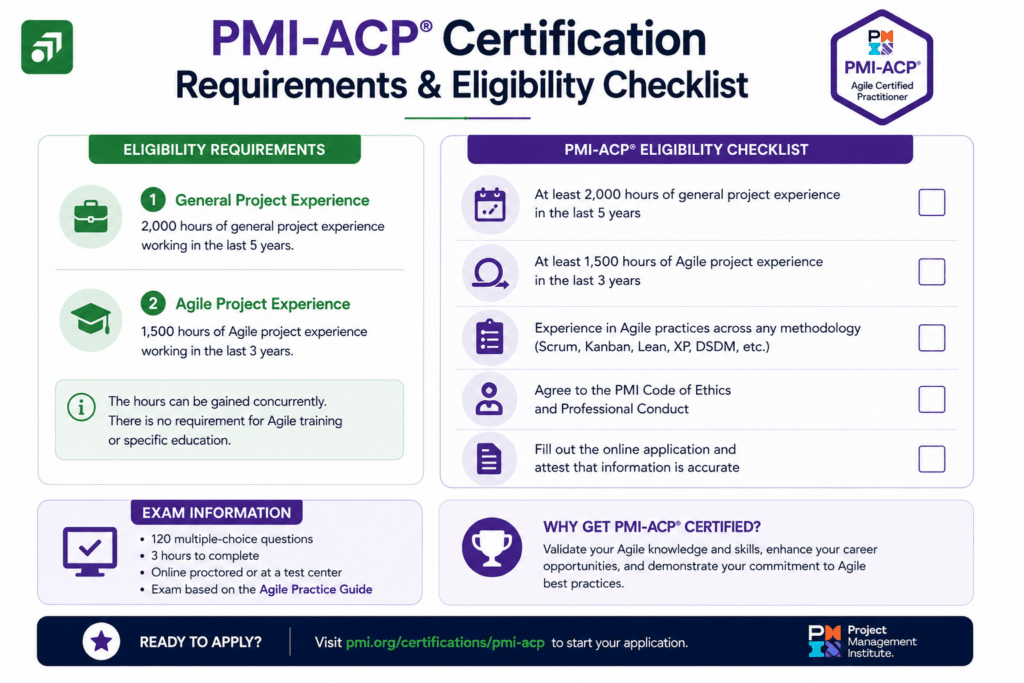
What Are the Three PMI-ACP Requirement Categories?

PMI-ACP eligibility rests on education, formal agile training, and documented agile experience. Every path requires a secondary diploma and 21 contact hours of agile training; only the experience requirement changes based on your background.
| Category | Fixed Requirement |
| Education | Secondary diploma (high school, GED, or global equivalent) — no degree required |
| Training | 21 contact hours of formal agile training from a PMI-recognized provider |
| Experience | Varies by path — see below |
Which of the Four PMI-ACP Eligibility Paths Applies to You?
PMI offers four eligibility paths, and most candidates qualify for more than one. An active PMP certification satisfies the experience requirement automatically; everyone else needs 1 to 2 years of documented agile experience depending on education and prior certifications.
Match your situation against these four paths:
- You hold an active PMP certification — Your agile and hybrid project experience carries into the application automatically. You only need to complete the 21 training hours.
- You hold a third-party agile certification (CSM, PSM, or similar) for 1+ year — You need 1 year of agile experience instead of 2, since the certification credits 12 months toward the requirement.
- You have a bachelor’s degree from a GAC-accredited program — You need 1 year of agile experience instead of 2.
- None of the above apply — You need the standard path: a secondary diploma plus 2 years of agile experience within the past 5 years.
Does Your Job Title Have to Say “Project Manager” to Qualify?
No. PMI evaluates day-to-day responsibilities, not job titles. A business analyst, product owner, or team lead who worked on agile teams qualifies the same as someone with “project manager” in their title — and having “project manager” in your title does not guarantee eligibility either.
This is the point most candidates get wrong before they even check the requirements: they self-disqualify because their title doesn’t match what they assume PMI wants. PMI looks at what you actually did on agile teams — sprint planning, backlog work, facilitation, iterative delivery — not what your business card says.
What Counts as Qualifying Agile Experience? (Edge Cases)
Qualifying agile experience must fall within the past 5 years, come from non-overlapping project groups, and be individually documented and summarized. Time spent transitioning a team from waterfall to agile counts from the point agile practices began, not from the project’s start date.
- Document each project as a separate, non-overlapping entry — PMI reviews project groups individually, not as one continuous block.
- Count only the portion of a waterfall-to-agile transition project where agile practices were actually in use.
- Include agile work performed in a hybrid role, even if your formal title was traditional (e.g., “Project Manager” running Scrum ceremonies).
- Exclude self-directed learning, PMI chapter meetings, or informal agile reading — none of it counts as training or experience hours.
What If You’re Not Sure You Qualify?
The paths above cover most cases, but overlapping certifications, part-time agile work, and mixed-methodology roles can make the math genuinely unclear on paper. Run your specific work history through PMTI’s PMI-ACP Certification Eligibility Tool — it takes about 5 minutes and gives you a personalized eligibility read along with the roadmap to close any gap.
PMI-ACP Eligibility Checklist FAQs
Do I need a college degree for PMI-ACP?
No. A secondary diploma, GED, or global equivalent meets the education requirement. A bachelor’s degree from a GAC-accredited program only matters because it reduces the required agile experience from 2 years to 1, not because a degree is mandatory.
Does self-taught agile experience count toward PMI-ACP eligibility?
No. Self-learning, reading, and informal study do not count as training hours or experience. Training hours must come from a documented course with a certificate of completion; experience must come from actual agile project work you can document and have verified.
Can I use the same project for both general and agile experience?
No. PMI reviews project entries as non-overlapping groups. A single project can support one experience claim, not two separate categories within the same timeframe.


