


PMP Exam Passing Score Explained

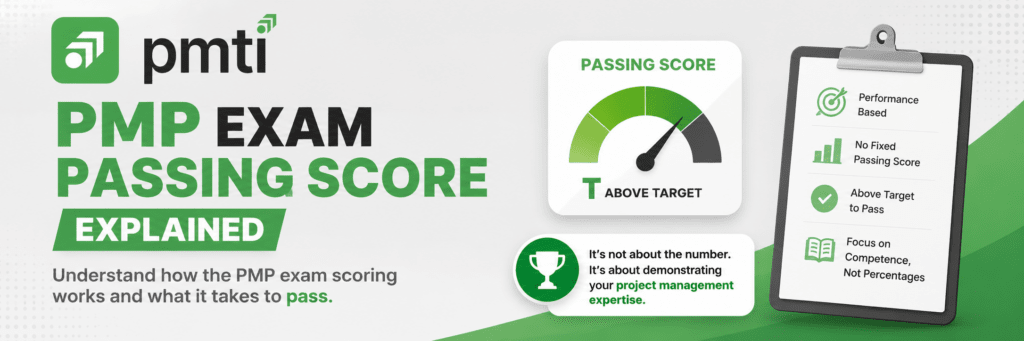
PMI does not publish a numeric passing score for the PMP exam. Performance is reported by domain — People, Process, and Business Environment — across four ratings: Above Target, Target, Below Target, and Needs Improvement. The exam evaluates 170 scored questions under a psychometric model called Item Response Theory (IRT), which weights each question by calibrated difficulty rather than treating all correct answers equally. No fixed passing percentage exists because the adaptive scoring model considers question complexity rather than raw correct answers. This is also one of the primary reasons the PMP exam is considered difficult to pass. The practical readiness benchmark—drawn from aggregated training provider data and IRT modeling—is 70% or higher in every domain individually, not as a blended overall average. A candidate who scores 82% overall but 54% in Process is not exam-ready. Domain consistency is the measure that matters.
What Is the PMP Passing Score?

PMI does not publish a numeric PMP passing score. Results report at the domain level across 4 ratings: Above Target, Target, Below Target, and Needs Improvement for each of the 3 performance domains. No minimum question count or percentage threshold is disclosed.
This is not a recent policy change — PMI has operated without a published passing threshold since 2007. The exam does not reward reaching a fixed number of correct answers. It measures whether a candidate’s demonstrated competency meets or exceeds the performance standard of a minimally qualified project manager, as defined by PMI’s role delineation study.
Candidates cannot calculate a safe answer count in advance. Attempting to reverse-engineer a threshold from practice test scores produces an unreliable target because question difficulty weighting varies across each exam administration.
Why Doesn’t PMI Publish a Passing Score?

PMI withholds the PMP passing score because the exam uses Item Response Theory (IRT) scoring, which weights each of the 170 scored questions by its calibrated difficulty. A correct answer on a harder question carries more scoring weight than a correct answer on an easier one — making a single fixed percentage meaningless.
IRT is a psychometric model used by high-stakes professional credentialing bodies to ensure consistent pass standards across exam versions with different question sets. PMI calibrates each question in its item bank with a difficulty rating. The scoring model then builds a candidate’s competency estimate based on which questions they answered correctly and how difficult those questions were — not simply how many correct answers they accumulated.
This means 2 candidates who each get 120 questions correct can receive different results if the difficulty distribution of their correct answers differs. The IRT model surfaces the more accurately qualified candidate rather than the one who happened to face easier questions.
How Does PMI Score the PMP Exam?

PMI scores the PMP exam using Item Response Theory across 170 scored questions. Each question carries a difficulty calibration weight. Candidate performance is measured against the competency profile of a minimally qualified project manager — the standard PMI defines through its role delineation study — not against other test-takers.
3 elements define the PMP scoring model:
Difficulty weighting — Each question in PMI’s item bank carries a calibrated difficulty value established during psychometric pretesting. The 10 unscored pretest items on the updated exam exist specifically to gather difficulty calibration data for future scored questions.
Competency threshold — PMI establishes a passing standard based on the minimum competency level a PMP-certified project manager should demonstrate. This threshold is set by subject matter experts, not by a curve relative to how other candidates perform.
Domain segmentation — Scoring separates across all 3 domains. A candidate’s performance in People, Process, and Business Environment is evaluated independently. Weakness in any single domain is visible in the results regardless of overall score strength.
PMI reports performance at 4 levels for each domain — not as a total score. The result report does not show a numeric percentage, an aggregate pass/fail mark, or a comparison to other candidates.
What Do the 4 PMP Domain Score Ratings Mean?
The 4 PMP domain score ratings measure demonstrated competency in each performance domain against PMI’s minimally qualified project manager standard. Above Target and Target indicate passing performance. Below Target and Needs Improvement indicate performance gaps that require remediation before the next attempt.
| Rating | What It Means | Exam Implication |
| Above Target (AT) | Performance exceeds the minimally qualified standard | Strong domain mastery |
| Target (T) | Performance meets the minimally qualified standard | Sufficient domain competency |
| Below Target (BT) | Performance falls short of the minimum standard | Domain gap — requires study correction |
| Needs Improvement (NI) | Performance is significantly below the minimum standard | Significant gap — prioritize this domain on retake |
Candidates need Target or Above Target in all 3 domains to pass. Receiving Needs Improvement in one domain while achieving Above Target in the other 2 does not produce a passing result. PMI evaluates each domain independently — strong performance in one domain does not compensate for failure in another.
What Score Should You Target on PMP Practice Tests?

Score 70% or higher in every individual domain — People, Process, and Business Environment — across full-length 240-minute timed simulations before scheduling the exam. Domain consistency signals readiness. An overall average above 70% with any domain below 65% means the exam is not ready to schedule.
3 readiness benchmarks define exam eligibility based on practice test performance:
Benchmark 1 — Domain Consistency Every domain scores 70% or higher across at least 3 consecutive full-length timed simulations. A single strong simulation does not confirm readiness — a consistent trend across 3 simulations does.
Benchmark 2 — Agile/Hybrid Parity Agile and hybrid scenario scores fall within 5 percentage points of predictive scenario scores. Agile and hybrid content accounts for approximately 60% of exam questions. Candidates who prepare heavily for predictive content and underweight Agile study fail this benchmark and typically fail the exam despite a strong overall score.
Benchmark 3 — Timed Completion The full 180-question simulation completes in 230 minutes or less, leaving a minimum 10-minute buffer within the 240-minute exam window. Candidates who consistently use the full 240 minutes in practice will face unmanageable time pressure on the last 60 questions of the actual exam.
How Do the 2026 Domain Weights Affect Scoring Strategy?

Business Environment rises from 8% to 26% under the 2026 ECO — approximately 44 of 170 scored questions. Process at 41% contributes ~70 questions and demands the largest study allocation. People at 33% contributes ~56 questions. Candidates who studied under the pre-2026 weights carry a 30-question gap in Business Environment alone.
| Domain | 2026 Weight | Approx. Scored Questions | Pre-2026 Weight | Pre-2026 Questions |
| People | 33% | ~56 | 42% | ~76 |
| Process | 41% | ~70 | 50% | ~90 |
| Business Environment | 26% | ~44 | 8% | ~14 |
The Business Environment shift is the most consequential change for score strategy. This domain now covers strategy alignment, benefits realization, compliance, AI in project management, sustainability, and organizational change — topics that received minimal preparation time under the pre-2026 8% allocation.
Study time allocation directly mirrors these weights. Process at 41% receives the most preparation hours. Business Environment at 26% requires structured, dedicated study — not a final-week review. People at 33% demands active scenario practice, particularly in leadership, stakeholder complexity, and psychological safety contexts.
How Do Unscored Pretest Items Affect Your PMP Score?

The 10 unscored pretest items on the updated PMP exam carry no scoring penalty and do not affect any domain rating. PMI includes them for difficulty calibration of future exam versions. Candidates cannot identify which 10 of the 180 questions are unscored during the exam.
The shift from 5 to 10 unscored items on the updated exam reflects PMI’s expanded item development cycle. Every question receives full effort — treating any item as potentially unscored and reducing effort on difficult questions is not a viable test strategy and risks dropping scored items.
For pacing purposes, candidates plan for all 180 questions at 80 seconds per question (240 minutes ÷ 180 = 1.33 minutes per question). The 10 unscored items do not create additional time — the 240-minute limit covers the full 180-question set.
What Was the PMP Passing Score Before the Current System?

The PMP had a published numeric passing score until 2007. It was 61% before 2005, raised to 81% from 2005 to 2007. PMI dropped the numeric threshold in 2007 and introduced domain-level proficiency reporting. The Above Target / Target / Below Target / Needs Improvement system launched in 2017 and remains active today.
| Period | Passing Score System | Threshold |
| Before 2005 | Fixed percentage | 61% |
| 2005–2007 | Fixed percentage | 81% |
| 2007–2017 | Domain proficiency ratings | No published threshold |
| 2017–present | AT / T / BT / NI ratings | No published threshold |
| 2026 ECO Update | Same AT/T/BT/NI system — domain weights revised | People 33%, Process 41%, Business Environment 26% |
The move to IRT-based domain ratings in 2007 reflected PMI’s recognition that a single percentage threshold could not fairly account for variation in question difficulty across different exam administrations. The current system produces a more accurate and defensible measure of competency than a fixed answer count.
How Do You Achieve Above Target Scores in All 3 Domains?
Achieving Above Target in all 3 PMP domains requires 4 elements: study time proportional to the 2026 domain weights, scenario-based practice across all 6 question formats, structured debrief by error type after each simulation, and a minimum of 3 full-length timed simulations before scheduling.
Step 1 — Align study time to domain weights Distribute preparation hours to mirror the 2026 ECO: 41% to Process, 33% to People, 26% to Business Environment. Candidates who allocate time based on personal interest or familiarity — rather than exam weight — consistently underperform in Business Environment.
Step 2 — Practice all 6 question formats The updated exam uses 6 formats: multiple-choice, multiple response, enhanced matching, point and click, pull-down, and case study sets. Case study sets require sustaining situational judgment across linked multi-question scenarios — a skill isolated multiple-choice practice does not build.
Step 3 — Debrief by error type, not by question 4 error types require 4 different corrections: knowledge gap (return to source material), reasoning gap (targeted scenario practice), distractor selection (PMI values framework alignment), and time pressure error (deliberate pacing strategy). Reading correct answer explanations addresses only the knowledge gap — the other 3 require active correction.
Step 4 — Run 3 to 5 full-length timed simulations 3 simulations establish a performance trend. 5 simulations build stamina without crossing into question familiarity territory. Beyond 5 simulations from the same question bank, recall inflates scores without improving exam-day reasoning.
FREQUENTLY ASKED QUESTIONS
Q: What is a passing score on the PMP exam? PMI does not publish a numeric passing score. Performance is reported by domain — People, Process, and Business Environment — across 4 ratings: Above Target, Target, Below Target, and Needs Improvement. Candidates need Target or Above Target in all 3 domains to pass.
Q: What percentage do you need to pass the PMP exam? No fixed percentage exists. PMI uses Item Response Theory scoring that weights questions by difficulty. The practical readiness benchmark based on training provider data is 70% or higher in every individual domain on full-length timed practice simulations — not as an overall average.
Q: How many questions do you need to get right to pass the PMP exam? PMI does not disclose a minimum correct answer count. The IRT scoring model means a correct answer on a harder question carries more weight than a correct answer on an easier one — making a fixed answer count target unreliable as a preparation goal.
Q: What happens if you score Below Target in one domain? A Below Target score in any single domain means the exam result is not a pass, regardless of Above Target performance in the other 2 domains. PMI evaluates each domain independently. Strong performance in Process does not compensate for Below Target in Business Environment.
Q: How many scored questions are on the PMP exam? The PMP exam contains 170 scored questions and 10 unscored pretest items, totaling 180 questions. The 10 unscored items are not identified during the exam and carry no scoring penalty. All 180 questions receive full attention.
Q: What do Above Target, Target, Below Target, and Needs Improvement mean? Above Target means performance exceeds the minimally qualified project manager standard PMI defines through its role delineation study. Target means performance meets that standard. Below Target and Needs Improvement indicate performance gaps — the distinction between the two reflects the degree of the gap, with Needs Improvement representing the most significant shortfall.


