


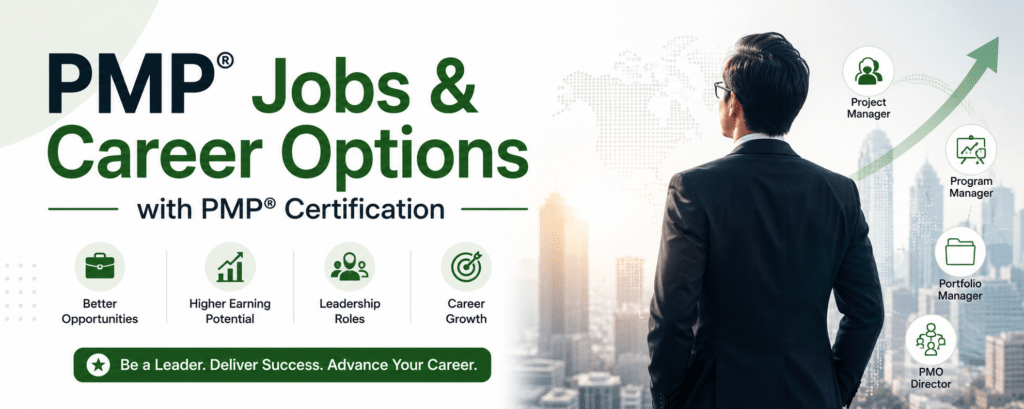

According to PMI’s 2024 Earning Power Salary Survey, PMP-certified professionals make 22% more than their non-certified counterparts in the same position. Project management positions are the most in-demand, with 2.3 million job openings across the United States every year. PMP certification provides the competitive edge to fill the most senior, cross-functional, and highest-ranking project management roles.
This article presents every feasible career option for PMP-certified professionals in 2026, including job title, salary, industry, skills, and career progression.
Potential Careers for PMP Certification Holders
PMP certification opens ten high-level roles: Project Manager, Program Manager, Portfolio Manager, PMO Director, Project Director, Senior Project Manager, Technical Project Manager, Engineering Project Manager, Management Consultant, and Scrum Master. These roles are available in IT, construction, healthcare, finance, and consulting.
1. Project Manager
Overview: Operates single projects and manages all aspects of project scope, schedule, budget, stakeholder communication, and quality.
Budget: $250,000 to $5 million per project.
Average Salary in the U.S.: $95,000 to $125,000
2. Program Manager
Overview: Manages 3 to 10 projects and integrates each with the goals of the organization. Streamlines resources across projects and reports aggregated KPIs to the C-suite.
U.S. Average Salary: $130,000 – $158,000
3. Portfolio Manager
Overview: Manages an organization’s total investment in each Project or Program. Identifies and selects the most valuable initiatives and Programs and brings to closure Projects and Programs that are not adding value. Ensures that every Project and Program that is ongoing is aligned to a business objective and has measurable value.
Value of Portfolio Managed: $10 Million – $500 Million
U.S. Average Salary: $140,000 – $170,000
4. PMO Manager / Director
Overview: Directs the Project Management Office (PMO) and creates delivery governance frameworks. Establishes standards for Projects, reporting, and performance KPIs, and manages performance across Projects undertaken by the organization.
Size of the Team: 5 – 50 Project Management professionals
U.S. Average Salary: $140,000 – $170,000
5. Project Director
Overview: Directs Projects of a high value and high risk that require organization-wide transformation. Engages with C-Suite executives and leads a workforce of 50 or more employees. Responsible for execution of the strategy.
U.S. Average Salary: $148,000 – $180,000
6. Technical Project Manager
Overview: Oversees Project Management and governance. Manages Architects, Developers, and QA teams. Ensures Projects are completed within the agreed timelines and that all necessary technical requirements are met.
U.S. Average Salary: $115,000 – $142,000
7. Senior Project Manager
Overview: Manages Projects with a value of more than $5 Million. Provides guidance and mentorship to less experienced Project Managers. Handles advanced risks and issues and manages change requests.
U.S. Average Salary: $118,000 – $145,000
8. Engineering Project Manager
Overview: Manages the design, buying, and construction of an engineering Project. Ensures that technical safety and code requirements and cost estimation and controls are undertaken by all teams.
U.S. Average Salary: $110,000 – $138,000
9. Project Management Consultant
Overview: Consults with companies on delivery methods, PMO setup, and governance frameworks and operational efficiency across industries. Works on many client projects at once and increases the success of client projects by 30-45%.
U.S. Average Salary: $100,000 – $145,000
10. Scrum Master / Product Owner
Overview: Guides the Agile or hybrid delivery process. Organizes and defines the order of the product backlog. Also manages the planning and retrospectives of sprints and keeps the development teams in sync with the business.
U.S. Average Salary: $105,000 – $133,000
What Will the Average PMP Salary Be in 2026?

U.S. PMP professionals make between $117,000 and $147,000, making them 22% more than equivalent project managers without a PMP certification. Globally, this salary range is 15% to 32% more than project managers without certification based on country, sector, and level of management.
Based on the PMI Earning Power Salary Survey 2024 and Glassdoor 2026 Compensation Data, the average PMP annual salary and top-end roles by country are as follows:
- United States: Average PMP salary is $132,000, and the top-end role is PMO Director, earning $200,000+
- Canada: Average salary is CAD $100,000 (USD $74,000), with PM Directors earning CAD $130,000
- Australia: Average is AUD $136,000 (USD $89,000), and the top-end role is Infrastructure PM lead
- United Kingdom: Average is £50,000 – £52,700 (USD $64,000–$68,000), with Finance PMs earning a 15% premium
- Germany: Average is €64,400 – €80,000 (USD $70,000–$88,000), with the highest pay in Manufacturing
- United Arab Emirates: Average is AED 302,000/year (USD $82,000), with Energy roles receiving benefits packages
- Singapore: Average is SGD $96,500 – $119,900 (USD $71,000–$88,000)
- India: Average is ₹16 – ₹20 lacs (USD $19,000–$24,000), with IT and cloud PMs receiving the highest pay
The gap between salaries of certified and non-certified professionals widens with seniority. The average salary of a non-certified Senior PM in the US is $96,000; the average salary of a Senior PM with a PMP certification is $122,000, giving a difference of $26,000.
How is PMP Certification Salary Compensated by Role, Seniority, and Geography?
In 2026, 8 industries will be most likely to recruit PMP-certified professionals, including IT and Construction, which will have the largest number of openings. The highest paying jobs for PMP-certified professionals will be in IT and Construction.
IT and Cloud
PMP-certified professionals will be required for IT organizations to run Cloud Programs, Launch Products, implement Business Process Re-engineering (BPR) via ERP Systems, and lead Agile Transformations. Some job titles will be Technical PM, Program PM, and Cloud Delivery Manager. IT and Cloud PMs are the highest paying jobs in India.
Construction & Engineering
For construction managers on projects exceeding $10 million, firms specify PMP certification for managing contracts in infrastructure, civil, and commercial development. Senior roles for federal highway, airport, and utility projects require PMP-equivalent credentials.
Finance & Banking
In Finance, PMP certification is required for managing transformational projects such as digital banking, core banking, and regulatory compliance. Projects in payment infrastructure also require PMP certification. PMO Director and Senior Program Manager are the most frequently hired designations.
Healthcare & Pharmaceuticals
In Healthcare, PMP certification is required to manage clinical trials, the rollout of EHR, the implementation of hospital IT, and FDA compliance projects. These projects also require PMP for managing regulatory compliance, documented risk, and change control.
Consulting & Professional Services
Most top 20 consulting firms, including Accenture, Deloitte, McKinsey, and Booz Allen, require their engagement managers and principal consultants to hold a PMP certification to manage client delivery. Therefore, PMP certification is required for consultants at these firms.
Energy & Utilities
For offshore projects and programs related to the construction of renewable energy, PMP certification is required from professionals in energy companies. The highest concentration of PMP certification is in the UAE, Australia, and the U.S. Gulf Coast.
Manufacturing
In the manufacturing sector, PMP certification is required for managers for Lean Six Sigma and ERP programs, as well as Product Innovation and Supply Chain Transformation. The highest hiring is in aerospace, automotive, and pharmaceuticals.
Government & Defense
For project management positions in U.S. federal agencies at GS-12 and higher, PMP certification is required. For government contracts, defense contractors such as Lockheed Martin, Raytheon, and Northrop Grumman require PMP certification for their Program Managers and Program Directors.
What Skills Do Employers Want for PMP Jobs?
There are seven essential skills employers want for PMP jobs. These are project planning and scheduling, risk management, budget control, and stakeholder communication. They also include knowledge of Agile and hybrid methodologies, team leadership, and digital tools. By 2026, AI-assisted project management will be the eighth skill cited by organizations.
Project Planning & Scheduling
With a PMP certification, candidates can build a Work Breakdown Structure (WBS). They can use the Critical Path Method (CPM) or Program Evaluation and Review Technique (PERT) to determine and schedule task dependencies in a distributed team. Job postings for 84% of PM roles state that candidates must have a working knowledge of MS Project, Primavera P6, or Smartsheets.
Risk & Issue Management
Identifying risks, assigning a probability and impact, and developing mitigation strategies assist PMP Managers in the reduction of cost and schedule overruns. Active risk registers shrank project failures by 28% according to the PMI Pulse of the Profession 2023.
Budget & Cost Control
PMP Managers work on budgets ranging from $500,000 to $50 million. Organizations at the Senior PM level and above must have experience managing budgets of at least $1 million.
Stakeholder Communication & Negotiation
Managing stakeholders, creating and carrying out communication plans, resolving conflicts, and reporting to Executives are all skills developed in PMP training. Employers see stakeholder management as the most important leadership skill for a Program Manager or PMO Director in 2026.
Agile & Hybrid Methodology Proficiency
According to PMI’s 2024 Pulse of the Profession, 58% of organizations use hybrid delivery models to run their projects. PMP certified candidates utilizing the PMBOK with predictive governance integrated into Scrum, Kanban, or the SAFe frameworks are the most sought after by employers.
Leadership and Team Management
PMP Certification emphasizes understanding of servant leadership and empowers professionals to craft delegation frameworks and manage team performances effectively. In senior project management roles like program managers, PMO directors, and vice presidents of project management, leadership skills are the most sought-after.
Digital Tool Proficiency
From 2026, using anywhere between 3 to 5 project management software, including JIRA, Asana, Microsoft Projects, Monday.com, or Smartsheet, will be a requirement of most jobs. Senior roles will increasingly require familiarity with AI-integrated project management tools such as Asana Intelligence, Microsoft Copilot for Projects, and Motion AI.
The Top 10 Companies Hiring PMP-Certified Professionals
The top 10 companies recruiting PMP-certified professionals in 2026 are Amazon, Microsoft, Google, Accenture, IBM, Deloitte, Tata Consultancy Services, Siemens, Lockheed Martin, and Johnson & Johnson. All these companies mention PMP Certification as the minimum qualification for senior project management, program management, and PMO positions.
Amazon
With its global operations across AWS, logistics, and ecommerce, Amazon runs more than 10,000 projects at a time. Certified PMP Program Managers and Technical Project Managers earn a base pay of $130,000 to $165,000, plus RSUs worth $40,000 to $80,000 a year.
Microsoft
PMP Certification is mandatory for Microsoft’s Principal Program Manager across Vacancies in Azure and Microsoft’s AI offerings. Project Managers at this level can expect to earn between $165,000 to $195,000.
Google’s PMP-certified Technical Program Managers and Data Center Program Managers will lead Projects to support Google’s Infrastructure and AI. Google Technical Program Manager roles are expected to earn between $175,000 to $215,000.
Accenture
Accenture has more than 700,000 employees and has locations in 120 countries. Accenture hires PMP Senior Managers to consult on delivery, SAP S/4HANA, and cloud transformation. The average salary for an Accenture Senior Manager ranges from $130,000 to $155,000.
IBM
IBM employs PMP Project Executives and Project Managers to lead multi-year government and financial services transformation projects that are worth $50 million to $500 million.
Deloitte
Deloitte hires PMP Senior Managers and Directors to manage technology consulting and risk programs. PMP certification is mandatory in Deloitte’s Government & Public Services practice for all delivery leadership roles above Manager.
Tata Consultancy Services
Tata Consultancy Services has more than 600,000 employees. TCS hires Delivery Managers and Program Managers who are PMP certified to manage American and European contracts.
Siemens
Siemens employs nearly 400,000 employees and hires PMP certified Engineering Project Managers. Countries that have the most demand for PMP certified Project Managers by Siemens are Germany, the United Arab Emirates, and the United States.
Lockheed Martin
Lockheed Martin hires PMP certified individuals in Program Director and Senior Program Manager positions.
Johnson & Johnson
Johnson & Johnson hires PMP certified individuals to lead projects that launch Class III medical devices and pharmaceuticals and transform the global supply chain.
What Career Advancement Options Exist for PMPs?
There are 5 levels to the PMP career ladder, each bringing with it a 20-35% increase in salary and a greater scope of authority: Project Coordinator, Project Manager, Senior Project Manager, Program/Portfolio Manager, and PMO Director/VP of Project Management.
Level 1 — Project Coordinator (0–2 Years)
Scope: Assists up to 3 project managers in scheduling, status reports, meetings, and documentation.
Average Salary in the U.S.: $52,000 – $68,000
Note: PMP certifications are out of reach for project coordinators as 36 months of leading projects are required for the certification.
Level 2 — Project Manager (3–6 Years)
Scope: Conducts one project with a defined scope, team of 5–20, and budget of $250,000 – $3,000,000. Responsible for completion of project within time, cost, and scope.
Average Salary in the U.S.: $85,000 – $115,000
Note: Gaining PMP certification increases pay by $15,000 to $25,000 instantly.
Level 3 — Senior Project Manager (6–10 Years)
Scope: Runs big projects with $3 million – $20 million budgets. Teaches junior PMs, deals with C Suite, and runs teams of 20–50.
Average Salary in the U.S.: $112,000 – $140,000
Level 4 — Program Manager / Portfolio Manager (10–16 Years)
Scope: Has responsibility for 5–20 projects or a project portfolio. Has authority over ROI for the portfolio and selection of projects.
Average Salary in the U.S.: $135,000 – $165,000
Level 5 — PMO Director / VP of Project Management (14+ Years)
Scope: Manages project management capabilities across the enterprise. Establishes delivery standards, governance frameworks, and PM career path frameworks for organizations with 5,000 to 100,000+ employees.
Average U.S. Salary: $155,000–$210,000
What Is the 2026 PMP Job Market Forecast?
There are 2.3 million new PM job openings globally every year. Digital transformation, U.S. federal infrastructure projects, and the global adoption of hybrid delivery frameworks are the primary contributors. More than 800,000 PM job opportunities are posted each year in the U.S., with Texas, California, New York, Illinois, and Virginia having the greatest number.
PMI’s Talent Gap Report estimates that by 2027 there will be 87.7 million project management jobs globally. This is a 33% increase since 2017. The talent shortage is significant, with less than 40% of mid-to-large companies having enough certified PMs to handle their current project workload.
Four Main Areas Driving the Largest Demand for New PMPs in 2026
AI and Automation 18% year-over-year growth as companies increasingly build and automate large-scale AI systems.
Renewable Energy 22% year-over-year growth and new IRA-funded clean energy projects.
Health IT 14% year-over-year growth driven by the modernization of EHRs and Telehealth and the building of Clinical Data Platforms.
U.S. Federal Infrastructure Programs A peak in projects funded by the Bipartisan Infrastructure Law (with $1.2 trillion authorized) through 2028, requiring an extensive number of credentialed PMs.
What Skills Will Make PMP Candidates Competitive in the Future?
Five new skills will set PMP certified professionals apart in the 2026 job market: AI project prediction, analytics for performance, an understanding of cybersecurity risks, integration of ESG processes, and the ability to influence executives and stakeholders. Individuals who combine PMP certification with these skills will attain Program Manager and PMO positions 40% sooner.
AI Project Prediction
Applications such as Microsoft Copilot for Project, Asana Intelligence, and Motion AI can identify scheduling risks, alert conflicts, and forecast cost variances. PMPs who manage AI scheduling applications can accomplish up to 35% more and are more likely to be candidates for advanced positions in more progressive companies.
Analytics for Performance
Utilizing dashboards in Power BI, Tableau, and Looker provides project managers with an accelerated view of earned value, trends in sprint velocity, and assessment of delivery likelihood. By 2026, employers will cite data management skills, including the ability to determine, analyze, and communicate performance of the project, among the top five skills for hiring Program Managers.
Understanding Cybersecurity Risks
Of the IT projects initiated in 2026, 73% will involve the protection of data and cloud infrastructure. The certified PMP who understands the NIST CSF, ISO 27001, and vendor security assessments will more adeptly manage the data governance of a project and the risks associated with vendor breaches than the non-certified PMP.
Integration of ESG Programs
At 60% of Fortune 500 companies, project charters will require the integration of Environmental, Social, and Governance reporting. PMP certified professionals who add ESG KPIs to project scopes/budgets and reporting will be at the forefront of a developing, senior level market.
Influence of Executive Stakeholders
The capability to communicate effectively to the Board, justify capital expenditures, and achieve alignment across the C-suite is an important accelerator for promotion from Program Manager to Vice President of Project Management. Graduate-level executive leadership training, along with coaching for executive presence and formal training in public speaking, provide this capability to individuals at an accelerated pace.
How Do You Begin Your PMP Career?
Beginning the journey to becoming a Project Management Professional involves completing three formal steps in the correct order: satisfying the specific educational and experiential eligibility criteria, completing 35 hours of formal training in project management, and passing the PMP exam.
Step 1 — Satisfy the Educational and Experiential Eligibility Criteria
This criterion is satisfied by holding either a U.S. bachelor’s degree and three years of formal project management experience or a U.S. high school diploma and five years of formal project management experience. In addition, all candidates complete 35 hours of formal training in project management prior to submitting the application. Review the full PMP eligibility requirements to ensure you satisfy all other prerequisites before embarking on this formal step.
Step 2 — Complete PMP Training
35 hours of project management training is a formal PMP eligibility criterion that is satisfied by attending an accredited PMP training program. All 35 hours are completed in a 4-day, live instructor-led boot camp. PMTI’s boot camp is conducted in both live, online and in-person formats. The training is conducted by PMP-certified instructors who are project management practitioners with a minimum of 15 years of experience.
Step 3 — Apply and Pass the PMP Exam
The PMP exam includes 180 questions based on 3 main categories: People (approx. 42%), Process (approx. 50%), and Business Environment (approx. 8%). The total duration of the exam is 230 minutes and includes 2 breaks of 10 minutes each. PMI assesses results as Above Target, Target, Below Target, or Needs Improvement. PMTI’s boot camp incorporates a 200-question full-length exam and provides application support to ensure participants submit a full, audit-ready PMI application.
PMTI’s PMP Pass Guarantee
As a PMI Authorized Training Partner (ATP), PMTI is among a select few training providers authorized by PMI to provide training. PMTI’s full PMP training program comes with a money-back guarantee: if a participant does not pass the PMP exam, PMI will refund the course fee. No other conditions apply.
Details on PMP Certification Training, including formats, schedules, and pricing, are available at: PMP Certification Training — PMTI


