


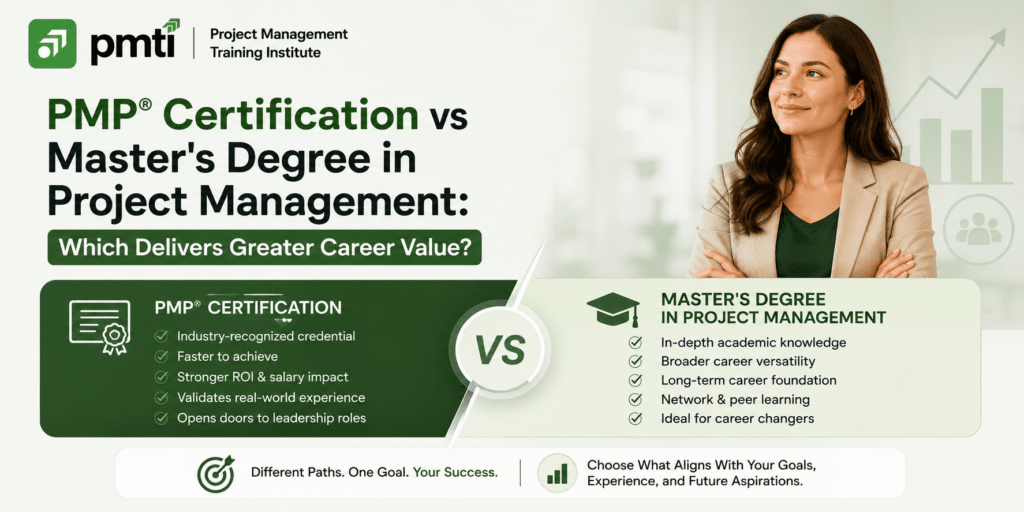
PMP Certification vs Master’s Degree in Project Management: Which Delivers Greater Career Value?

For working project management professionals, PMP certification delivers faster career returns at a fraction of the cost. PMP certification costs $2,000–$4,500 total, takes 2–6 months, produces a documented 33% salary premium (PMI 2023), and adds a globally recognized credential to your profile immediately. A Master’s Degree in Project Management costs $20,000–$120,000, takes 1–4 years, and does not require verified project leadership experience before you enroll.
These 2 pathways validate different forms of professional value. Choosing the wrong one wastes time and money at a critical career stage.
| Attribute | PMP Certification | Master’s Degree in PM |
| Total Cost | $2,000–$4,500 | $20,000–$120,000 |
| Time to Complete | 2–6 months | 1–4 years |
| Experience Required Before Starting | 36–60 months project leadership | None (bachelor’s degree minimum) |
| Learning Format | Instructor-led training + proctored exam | Academic coursework + university assessments |
| Salary Premium | 33% higher median (PMI 2023, US) | No published benchmark premium |
| Median Salary (US) | $120,000–$150,000 (senior PM roles) | $90,000–$135,000 |
| Employer Recognition | Global — 180+ countries, all industries | Strong in academic, consulting, executive roles |
| Career Stage | Mid-career to senior leadership | Entry-level to early mid-career |
| ROI Timeline | Under 2 months of salary premium | 1.5 – 4 years of salary premium |
| Renewal Required | 60 PDUs every 3 years | No renewal |
What Is the Core Difference Between PMP and a Master’s Degree in Project Management?
PMP validates verified project leadership experience and applied competency. A Master’s Degree in Project Management develops academic and theoretical knowledge of project management frameworks, business strategy, and organizational behavior. One proves you can lead projects. The other proves you have studied how organizations manage them.
This distinction drives employer behavior. Project management job postings in IT, construction, healthcare, and government list PMP certification as a required or preferred qualification. The same postings rarely specify a project management master’s degree because the credential does not verify hands-on project delivery capability.
What Is PMP Certification?
PMP (Project Management Professional) is PMI’s advanced credential that validates the ability to lead projects across predictive, Agile, and hybrid delivery environments, recognized across 180+ countries and all major industries. PMI requires verified project leadership experience before any candidate qualifies to sit the exam — PMP is not an educational program, it is a professional competency credential.
PMP evaluates 3 performance domains: People (leadership, conflict management, stakeholder engagement), Process (risk, schedule, scope, quality, change management), and Business Environment (compliance, benefits realization, organizational change). Approximately 60% of the current PMP exam tests Agile and hybrid project management approaches.
Review the full PMP exam structure and content outline to understand what the certification measures and how it maps to real project leadership responsibilities.
What Is a Master’s Degree in Project Management?
A Master’s Degree in Project Management is a 1–4 year graduate program that develops academic competency in project planning methodologies, strategic management, organizational behavior, financial management, risk analysis, and leadership theory. Unlike PMP, a master’s program does not require project leadership experience before enrollment — many students enter directly from undergraduate study.
Master’s programs cover 6 core areas: project planning and execution methodology, organizational behavior and change management, financial management and budgeting, leadership theory and organizational systems, research methodology, and portfolio and program management. The curriculum emphasizes understanding why project management principles work rather than applying them under real delivery conditions.
What Are the Eligibility Requirements for Each?

PMP certification requires 36 months of project leadership experience (bachelor’s degree holders) or 60 months (secondary degree holders), plus 35 contact hours of PM education before applying. Qualifying experience can come from the last 10 years, expanded from the previous 8-year window. A Master’s Degree in Project Management requires a bachelor’s degree and, in competitive programs, 2–3 years of work experience plus GMAT/GRE scores.
PMP Eligibility
| Requirement | With Bachelor’s Degree | With Secondary Degree |
| Project Leadership Experience | 36 months | 60 months |
| PM Education | 35 contact hours | 35 contact hours |
| Exam Fee (PMI member) | $445 | $445 |
| Exam Fee (non-member) | $675 | $675 |
Review the full PMP certification requirements to verify your experience qualifies before beginning a preparation program. If you’re unsure whether your work history meets PMI’s standards, the PMP eligibility overview covers common eligibility questions and documentation requirements.
Master’s Degree Eligibility
| Requirement | Details |
| Education | Bachelor’s degree from an accredited institution |
| Work Experience | 2–3 years (varies by program; competitive programs require this) |
| GMAT / GRE | Required by some programs; may be waived with strong work experience |
| English Proficiency | TOEFL or IELTS for non-native speakers |
| Application Materials | Statement of purpose, letters of recommendation |
How Do the Costs Compare Between PMP and a Master’s Degree?
PMP total investment ranges from $2,000 to $4,500 including exam fees, training, and study materials. A Master’s Degree in Project Management costs $20,000–$60,000 per year in tuition — totaling $20,000–$120,000 depending on program length and institution.
PMP Cost Breakdown
| Cost Component | Typical Range |
| Exam Fee (non-member) | $675 |
| Exam Fee (PMI member) | $445 |
| PMI Annual Membership | $139 |
| Instructor-Led Training | $1,500–$3,500 |
| Study Materials | $50–$300 |
| Practice Exams | $30–$150 |
| Total Investment | $2,200–$4,700 |
Full PMP certification costs and renewal fees break down each line item, including PMI membership savings, retake fees, and PDU renewal costs over the 3-year certification cycle.
Master’s Degree Cost Breakdown
| Cost Component | Typical Range |
| Tuition (per year) | $20,000–$60,000 |
| Total Tuition (1–2 year program) | $20,000–$120,000 |
| Application and Registration Fees | $200–$500 |
| Learning Materials | $500–$2,000 |
| Opportunity Cost (income missed) | Significant for full-time students |
Many employers reimburse PMP exam fees and training costs as part of professional development budgets. Master’s degree tuition reimbursement programs are less common and typically cap at $5,000–$10,000 per year.
How Long Does Each Credential Take to Earn?
PMP certification takes 2–6 months to prepare for and earn while maintaining full-time employment. A Master’s Degree takes 1–2 years full-time or 2–4 years part-time — with no option to compress the timeline without leaving your current role.
PMP Timeline
| Phase | Duration |
| Eligibility verification and PMI application | 1–2 weeks |
| Instructor-led training (35 contact hours) | 1–5 days (boot camp) or 4–8 weeks (part-time) |
| Self-study and practice exams | 6–12 weeks |
| PMI application approval | 5–10 business days |
| Exam scheduling to sitting | 1–4 weeks |
| Total time to credential | 2–6 months |
Master’s Degree Timeline
| Program Format | Duration |
| Full-time (on-campus) | 12–18 months |
| Part-time (evening or online) | 24–48 months |
| Accelerated programs | 12 months (limited availability) |
For working professionals seeking career advancement without pausing their income, PMP’s 2–6 month timeline is the decisive advantage.
How Do Employers Recognize PMP vs a Master’s Degree?
PMP certification appears as a required or preferred qualification in project management job postings across IT, construction, healthcare, finance, government, and defense. A Master’s Degree in Project Management is valued for executive leadership, consulting, and academic roles but rarely listed as a hiring requirement for project manager positions.
PMI’s 2021 Talent Gap Report identifies 2.2 million new project management role openings annually through 2027. Employers filling these roles use PMP certification as the primary screening filter because it verifies both experience and competency — credentials a master’s degree alone does not guarantee.
Federal government and defense contractors frequently list PMP certification as a contract requirement for project leadership positions, particularly on GSA Schedule and DoD-funded programs. A master’s degree does not satisfy this requirement. Review why PMTI holds PMI Authorized Training Partner status — this accreditation matters for candidates whose employers or contracts verify training source credentials.
What Career Roles Does Each Credential Support?
PMP certification supports 6 mid-career to senior-level project leadership roles. A Master’s Degree supports a broader set of organizational leadership, consulting, and strategic roles that extend beyond direct project delivery.
PMP-Supported Roles
| Role | Typical Salary Range (US) |
| Project Manager | $95,000–$120,000 |
| Senior Project Manager | $110,000–$140,000 |
| Program Manager | $120,000–$155,000 |
| PMO Manager | $115,000–$150,000 |
| Portfolio Manager | $130,000–$165,000 |
| Project Director | $140,000–$175,000 |
Master’s Degree-Supported Roles
| Role | Typical Salary Range (US) |
| Project Manager | $90,000–$120,000 |
| Program Manager | $100,000–$140,000 |
| Portfolio Manager | $110,000–$160,000 |
| Strategic Consultant | $90,000–$135,000 |
| Organizational Change Leader | $95,000–$130,000 |
| Executive / Operations Leader | $120,000–$160,000+ |
PMP certification consistently positions holders above the salary floor in project leadership roles. A master’s degree creates flexibility for broader career paths but does not guarantee a higher starting salary in project management roles.
How Do the Salaries Compare Between PMP Certification and a Master’s Degree?
PMI’s 2023 Earning Power Salary Survey reports that PMP-certified professionals earn a 33% higher median salary than non-certified project management peers in the United States. No equivalent published salary premium benchmark exists for the Master’s Degree in Project Management.
Full PMP salary data by role and region shows median annual compensation for PMP-certified project managers between $120,000 and $150,000 at senior levels in the US. The 33% premium applies across industries including IT, healthcare, construction, and government.
Master’s degree salary outcomes depend on role type, industry, and organization size rather than the credential itself. Graduates who enter consulting, finance, or strategic management often achieve salary ranges comparable to senior PMP holders, but the timeline to those roles is longer and less direct.
What Is the Return on Investment for PMP vs a Master’s Degree?
PMP certification usually generates positive ROI within 2 months of earning the credential. A Master’s Degree takes 1.5–4 years of salary premium to recover the tuition investment.
PMP ROI Calculation
| Variable | Value |
| Total PMP Investment | $3,500 (midpoint estimate) |
| Annual Salary Premium (33% of $90,000 base) | $29,700/year |
| Monthly Salary Premium | $2,475/month |
| Months to Break Even | ~1.5 months |
Master’s Degree ROI Calculation
| Variable | Conservative | Aggressive |
| Total Tuition Investment | $40,000 | $120,000 |
| Annual Salary Premium (assumed 20% lift) | $18,000 | $18,000 |
| Years to Break Even | 2.2 years | 6.7 years |
The master’s degree ROI calculation assumes a salary premium that may not materialize for project management roles specifically — the premium is more likely in consulting, executive leadership, or academic tracks where the degree is a qualification requirement.
Evaluate whether PMP certification is worth it for your career using your specific experience history, current salary, and target role before committing to either pathway.
Should You Get PMP Certification or a Master’s Degree First?
For working professionals who already manage projects and meet PMI’s 36–60 month experience requirement, PMP certification delivers faster, more direct career value. A master’s degree is the stronger first investment for career changers entering project management without experience, or professionals targeting executive leadership roles that value academic credentials.
3 scenarios that define the right sequence:
Scenario 1 — You already lead projects (choose PMP first): You meet the experience requirement, your employer recognizes PMP certification, and the 33% salary premium applies immediately after passing. A master’s degree can add strategic depth later without career disruption.
Scenario 2 — You are entering project management without experience (consider master’s first): You do not yet qualify for PMP certification. A master’s degree builds foundational knowledge while satisfying the education component of many employer project management requirements. Once you accumulate 36 months of project leadership experience, PMP becomes the natural next step.
Scenario 3 — You target executive or consulting roles (parallel or master’s first): Senior consulting, PMO director, and C-suite adjacent roles in large enterprises increasingly list graduate education alongside PMP certification as a hiring criterion. The master’s degree expands organizational leadership credibility; PMP certification maintains project management professional standing.
The 9-step PMP certification process maps each stage from eligibility verification to exam day for professionals ready to begin.
Is It Worth Earning Both PMP and a Master’s Degree?
Yes — for professionals targeting Program Director, PMO Leader, Senior Consultant, or Transformation Executive roles where both industry credibility and academic depth are valued, holding both credentials creates the strongest professional profile.
The combination delivers 4 distinct advantages:
- PMP certification provides immediate employer recognition and the documented salary premium.
- A master’s degree adds organizational leadership theory, strategic management, and academic credibility.
- Together they signal both practical delivery mastery and systemic leadership capability.
- The combined profile is most competitive for government leadership roles, enterprise consulting, and PMO director positions in large organizations.
For most mid-career professionals, earning PMP certification first produces faster financial returns. The master’s degree then adds value as a long-term investment in organizational leadership rather than a prerequisite for project management advancement.
The benefits of PMP certification details the specific career outcomes PMP certification holders report — salary growth, promotion speed, and employer recognition — as a baseline before evaluating whether the additional master’s degree investment produces incremental return for your specific career path.
PMP Certification vs Master’s Degree: Which Is Right for You?
Choose PMP certification if you already lead projects, meet PMI’s experience requirements, and want the fastest path to a documented salary increase, broader employer recognition, and direct project leadership advancement. Choose a Master’s Degree if you are entering project management without prior experience, targeting executive or academic roles, or seeking the organizational leadership knowledge that PMP certification does not provide.
Choose PMP certification When:
- You have 36–60 months of documented project leadership experience.
- You work in IT, construction, healthcare, government, or finance where PMP is a hiring filter.
- You want credentials within 6 months without leaving your current role.
- You want the highest ROI on a professional investment under $5,000.
- You target Project Manager, Senior PM, Program Manager, or PMO Manager roles.
Choose a Master’s Degree When:
- You are entering project management from another field without project leadership experience.
- You target executive leadership, consulting, or academic roles.
- Your organization or sector values graduate education for advancement.
- You have 1–4 years and $20,000–$120,000 to invest in credential development.
- You want broader organizational and strategic leadership capabilities beyond project delivery.
PMTI’s PMP Certification Training delivers instructor-led exam preparation through live online and in-person formats, aligned with the current PMI Examination Content Outline. PMTI is a PMI Authorized Training Partner — the same accreditation PMI requires for the 35 contact hours you need before applying. If you do not pass, PMTI’s money-back guarantee covers your next attempt.
If you lead a team or organization and want to explore group PMP training options, PMTI delivers private corporate programs built around your team’s schedule and project management environment.


