


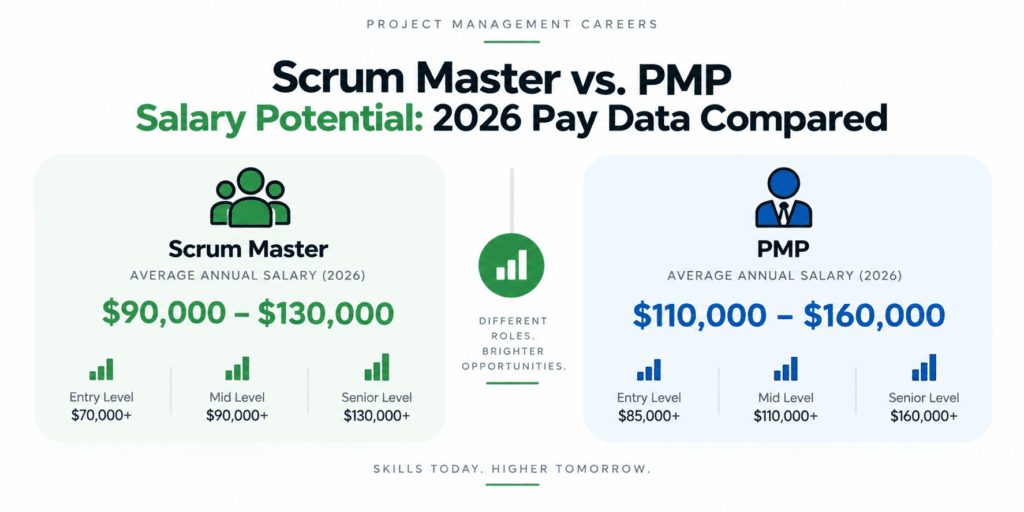
Scrum Master vs. PMP Salary Potential
Scrum Master salaries currently average $108,000 to $127,000 across major U.S. salary platforms, while PMP-certified professionals report a median salary of $135,000 according to PMI’s own 2025 survey — a 24% premium over non-certified project professionals. The comparison isn’t a simple ranking: Scrum Master pay data comes from job-posting and self-reported aggregators, while PMI’s PMP figure comes from a controlled survey of certified versus non-certified professionals. Each number measures a different population, so the honest comparison requires looking at both the raw figures and how each was collected.
Is a Scrum Master the Same Role as a Project Manager?
A Scrum Master facilitates a single Scrum team’s process; a project manager owns the full scope, schedule, budget, and stakeholder relationships of a project. Job postings often blend the 2 titles — “Scrum Master, Agile Project Manager” is a common combined listing — which inflates some Scrum Master salary data with project-manager-level compensation and responsibility.
What Is the Median Salary for Project Management Specialists?

Project management specialists earned a median salary of $100,750 per year as of May 2024, according to the U.S. Bureau of Labor Statistics. This BLS figure covers the full occupational category (SOC 13-1082) regardless of certification status, and reflects 1,046,300 workers in the role with 6% projected employment growth from 2024 to 2034. This is the most reliable baseline figure available, since BLS collects data from a comprehensive national survey rather than self-reported job postings.
What Salary Premium Does PMP Certification Provide?
PMP-certified professionals in the United States reported a median salary of $135,000 in 2025, compared to $109,157 for non-certified project professionals — a difference of nearly 24%. This figure comes from PMI’s 14th Edition Earning Power: Project Management Salary Survey, which collected responses from 14,628 project professionals across 21 countries between March and April 2025. The premium grows with tenure: U.S. respondents certified for more than 10 years reported a median salary of $173,000, compared to $123,000 for those more recently certified.
PMI’s survey methodology differs from BLS data in one important way: it surveys self-selected respondents who volunteer salary information, rather than sampling the full labor market. Treat PMI’s figures as directional evidence of a certification premium among certified professionals, not as a substitute for BLS’s broader occupational baseline.
What Is the Average Salary for a Scrum Master?
Scrum Master salary estimates range from $108,000 to $127,000 per year across major U.S. salary platforms, with the spread driven by differences in how each platform defines the role. No single authoritative source (like BLS) tracks Scrum Master as a distinct occupational category, so multiple platforms report different figures based on different data collection methods:
- PayScale reports an average Certified Scrum Master salary of $108,285.
- Salary.com reports an average of $110,653 for the combined title “Scrum Master, Agile Project Manager.”
- Indeed reports an average of $113,180 based on recent job postings.
- Glassdoor reports an average of $127,174 based on self-reported employee salaries.
Why Does Scrum Master Salary Data Vary So Widely?
Scrum Master salary figures vary because aggregator platforms pull from different data sources — job postings, self-reported salaries, or blended job titles — none of which match BLS’s controlled national survey methodology. 3 factors drive the spread:
- Title blending: many postings combine “Scrum Master” with “Agile Project Manager” or “Agile Coach,” pulling in higher-scope, higher-pay roles under the same listing.
- Industry concentration: Scrum Master roles cluster in technology and software sectors, which report higher-than-average compensation industry-wide, unlike the broader project management specialist category BLS tracks.
- Self-reported bias: platforms relying on voluntary salary submissions tend to skew toward respondents motivated to report above-average pay.
Which Credential Offers Better Salary Potential?
PMP offers a documented, survey-verified salary premium over non-certified project management roles; Scrum Master compensation runs comparably high but lacks an equivalent controlled-survey premium figure. The choice depends less on which credential pays more in isolation and more on which role matches your career path:
- Choose PMP if you want a certification with a directly measured, PMI-verified salary premium and broader applicability across predictive, agile, and hybrid project roles.
- Choose CSM if your target roles concentrate in software or technology, where Scrum Master compensation already runs high independent of certification status.
- Pursue both if you want the broadest salary ceiling — PMP’s documented premium plus CSM’s fast entry into agile-heavy, higher-paying tech sectors.
For a full breakdown of certification requirements, cost, and exam differences between the 2 credentials, see PMTI’s Certified Scrum Master vs. PMP comparison. Professionals who already meet the experience requirement can review PMP certification training to start capturing the documented certification premium PMI’s own research confirms.


