


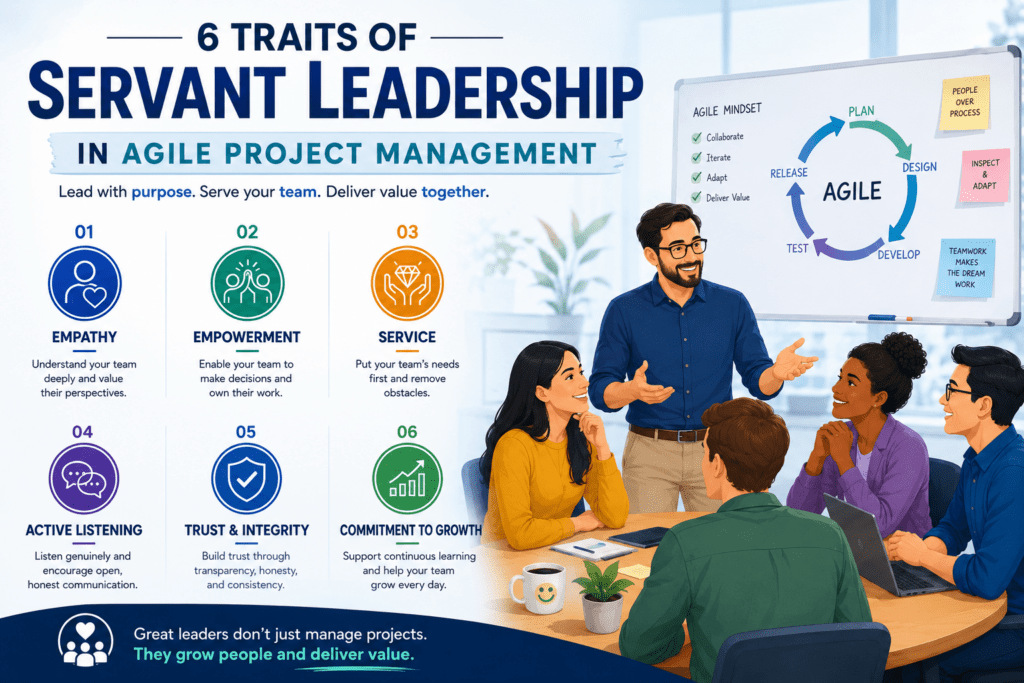
Servant leadership focuses on the individual growth of team members, and on their overall well-being, prior to the leader’s gain in authority or control. The term, “servant leadership,” was first recognized in the 1970 essay, “The Servant as Leader,” by Robert K. Greenleaf. Greenleaf claimed that the most successful leaders consider themselves servants, and choose to serve before leading. The concept of servant leadership resonates strongly in the Agile approach of project management within the role of Scrum Master. The Scrum Master facilitates transparent communication, removes barriers, and guides the team towards the answers.
What Is Servant Leadership?
In the lens of servant leadership, the leader has a strong belief that the empowered and self-organized team produces the best results more than a directed team. This leadership philosophy is the cornerstone of Agile, since self-organizing teams require a leader who has decision-making skills in contrast to a leader who makes all the decisions.
How Does Servant Leadership Differ From Autocratic Leadership?
Within a servant leadership framework, the role of the leader is obstacle removal and decision-making decentralization, whereas the core of autocratic leadership is centralized decision-making and execution through undirected compliance. Autocratic leadership can be effective in contexts where the results do not permit elaboration and where fast, immediate execution is a necessity, such as in certain military and emergency situations. With this leadership context, all the authority is centralized to one person.
- Servant leader — empowers self-organization, removes impediments, coaches rather than directs.
- Autocratic leader — centralizes decisions, directs task assignment, expects compliance without discussion.
What Are the 6 Traits of Servant Leadership in Agile Project Management?
In Agile environments, there are 6 key components of servant leadership – humility, active listening, trust and transparency, empathy, shared accountability, and empowerment by removing obstacles. Each component of servant leadership requires a different trait and is dedicated to the same overall goal of building a high performing team that requires little to no direct management.
How Does Humility Show Up in Servant Leadership?
Humility in servant leadership means genuinely recognizing that project results depend on the team’s collective effort, not the leader’s individual authority or expertise. A servant leader who demonstrates authentic humility, rather than a performed version of it, earns credibility that top-down authority alone cannot produce.
Why Is Active Listening Essential to Servant Leadership?
Active listening allows a servant leader to understand a team member’s perspective fully before responding, identifying where support is genuinely needed rather than assuming what the team requires. This deeper understanding is what allows a servant leader to know when to step in and when to step back.
How Does Trust and Transparency Define Servant Leadership?
A servant leader builds trust by extending trust first, giving the team real decision-making authority and communicating openly rather than withholding information to maintain control. This mutual trust is what makes self-organization possible — a team cannot organize itself effectively around a leader who withholds context or second-guesses every decision.
How Does Empathy Distinguish a Servant Leader?

Empathy in servant leadership means genuinely valuing each team member as an individual, understanding both their contribution to the group and their personal wellbeing, rather than treating people purely as task-executors. This combination of caring for the individual and recognizing their specific value to the team is what separates servant leadership from purely transactional management.
What Does Shared Accountability Look Like in Servant Leadership?
Shared accountability means the servant leader holds themselves answerable to the team, not just the reverse, treating authority as something distributed across the group rather than held exclusively by one person. A team that sees its leader accepting accountability alongside them, rather than assigning blame downward, develops a genuinely collective sense of ownership over outcomes.
How Does a Servant Leader Empower the Team and Remove Obstacles?
A servant leader empowers the team primarily by identifying and removing the obstacles blocking their progress, rather than directing how each task should be completed. This trait is the most operationally concrete of the six — it shows up daily in facilitating meetings, clearing blockers, and protecting the team’s focus, not just in a general leadership philosophy.
How Does Servant Leadership Apply to the Scrum Master Role Specifically?
The Scrum Master role is servant leadership applied directly to Agile practice, with day-to-day responsibilities including facilitating ceremonies, removing impediments, shielding the team from outside interruptions, and coaching rather than directing.
- Facilitates Agile ceremonies — sprint planning, daily stand-ups, reviews, and retrospectives — without dictating outcomes.
- Removes impediments blocking the team’s progress, escalating issues beyond the team’s own authority to resolve.
- Shields the team from external interruptions and scope changes mid-sprint, protecting focus.
- Coaches team members toward stronger self-organization rather than assigning tasks directly.
How Does Servant Leadership Appear on the PMP and PMI-ACP Exams?
Both the PMP and PMI-ACP exams test servant leadership through situational questions asking what a Scrum Master or Agile project manager should do when a team faces an obstacle, conflict, or a request to intervene directively. The correct answer typically favors facilitation, coaching, or obstacle removal over direct command, reflecting the servant leadership model tested throughout the People domain.
Sample Question 1
A development team is blocked because a required approval from another department has not arrived. What is the most appropriate servant leadership response? A) Assign a team member to complete the task without the approval B) Escalate and actively work to remove the blocker on the team’s behalf C) Wait for the team to resolve the issue independently D) Reassign the blocked work to a different sprint without further action
Sample Question 2
A stakeholder asks the Scrum Master to directly assign specific tasks to specific team members for the upcoming sprint. What is the servant leadership-aligned response? A) Assign the tasks as requested to maintain stakeholder satisfaction B) Facilitate the team’s own task selection and self-organization instead C) Refuse to engage with the stakeholder’s request at all D) Escalate the request to executive management immediately
Sample Question 3
Who is credited with originating the term “servant leader”? A) Ken Schwaber B) Robert K. Greenleaf C) Jeff Sutherland D) Kent Beck
Sample Question 4
A team member raises a concern during a retrospective that a recurring process issue is slowing the team down. What should a servant leader do first? A) Dismiss the concern to keep the retrospective on schedule B) Listen fully to understand the issue before proposing any solution C) Immediately implement a fix without team input D) Delay discussion of the issue to a future retrospective
Answers: 1) B — actively removing blockers on the team’s behalf is a core servant leadership responsibility. 2) B — facilitating self-organized task selection reflects servant leadership, even under stakeholder pressure to direct assignments. 3) B — Robert K. Greenleaf introduced the term in his 1970 essay “The Servant as Leader.” 4) B — active listening before responding is a foundational servant leadership trait, especially in a retrospective setting designed for open feedback.
Frequently Asked Questions
Is Servant Leadership Only for Scrum Masters?
Servant leadership is most closely associated with the Scrum Master role, but the underlying traits apply to any project manager or team lead working with a self-organizing or collaborative team, regardless of the specific Agile framework in use. A project manager on a hybrid or even predictive project can apply servant leadership principles within that project’s governance structure.
Who Coined the Term “Servant Leader”?
Robert K. Greenleaf coined the term “servant leader” in his 1970 essay “The Servant as Leader,” which argued that the most effective leaders choose to serve their team before aspiring to lead it. The concept predates Agile project management by decades and was later adopted into Agile practice because it matches the self-organizing team model Agile frameworks depend on.
Can Servant Leadership Work in Non-Agile Projects?
Servant leadership principles apply outside Agile projects as well, since traits like humility, active listening, and trust-building improve team performance regardless of the underlying project methodology. Agile frameworks formalize servant leadership into a specific role — the Scrum Master — but the leadership style itself is not exclusive to Agile.
Does Servant Leadership Mean a Leader Has No Authority?
Servant leadership does not mean the leader has no authority — it means the leader chooses to exercise that authority primarily by empowering the team and removing obstacles, rather than by directing every decision. A servant leader still makes decisions and holds accountability; the difference lies in how authority is exercised, not whether it exists.


