


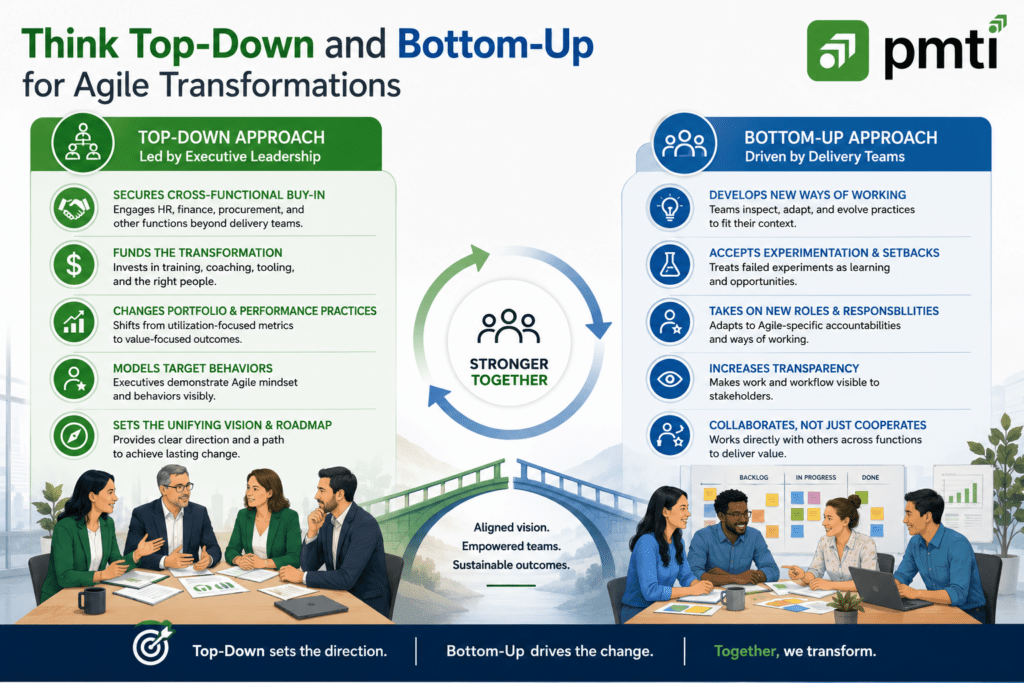
Agile transformations can fail when either solo approach is taken. When top executives do not push transformation, nor do the employees, funding, and the will to change the way the organization performs and manages the portfolio, the transformation effort is doomed to fail. The lack of bottom-up transformation engagement will mean that, no matter how much top-down effort is made, the changes to real-world practices will be cosmetic at best.

What Is a Top-Down Approach to Agile Transformation?
When discussing a top-down approach to Agile transformation, the starting point is executive leadership assembling coalition of commitment and a common vision to empower core delivery teams, which cannot succeed in isolation to the finance, HR, procurement and other support functions. Executive involvement is critical to the success of the transformation.
- Secures cross-functional buy-in, since Agile ways of working require support from HR, finance, and procurement, not just delivery teams.
- Funds the transformation, covering training, coaching, tooling, and any new staffing the change requires.
- Changes portfolio and performance practices, shifting measures like utilization-focused metrics toward value-focused ones that Agile actually rewards.
- Models target behaviors, since middle management will not adopt an Agile mindset the executive team does not visibly practice itself.
- Sets the unifying vision and roadmap, giving the transformation a clear direction rather than a collection of disconnected team-level experiments.
What Is a Bottom-Up Approach to Agile Transformation?
Bottom-up Agile transformation means focusing on individual delivery teams. If teams do not have a sense of urgency or ownership over a change, then they will only give it superficial compliance, which will not bring real transformation. Teams must expend real effort and bring about a new transformation in their daily behaviors instead of just doing what a new policy has decreed.
- Develops the details of new ways of working, inspecting and adapting them continuously rather than following a fixed executive mandate exactly.
- Accepts experimentation and setbacks, treating failed experiments as information rather than a problem to hide.
- Takes on new roles and responsibilities, adjusting to Agile-specific accountabilities that didn’t exist under the previous structure.
- Increases transparency, exposing work and workflow to stakeholders at a level teams may not have been accustomed to.
- Collaborates rather than merely cooperates, working directly with contributors from other functional areas instead of handing off work at fixed boundaries.
Why Do Agile Transformations Fail With Only a Top-Down Approach?
From the top results in superficial compliance. Teams do not take ownership and do not see the need for real engagement; this becomes “Agile theater.” Daily practices remain unchanged, and the only thing that changes is the organization’s? terminology. For example, meetings are now referred to as “standups,” and “retrospectives” are added to the calendar to satisfy a new checklist.
Why Do Agile Transformations Fail With Only a Bottom-Up Approach?
Transformations stemming entirely from team level fail because teams cannot change the various organization-wide funding models, portfolio intake processes, and performance metrics that continue to reward the previous way of working. Individual teams can work on improving their delivery practices, but unless policy at the executive level changes, improvement efforts will stay within that team and the organization will revert back to the previous state of working with the pull of middle management.
How Does Combining Both Approaches Create a “Sandwich Effect” on Middle Management?
Combining top-down and bottom-up pressure squeezes middle managers between executive mandate above and changed team-level practice below, leaving little room for managers resistant to Agile ways of working to maintain the status quo. Middle management is historically the layer most likely to resist Agile transformation, since it often sits furthest from both the executive vision and the team-level experience — the sandwich effect closes that gap from both directions at once.
How Do You Sequence Top-Down and Bottom-Up Efforts in Practice?
The best way to implement top-down and bottom-up approaches is to initiate change from the top-down by securing executive sponsorship and the funding needed to cover a pilot. While this is taking place, real-world bottom-up evidence-based changes will begin to be introduced by the pilot teams. These changes will help inform the broader portfolio and performance-metric changes that can only be made by the executive team. The two changes will not be implemented in a strict sequential order, but bottom-up changes will only be initiated after a top-down commitment has been made.
- Secure initial executive sponsorship and a funding commitment, even a modest one, before launching pilot teams.
- Launch pilot teams in parallel, generating concrete evidence of what Agile ways of working actually produce in your organization’s context.
- Feed pilot results back to executive leadership to inform portfolio, funding, and performance-metric changes at scale.
- Scale using both threads together — expanded executive commitment paired with lessons learned from the original pilot teams.
How Does This Connect to Established Change Management Models?
Agile transformation’s top-down and bottom-up dynamic mirrors established change management frameworks like Kotter’s 8-Step Model, where creating urgency and building a guiding coalition are top-down actions, while empowering action and generating short-term wins depend on genuine team-level engagement. Agile transformation is not a novel change management challenge — it follows the same fundamental dynamics organizational change has always required, applied specifically to how teams deliver work.
How Does This Appear on the PMI-ACP Exam?
The PMI-ACP exam tests Agile transformation concepts through scenario questions asking candidates to identify why a transformation is stalling and what corrective action addresses the root cause. A transformation scenario showing strong executive mandate but disengaged teams, or the reverse, is a common exam pattern testing whether candidates recognize the need for both directions of engagement.
Sample Question 1
An organization’s executive team has fully committed to an Agile transformation, funded training, and set a clear vision, but individual delivery teams show only superficial compliance with new ceremonies. What is the most likely root cause? A) Insufficient executive funding B) Lack of genuine bottom-up team engagement and ownership C) The vision statement was not detailed enough D) The organization moved too quickly through the transformation
Sample Question 2
A single delivery team has successfully adopted strong Agile practices on its own initiative, but the improvement has not spread to other teams and the organization’s funding model still rewards utilization over value delivered. What is missing? A) Better team-level retrospectives B) Top-down executive sponsorship and portfolio-level policy change C) A different Agile framework D) More frequent daily stand-ups
Sample Question 3
What does the “sandwich effect” refer to in the context of Agile transformation? A) A scheduling technique for sprint planning B) Pressure on resistant middle management from both executive mandate and team-level practice change simultaneously C) A method for prioritizing the product backlog D) A technique for combining Scrum and Kanban
Sample Question 4
Which combination of actions best reflects a well-sequenced Agile transformation? A) Wait for full organization-wide agreement before starting any pilot teams B) Secure initial executive sponsorship, run pilot teams in parallel, then use pilot evidence to inform broader policy change C) Launch pilot teams first, then seek executive sponsorship only after full success is proven D) Change portfolio funding models before any team-level piloting begins
Answers: 1) B — strong top-down commitment without genuine team-level ownership produces exactly this superficial-compliance pattern. 2) B — isolated team-level success cannot scale without top-down authority to change funding and portfolio practices. 3) B — the sandwich effect describes simultaneous top-down and bottom-up pressure squeezing resistant middle management. 4) B — concurrent, mutually reinforcing top-down and bottom-up action, rather than a strict either-first sequence, reflects best practice.
Frequently Asked Questions
Should Agile Transformations Start Top-Down or Bottom-Up?
Simultoenously engaging top-down commitment and bottom-up urgency is essential for the successful transformation of an organization, as opposed to starting with one approach before the other. A purely top-down transformation may result in superficial compliance, while a purely bottom-up transformation will result in transformation stalling due to a lack of funding and/or authority to growth.
What Is the “Sandwich Effect” in Agile Transformation?
The sandwich effect articulates the dilemma created in the middle management layer of an organization when specific directives from the upper management layer merge with the practices of the lower management layer. The lower management layer comprises the Agile team. The simultaneous application of the upper and lower management layers is the most effective way to overcome the resistance of middle management to Agile ways of working, as compared to the application of either layer in isolation.
How Long Does an Agile Transformation Typically Take?
The agility of an organization is demonstrated by the transformation of its working practices. The size and the complexity of an organization determine the length of an Agile transformation. Substantive transformations take at least a year to achieve. Most organization expect that transformations can be achieved in a quarter or two, and often confuse the adoption of transformational practices with the completion of the transformation.
Can a Small Team Start an Agile Transformation Without Executive Support?
A small team can begin adopting Agile practices without executive support, but the transformation will likely stay isolated to that team without the funding, portfolio changes, and cross-functional cooperation only executive sponsorship can provide. A grassroots pilot can generate valuable evidence to eventually secure that executive backing, but it functions as a starting point, not a substitute for top-down engagement.


