


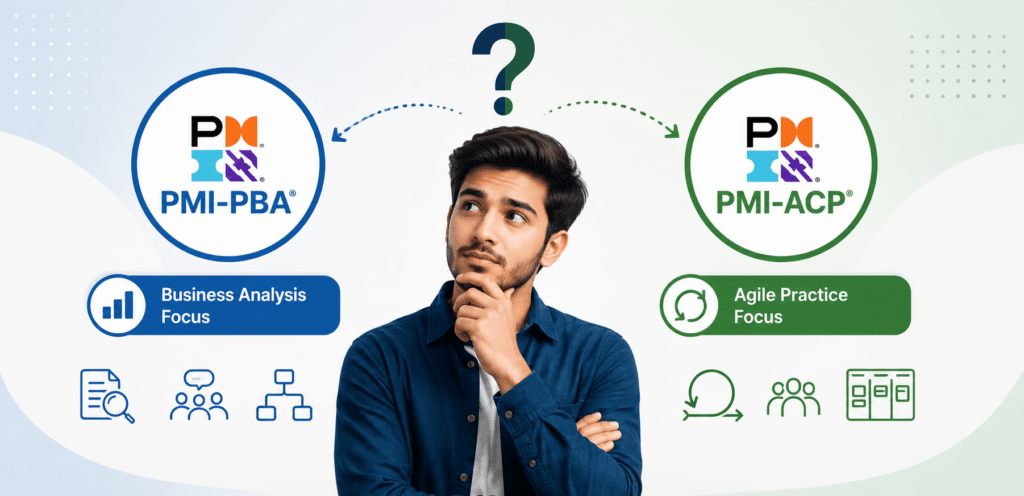
Which Certification to Choose: PMI-PBA or PMI-ACP?

Both PMI-PBA and PMI-ACP certifications come from PMI and require Agile training for applicants. Both certifications enable candidates to become qualified Product Owners. But they actually differ quite a lot:
- PMI-PBA focuses on the ability to elicit, trace, and verify requirements in predictive, Agile, and mixed methods environments.
- PMI-ACP focuses on the mastery of Agile frameworks, with candidates facing 120 questions on Scrum, Kanban, Lean, XP, and Crystal in 180 minutes.
One describes the “what” of the project. The other describes the “how” of the project in an adaptive context. There really isn’t an effect on your career no matter which of the two you choose; however, the certification you choose may provide you with skills that are more relevant to your career.
What Is the Fundamental Difference Between PMI-PBA and PMI-ACP?
- PMI-PBA is about managing requirements regardless of delivery. The Business Analyst elicits, traces, and validates requirements realized in a solution across predictive, Agile, and blended environments.
- PMI-ACP focuses on managing delivery in an Agile way using Scrum, Kanban, Lean, XP, and Crystal to maximize value through iterations. Requirements are secondary to validated competencies.
The Product Owner role combines both aspects:
- From PMI-PBA, it is focused on requirements by articulating user stories in relation to business needs, including criteria for acceptance, and validating the backlog in response to the business problem.
- From PMI-ACP, it is focused on Agile delivery by prioritizing the backlog based on business value, and facilitating sprints and iterations.
How Do the Eligibility Requirements Compare?

| Requirement | PMI-PBA | PMI-ACP |
| Education | Bachelor’s or secondary | Not specified |
| General Experience | 36 months (Bachelor’s) or 60 months (secondary) of BA experience | 2,000 hours on project teams |
| Agile Experience | Not separated | 1,500 hours in last 3 years |
| Training | 35 contact hours of BA education | 21 contact hours of Agile training |
| Lookback Period | Within last 8 years | Within last 3 years (Agile) |
| References | None required | None required |
PMI-PBA establishes deep BA mastery with no separate Agile requirement. PMI-ACP requires both general project and specific recent Agile experience.
How Are the Exams Distinct?
| Attribute | PMI-PBA | PMI-ACP |
| Total Questions | 200 | 120 |
| Scored Questions | 175 | 115 |
| Unscored Items | 25 | 5 |
| Duration | 240 min (4 hrs) | 180 min (3 hrs) |
| Time Per Question | ~72 sec | ~90 sec |
| Domains | 5 | 7 |
| Delivery | Pearson VUE | Pearson VUE |
| Passing Score | Not published | Not published |
| Primary Reference | PMI Guide to BA + ECO | Agile Practice Guide + ECO |
| Agile Content | Integrated | 100% of exam |
PMI-PBA is longer with more questions. PMI-ACP allows more time per question but requires fluency across all Agile frameworks.
Comparison of Domain Structures
PMI-PBA Domains
| Domain | Weight | # Questions | Core Function |
| Analysis | 35% | ~61 | Elicits, models, validates, prioritizes requirements |
| Planning | 22% | ~39 | Designs requirements management approach |
| Needs Assessment | 18% | ~32 | Frames business problem; defines success criteria |
| Traceability & Monitoring | 15% | ~26 | Traces requirements to deliverables; governs changes |
| Evaluation | 10% | ~17 | Validates delivered solution against business outcomes |
PMI-ACP Domains
| Domain | Core Function |
| Agile Mindset and Principles | Applies Agile values and principles to decisions |
| Value-Driven Delivery | Prioritizes and delivers highest-value increments first |
| Stakeholder Engagement | Collaborates with stakeholders in Agile contexts |
| Agile Team Performance | Builds, coaches, sustains high-performing Agile teams |
| Adaptive Planning | Plans iteratively; responds to change over specifications |
| Problem Detection and Resolution | Identifies and resolves impediments to delivery flow |
| Continuous Improvement | Facilitates retrospectives; drives process improvement |
The domains do not align. PMI-PBA has no equivalent to PMI-ACP’s focus on Agile principles, while PMI-ACP deprioritizes formal requirements traceability, a PMI-PBA domain.
What Career Roles Are Supported?
PMI-PBA Roles
| Role | US Salary | Main Competency |
| Business Analyst | $80-110K | Requirements elicitation, documentation, analysis |
| Senior Business Analyst | $100-130K | Complex requirements; stakeholder leadership |
| Requirements Manager | $105-135K | Cross-project requirements governance |
| Product Owner (req-led) | $100-130K | Requirements traceability; acceptance criteria |
| Business Architect | $110-140K | Enterprise requirements aligned to business architecture |
PMI-ACP Roles
| Role | US Salary | Main Competency |
| Scrum Master | $105-133K | Scrum facilitation, coaching, impediment removal |
| Agile Project Manager | $100-130K | Agile delivery leadership across sprints |
| Agile Coach | $110-145K | Agile transformation, adoption, team maturity |
| Agile Delivery Manager | $115-145K | Governance of Agile delivery; reporting |
| Product Owner (Agile-led) | $100-130K | Agile delivery, backlog prioritization, stakeholder alignment |
The Product Owner is the one role credentialed by both, from different angles.
Which Sectors Acknowledge Each?
| Sector | PMI-PBA | PMI-ACP |
| Financial Services/Banking | High | Growing (FinTech, digital) |
| Healthcare | High | Moderate (IT modernization) |
| Software Development | High | High |
| Digital Product Management | High | High |
| Enterprise Agile (SAFe) | Moderate | High |
| Government IT | High | Moderate |
| Construction/Engineering | Low-Moderate | Low |
| Consulting | High | High |
PMI-ACP leans tech-first (Amazon, Google, Microsoft, Salesforce). PMI-PBA leans governance-heavy (formal BA as a discipline).
How Do Salaries Compare?
| Dimension | PMI-PBA | PMI-ACP |
| US Salary Range | $80-140K (role-dependent) | $90-145K (role-dependent) |
| Premium Over Non-Certified | 15-25% | Role-specific; dominant in Agile tech |
| Highest Paying Role | Business Architect ($110-140K) | Agile Coach/Manager ($110-145K) |
| PMI Salary Survey | None PBA-specific | None ACP-specific |
Edge depends more on role/industry than credential. Business Architect with PBA in finance earns more than Scrum Master with ACP in a startup.
Which Should You Earn First?
If you mostly elicit, document, and manage stakeholders (regardless of your delivery method), then PMI-PBA should be your first choice.
- PMI-PBA first if you mainly elicit, document and manage stakeholders, regardless of delivery method.
- PMI-ACP first if you have 1500+ documented Agile hours in the last 3 years and want Agile roles in tech/product firms.
Consider these scenarios:
- BA managing requirements in Agile teams → PBA first
- Already have 1500+ Agile hours → ACP to avoid losing eligibility
- Want BA credential to pair with PMP → PBA for requirements governance
- Transitioning into Agile without the hours yet → PBA now, ACP later
Is Holding Both Beneficial?
Yes, if you both manage requirements and deliver in Agile environments.
- PMI-PBA validates requirements governance
- PMI-ACP validates Agile delivery expertise
Together they suit senior Agile BA, Product Owner and Delivery Lead roles. Renewal cycles align and some PDUs can apply to both.
Frequently Asked Questions
What are the primary differences between PMI-PBA and PMI-ACP?
PMI-PBA is based on requirements management and PMI-ACP is based on Agile delivery in the context of Scrum, Kanban, Lean, XP and Crystal frameworks.
Can Business Analysts apply for PMI-ACP?
Yes, if they meet the requirement of 2000 project delivery hours and 1500 Agile hours in the last 3 years. An environment consisting solely of Waterfall does not qualify.
Which exam is more difficult?
PMI-PBA is the longer exam, consisting of 200 questions and a 240 minute time allocation. PMI-ACP consists of 120 questions and a 180 minute time limit, and focuses on the 6 Agile frameworks. It is most dependent on the individual’s strongest exam domain.
Do they require the same PDUs for renewal?
Yes, and PDUs can apply to both. 30 of the 60 PDUs for ACP must be in Agile, and 35 of the 60 PDUs for PBA must be in BA. Some activities in Agile BA may count for both PDUs.
Is ACP better than PBA for Product Owners?
Neither is better than the other. PBA works better for requirements-side (traceability, acceptance criteria) and ACP works better for the delivery-side (prioritization, facilitation). Both are equally important for Senior PO roles.
Which is more globally recognized?
Both have PMI’s worldwide brand in 180+ countries. ACP has the lead position in sectors employing Agile within Product Development, whereas PBA is dominant in sectors (healthcare, finance, government) where there is formal BA governance.


