


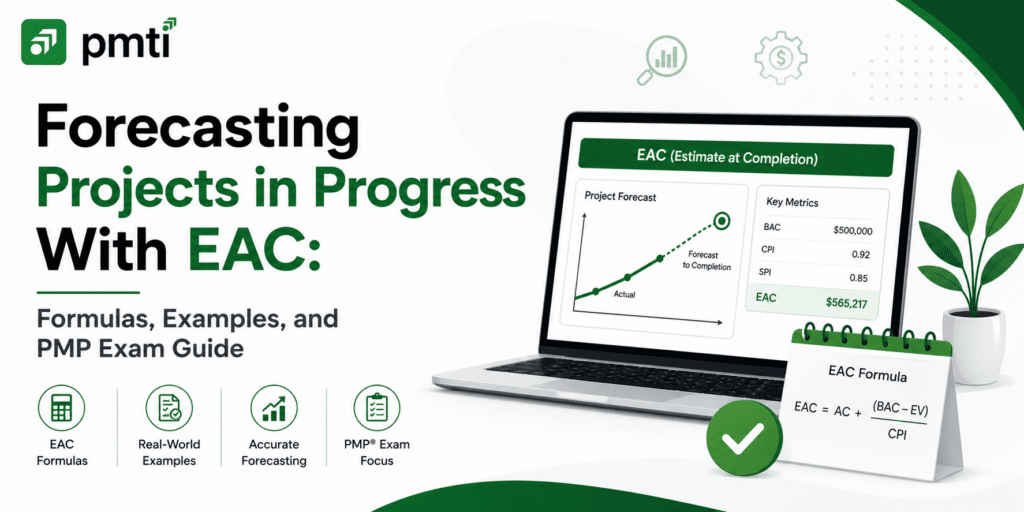
Forecasting Projects in Progress With EAC: Formulas, Examples, and PMP Exam Guide
Project Managers are continually asked about the cost of projects and want to know how the company is performing based on the work that has been completed and the expected work ahead. The answer to this important question is the Estimate at Completion (EAC). Estimated at Completion (EAC) is the expected total cost of the project based on both the work that has been completed and the work that is expected to be completed. EAC is recalculated at each reporting period. Project Managers must provide an estimate on what this project is expected to cost given the work that has actually been completed. Four different formulas are used to calculate the Expected Estimate at Completion (EAC) and selecting the incorrect formula results in a misleading EAC to the project sponsors.
What Is Estimate at Completion (EAC) in Project Management?

The Expected Estimate at Completion (EAC) is used to estimate the total cost of a project based on current project cost and scheduling performance. The Practice Standard for Earned Value Management (EVM) identifies Estimated at Completion (EAC) as a core output of the Control Cost process, whereas Budget at Completion (BAC) is fixed during the project’s planning.
EAC is project performance focused, while BAC is project planning focused. EAC is the new project performance focused estimate to replace the original funding estimate.
What Is the Relationship Between AC, EV, ETC, and EAC?

AC, EV, ETC, and EAC represent the cost values in an unbroken chain with AC and EV representing the past, while ETC represents the future, and EAC represents the total. Each value is a direct input to the next.
- Actual Cost (AC) is the total expenditure on a project as recorded in accounting or time logs.
- Earned Value (EV) captures the value of work done with current budget.
- Estimate to Complete (ETC) captures the expected cost of the unfinished work.
Estimate at Completion (EAC) captures the expected cost of the entire project, which is the sum of the actual cost (AC) and Estimate to Complete (ETC).
What Are the Four EAC Formulas?
PMI identifies four formulas for EAC, and the correct one is dependent on whether the original estimate is valid, whether current variances are of a one-time nature, and whether schedule performance impacts cost. Selecting a formula is a judgment call based on the project, and not a selection from a pre-determined list.
- EAC = AC + Bottom-Up ETC — use when the original estimate is fundamentally flawed.
- EAC = AC + (BAC − EV) — use when current variance is a one-time event, not expected to recur.
- EAC = BAC / CPI — use when current cost performance is expected to continue unchanged for the remainder of the project.
- EAC = AC + (BAC − EV) / (CPI × SPI) — use when both cost and schedule performance are expected to influence the remaining budget.
AC = Actual Cost, BAC = Budget at Completion, EV = Earned Value, ETC = Estimate to Complete, CPI = Cost Performance Index, SPI = Schedule Performance Index.
The four formulas are demonstrated below using one continuous case study — an IT infrastructure rollout with a $200,000 Budget at Completion — so the same project produces four different forecasts depending on the assumption applied.
When Do You Use EAC = AC + Bottom-Up ETC?
EAC = AC + Bottom-Up ETC applies when the original cost or schedule estimate is based on incorrect assumptions and does not reflect the current situation. This equation completely disregards the defective baseline and uses a new ground-up calculation to estimate the remaining work.
The IT infrastructure deployment has spent $50,000 (AC) when the vendor reveals that planning assumptions about the cost of hardware were obsolete. The project team estimates the remaining work from scratch and generates a new bottom-up ETC of $180,000.
EAC = $50,000 + $180,000 EAC = $230,000
The original $200,000 budget is no longer relevant to this forecast — the new estimate stands on its own.
When Do You Use EAC = AC + (BAC − EV)?
EAC = AC + (BAC – EV) applies when an estimated cost has been expended, but is attributed to a rare one-time cost, and the remaining work is expected to follow the original budget. This equation retains the original budget assumptions for the remaining work.
The same deployment reaches the completion of a reporting period with AC = $90,000 and EV = $70,000. The cost overrun was caused by a single vendor selling an invoice at an incorrect price, and the vendor has confirmed that future pricing will be correct.
EAC = $90,000 + ($200,000 − $70,000) EAC = $90,000 + $130,000 EAC = $220,000
When Do You Use EAC = BAC / CPI?
Use EAC = BAC / CPI when the cost variance observed so far is consistent enough to indicate it will continue for the remainder of the project. This equation treats the cost variance for the entire remaining project.
With the same reporting period, AC = $90,000 and EV = $70,000, which makes CPI = 0.78 (EV / AC). The project manager comes to the conclusion that the inefficiency is a permanent state (recurring resource limitation) and not temporary (one-time event).
EAC = $200,000 / 0.78 EAC = $256,410
When Do You Use EAC = AC + (BAC − EV) / (CPI × SPI)?
Use EAC = AC + (BAC – EV) / (CPI × SPI) when it is determined that cost performance and schedule performance will both influence the cost to complete the project. Of the four equations, this is the most conservative equation, as schedule delays will likely cause cost to increase even more.
AC = $90,000, EV = $70,000, CPI = 0.78, and Planned Value (PV) = $80,000, which means SPI = 0.88 (EV / PV). The project manager decides both the cost trend and the schedule delay will continue.
EAC = $90,000 + ($200,000 – $70,000) / (0.78 × 0.88) EAC = $90,000 + $130,000 / 0.6864 EAC = $90,000 + $189,394 EAC = $279,394
How Do You Choose the Right EAC Formula?
The scenario must include specific language regarding the nature of the variances (one-time, ongoing, isolated to cost, affecting schedule). Scenarios in exam questions and project reports include this language to indicate the correct formula.
- Select AC + Bottom-Up ETC when the question states the original estimate was wrong or based on invalid assumptions.
- Select AC + (BAC − EV) when the question states the variance was atypical or a one-time event.
- Select BAC / CPI when the question states current performance is expected to continue.
- Select AC + (BAC − EV) / (CPI × SPI) when the question references both cost and schedule performance influencing the remainder.
- Default to BAC / CPI only when no other qualifying language is present, since it is the most commonly tested variant.
How Do You Interpret an EAC Result?
EAC less than BAC suggests the performance of the project will result in a budget savings; EAC greater than BAC suggests a budget overrun; EAC equal to BAC suggests the project is performing to budget expectations. EAC and BAC comparison is the best indicator to provide to a project sponsor.
- EAC < BAC — the project is trending under budget based on current performance.
- EAC = BAC — the project is trending exactly on budget.
- EAC > BAC — the project is trending over budget and requires corrective action or rebaselining.
What Is Variance at Completion (VAC) and How Does It Relate to EAC?
EAC less than BAC suggests the performance of the project will result in a budget savings; EAC greater than BAC suggests a budget overrun; EAC equal to BAC suggests the project is performing to budget expectations. EAC and BAC comparison is the best indicator to provide to a project sponsor.
Using the one-time-event scenario above, where EAC = $220,000:
VAC = $200,000 − $220,000 VAC = −$20,000
A negative VAC confirms the project is forecast to finish $20,000 over its original budget.
What Common Mistakes Do Project Managers Make When Calculating EAC?
The most frequent of these is using the wrong formula to support the stated assumption, confusing EAC and ETC, and using a single case as an ongoing trend. Each produces an inaccurate forecast concerning the financial health of the project.
- Confusing EAC with ETC, reporting total project cost when only remaining cost was requested.
- Applying BAC / CPI by default without checking whether the scenario actually describes an ongoing trend.
- Ignoring SPI entirely in situations where schedule delays are compounding cost overruns.
- Treating a single reporting period’s CPI as a permanent trend without reviewing prior periods.
- Forgetting to recalculate EAC at each reporting cycle, leaving stakeholders working from a stale forecast.
How Does EAC Appear on the PMP Exam?
A candidate is expected to answer EAC related questions on the PMP exam by identifying the correct assumption upon which the particular variant of the formula hinges. The exam does not provide the candidate with the formula and is instead concerned with the candidate’s ability to identify the correct assumption.
Sample Question 1: A project has a BAC of $400,000. Current CPI is 0.8, and the project manager expects this cost efficiency to hold steady for the remainder of the work. What is the EAC? A) $320,000 B) $400,000 C) $500,000 D) $480,000
Sample Question 2: A project manager discovers that the original cost estimate relied on a vendor quote that has since been withdrawn. AC to date is $60,000, and the team produces a new bottom-up estimate of $210,000 for the remaining work. What is the EAC? A) $150,000 B) $210,000 C) $270,000 D) $60,000
Sample Question 3: A project has BAC = $150,000, AC = $80,000, and EV = $95,000. The project manager attributes the favorable variance to a one-time discount from a supplier that will not recur. What is the EAC? A) $135,000 B) $150,000 C) $158,000 D) $175,000
Sample Question 4: A project has EAC = $310,000 and BAC = $280,000. What does this forecast indicate, and what is the VAC? A) The project is under budget; VAC = $30,000 B) The project is over budget; VAC = −$30,000 C) The project is on budget; VAC = $0 D) The project is over budget; VAC = $30,000
Answers: 1) C — BAC / CPI = $400,000 / 0.8 = $500,000. 2) C — AC + Bottom-Up ETC = $60,000 + $210,000 = $270,000. 3) A — AC + (BAC − EV) = $80,000 + ($150,000 − $95,000) = $135,000, used for one-time, non-recurring variances. 4) B — VAC = BAC − EAC = $280,000 − $310,000 = −$30,000, indicating a forecasted overrun.
Frequently Asked Questions
What Is the Difference Between EAC and ETC?
EAC includes the cost for all work on a project in the future, ETC includes the cost of the work that is remaining only. The two have a direct relationship: EAC = AC + ETC.
Which EAC Formula Is Most Commonly Tested on the PMP Exam?
The most commonly tested EAC formula on the PMP exam is BAC/CPI. This formula is typically the one most applicable in the scenario where it is expected that CPC (current cost performance) will continue. That being said, candidates are still required to know the other three variants of this formula since the intent of PMP exam questions is not to determine if a candidate can correctly answer one formula, but rather to answer which of the provided formulas is most appropriate.
Can EAC Be Lower Than Actual Cost?
EAC cannot be less than Actual Cost in any scenario since EAC is always equal to AC + a non-negative remainder. A lower Actual Cost value would mean a calculation error, and most often this would be the case where a formula was used that was not appropriate for that scenario.
Does a Negative VAC Always Require Corrective Action?
A negative VAC denotes a forecasted budget overrun and, therefore, needs to be reviewed. This does not necessitate corrective action; for example, if the budget overrun is due to a variances caused by a scope change that the sponsor has approved, then no corrective action is required. The project manager will distinguish between variances due to scope changes that have been approved and variances due to performance issues before deciding to recommend a response.PMP Exam Update 2026: Who’s Affected and How to Successfully Pass the New Exam


