


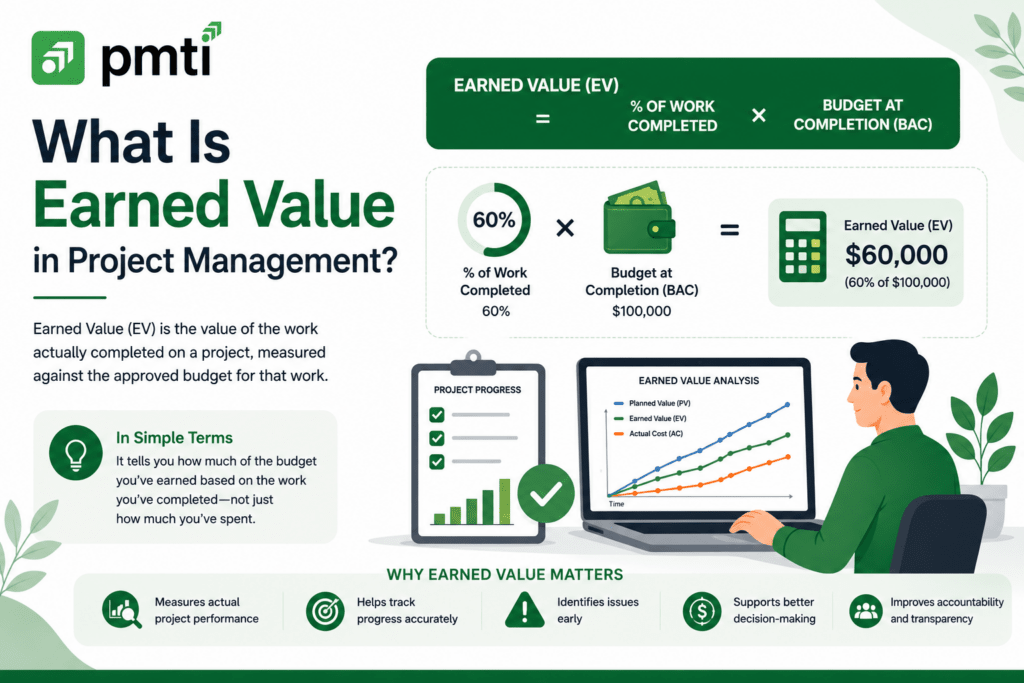

Earned Value (EV) means measuring the budgeted value for work performed on a project to determine the project’s status in relation to time and cost. Earned Value Management (EVM) includes the methodologies to relate EV to Planned Value and Actual Cost to bring all the performance equations and formulas that project managers need to predict the project’s final outcome. Each of the EVM formulas: CPI, SPI, EAC, ETC, and VAC, are built on these three components.
Earned Value (EV) is the budgeted cost of the work performed on the project to date. EV assigns a value to the progress made on a project, and helps project managers to compare work against time and expenditures.
What Is Earned Value Management (EVM)?
Earned Value Management (EVM) is a methodology of project management that assesses performance objectively through integration of scope, time and cost domains and is based on work breakdown structure. EVM is based on metrics rather than verbal progress reports.
What Are the Core Earned Value Management Terms and Formulas?
Every single EVM formula is derived from the combination of three factors: Actual Cost (AC), Planned Value (PV), and Earned Value (EV). Understanding the formulas and their meaning is essential to understand and interpret all the performance measures and predict the project’s outcome.
- Actual Cost (AC) — total money spent on the project to date. Direct input value, not calculated.
- Planned Value (PV) — budgeted cost of work scheduled to be complete by this date. Formula: Planned % Complete × BAC.
- Earned Value (EV) — budgeted cost of work actually completed to date. Formula: % Work Complete × BAC.
- Budget at Completion (BAC) — total approved budget for the entire project.
- Cost Performance Index (CPI) — cost efficiency ratio. Formula: EV / AC. CPI below 1 signals over budget; above 1 signals under budget.
- Schedule Performance Index (SPI) — schedule efficiency ratio. Formula: EV / PV. SPI below 1 signals behind schedule; above 1 signals ahead of schedule.
- Cost Variance (CV) — dollar amount over or under budget. Formula: EV − AC. Negative signals over budget.
- Schedule Variance (SV) — dollar amount ahead or behind schedule. Formula: EV − PV. Negative signals behind schedule.
- Estimate at Completion (EAC) — forecasted total project cost given current performance. Four formula variants apply depending on project conditions.
- Estimate to Complete (ETC) — forecasted cost of remaining work only. Formula: EAC − AC.
- Variance at Completion (VAC) — forecasted budget variance at project end. Formula: BAC − EAC.
How Do You Calculate Earned Value?
To calculate Earned Value, the project manager will need to multiply the percentage of work accomplished by the total approved budget.
A software implementation project has a total budget (BAC) of $400,000 and has 800 planned units of work to be accomplished. As of today’s reporting, the work units completed are at 560.
Percent Complete = 560 / 800 = 70% EV = 70% × $400,000 EV = $280,000
The project has earned $280,000 in budgeted value based on the work actually completed, regardless of how much has actually been spent.
How Do You Interpret Earned Value Against Planned Value and Actual Cost?
EV versus PV illustrates performance on the project schedule, and EV versus AC illustrates performance on project cost. Both comparisons need to be done separately. A project can be scheduled ahead of completion and cost ahead of completion, or cost behind completion and scheduled behind completion — either comparison does not imply the other.
- EV below PV — the project is behind schedule; less work has been completed than planned by this date.
- EV above PV — the project is ahead of schedule; more work has been completed than planned by this date.
- EV below AC — the project is over budget; more has been spent than the value of work completed.
- EV above AC — the project is under budget; less has been spent than the value of work completed.
How Do You Read an Earned Value Graph?
PV, EV, and AC are plotted on an Earned Value graph over time, and the relative position of the three lines helps define the status of the project schedule and cost. Earned Value graphs simplify reporting the status of the project for stakeholders who are unfamiliar with the Earned Value Management System.
- EV line below the PV line indicates the project is behind schedule.
- EV line above the PV line indicates the project is ahead of schedule.
- AC line above the EV line indicates the project is over budget.
- AC line below the EV line indicates the project is under budget.
How Does Earned Value Connect to Other EVM Formulas?
The PMP exam assesses Earned Value through direct calculations and multi-metric interpretations. These interpretations require the understanding of the relationship between CPI and SPI rather than their individual values. Exam questions often include 5 or more values. They assess the overall health of the project based on those values.
- PERT and three-point estimating generate the duration and cost inputs used to establish PV before a project begins.
- EAC forecasting uses EV, AC, and CPI to project total project cost once work is underway.
- Payback Period evaluates a project’s investment recovery timeline before EVM tracking begins.
- Return on Investment (ROI) evaluates overall project profitability alongside EVM cost data. See the full formula
- Parametric and analogous estimating establish the original BAC and PV figures that EVM tracks against throughout execution.
How Does Earned Value Appear on the PMP Exam?
The PMP exam tests Earned Value through both direct calculation questions and multi-metric interpretation scenarios that require reading CPI and SPI together rather than in isolation. Exam questions frequently supply five or more values at once and ask what they collectively indicate about project health.
Sample Question 1: A project has BAC = $500,000, PV = $310,000, EV = $290,000, and AC = $270,000. What does this data indicate about project performance? A) The project is ahead of schedule and over budget B) The project is behind schedule and under budget C) The project is ahead of schedule and under budget D) The project is behind schedule and over budget
Sample Question 2: A project manager calculates CPI = 1.08 and SPI = 0.91 for an active project. Which statement correctly interprets these figures? A) The project is spending efficiently but running behind schedule B) The project is over budget and ahead of schedule C) The project is on budget and on schedule D) The project is under budget and behind on cost efficiency
Sample Question 3: A project has EV = $150,000 and PV = $180,000. If this trend continues unchanged, what is the most likely outcome? A) The project will finish ahead of schedule B) The project will finish behind schedule C) The project will finish under budget D) The project will finish exactly on budget
Sample Question 4: A project has completed 45% of its total scope. The total approved budget is $220,000. What is the current Earned Value? A) $45,000 B) $99,000 C) $121,000 D) $220,000
Answers: 1) B — EV ($290,000) is below PV ($310,000), indicating the project is behind schedule; EV ($290,000) is above AC ($270,000), indicating the project is under budget. The project is behind schedule and under budget. 2) A — CPI above 1 indicates strong cost efficiency; SPI below 1 indicates the project is behind schedule. 3) B — EV below PV indicates the project is behind schedule, and this trend, if unchanged, results in finishing behind schedule. 4) B — EV = 45% × $220,000 = $99,000.
Frequently Asked Questions
What Is the Difference Between Earned Value and Planned Value?
Earned Value focuses on the budgeted cost of work that has been completed, whereas Planned Value focuses on the budgeted cost of work that was scheduled to be completed by a given date. The difference between the two indicates if the project is ahead of schedule, on schedule, or behind schedule.
Is Earned Value the Same as Earned Value Management?
Earned Value is a single metric, whereas Earned Value Management is the entire methodology that combines Earned Value, Planned Value, and Actual Costs to provide a variety of performance and forecasting metrics. EV is one input among many in Earned Value Management.
How Often Should Earned Value Be Calculated During a Project?
Earned Value should be evaluated on a scheduled and consistent basis (e.g. weekly, bi-weekly, monthly). Not evaluating Earned Value until the later stages of the project removes the purpose for which the metric was implemented.
Do You Need Special Software to Calculate Earned Value?
Earned value calculations rely primarily on simple percentage and budget data that are placed in a spreadsheet. So, specialized software for earned value is unnecessary. Larger organizations may have dedicated EVM software, but the calculations are still simple mathematics.PMP Exam Update 2026: Who’s Affected and How to Successfully Pass the New Exam


