


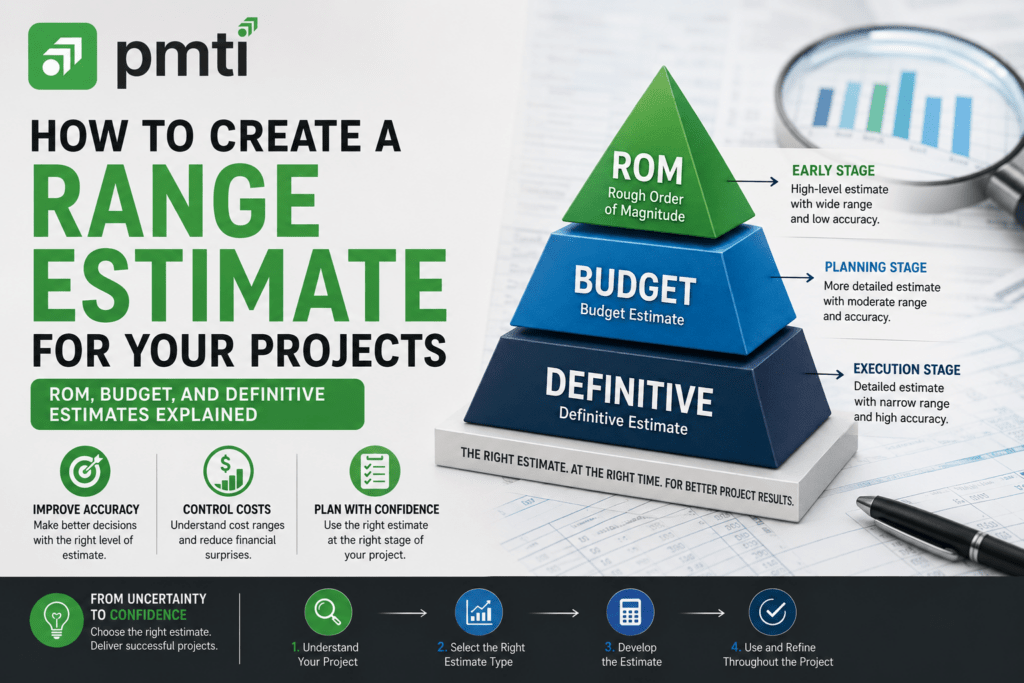

What Is a Range Estimate in Project Management?
A range estimate in project management is a risk-adjusted value for a project cost or duration that is described within a range, considering the uncertainty present with early or limited project information. Range estimates imply that the accuracy of the estimate will improve as a project progresses from the initiation phase to the detailed planning phase.
What Are the Three Types of Range Estimates?
PMI defines three range estimate types — Rough Order of Magnitude, Budget Estimate, and Definitive Estimate — each of which represents an increasingly refined accuracy band as the project moves through its lifecycle.
- Rough Order of Magnitude (ROM): accuracy range of −25% to +75%, used during early initiation when detailed information is not yet available.
- Budget Estimate: accuracy range of −10% to +25%, used during planning once scope is better defined.
- Definitive Estimate: accuracy range of −5% to +10%, used after detailed planning is complete, when the estimate is reliable enough to control execution against.
How Do You Calculate a Range Estimate?
To calculate a range estimate, take a point estimate and apply the accuracy percentage under the estimate type. A PMI formula will not provide the point estimate. That figure is derived from an analogous, parametric, or bottom up estimate. However, a range is easy to calculate once a point estimate is obtained.
A project manager produces an early ROM point estimate of $200,000 for a new facility build.
Lower Bound = $200,000 × (1 − 0.25) = $150,000 Upper Bound = $200,000 × (1 + 0.75) = $350,000 ROM Range = $150,000 to $350,000
Later, after detailed planning, the same project’s estimate refines to $210,000, now qualifying as a Definitive Estimate.
Lower Bound = $210,000 × (1 − 0.05) = $199,500 Upper Bound = $210,000 × (1 + 0.10) = $231,000 Definitive Range = $199,500 to $231,000
The range shrinks heavily from a $200,000 gap at ROM to a $31,500 gap at Definitive, Building trust and demonstrating the true value added by detailed planning.
What Are the Benefits of Range Estimation?
Range estimation communicates project uncertainty honestly, supports contingency planning, and improves stakeholder trust by setting realistic expectations instead of a falsely precise single number.
- Communicates the genuine level of confidence behind a cost or duration figure at each project stage.
- Identifies best-case, most likely, and worst-case outcomes for stakeholder planning.
- Supports contingency reserve decisions by quantifying the potential range of overrun.
- Improves stakeholder trust by avoiding the false precision of a single fixed number presented too early.
What Are the Pitfalls of Range Estimation?
Range estimation fails when wider estimates made early on by PMs convince stakeholders that a range is final. It also fails when a project manager’s personal bias causes them to believe that a range must be tight.
- Misinterpretation occurs when stakeholders anchor to the low end of a ROM range and treat it as a guaranteed final cost.
- Bias occurs when a project manager’s optimism or pressure to appear confident narrows a range beyond what the available information actually supports.
- Overreliance occurs when a range estimate is not revisited and tightened as the project moves into more detailed planning stages.
How Does Range Estimation Differ From Three-Point (PERT) Estimating?
From the perspective of accuracy, fixed range estimating and three-point estimating, which utilizes the PERT formula, each rely on different inputs. Range estimating is concerned with confidence at a particular stage of the project, whereas three-point estimating is concerned with a statistically weighted number at the activity level. For three-point estimating, the project manager starts with an activity level PERT estimate, after which a range of ROM (Rough Order of Magnitude), Budget, or Definitive accuracy is applied.
What Are the Inputs, Activities, and Outputs of Range Estimating?
The inputs to range estimating include the project approach to estimating, information available, organizational resources, and project context. The activity is analogous, parametric, or bottom-up estimating techniques. The output is an estimate along with a rationale.
- Inputs: project estimating approach, estimating information, estimator expertise, enterprise environmental factors, organizational process assets.
- Activities: analogous estimating, parametric estimating, bottom-up estimating.
- Outputs: completed range estimate, documented basis of estimate.
How Might Range Estimation Be Tested in the PMP Exam?
Range estimation in the context of the PMP exam is typically a question of scenario identification and recognition of the three accuracy level bands, followed by a recall of the context of that estimate at a given project stage. Other questions within this context may require an understanding of the logic of the accuracy bands, and in certain situations, convert the accuracy bands to a dollar value.
Sample Question 1: Which range estimate type carries an accuracy range of −25% to +75%? A) Definitive Estimate B) Budget Estimate C) Rough Order of Magnitude D) Three-Point Estimate
Sample Question 2: A project manager has just completed detailed planning, including a full work breakdown structure and resource assignments. Which estimate type is now appropriate? A) Rough Order of Magnitude B) Budget Estimate C) Definitive Estimate D) Parametric Estimate
Sample Question 3: A Budget Estimate point figure is $75,000. What is the estimate’s upper bound? A) $67,500 B) $82,500 C) $93,750 D) $131,250
Sample Question 4: A sponsor asks for a very early cost figure to decide whether to proceed with a proposed project, before any detailed scope work has occurred. Which estimate type should the project manager provide? A) Definitive Estimate B) Rough Order of Magnitude C) Budget Estimate D) Bottom-up Estimate
Answers: 1) C — Rough Order of Magnitude carries the widest accuracy band, −25% to +75%, reflecting the limited information available early in a project. 2) C — a completed work breakdown structure and resource assignments indicate detailed planning is finished, qualifying the project for a Definitive Estimate. 3) C — Budget Estimate upper bound = $75,000 × (1 + 0.25) = $93,750. 4) B — a very early request with no detailed scope calls for a Rough Order of Magnitude estimate.
Frequently Asked Questions
Is There a Formula for Range Estimate?
There is no specific formula for a range estimate. The three types of estimates PMI describes have fixed accuracy bands rather than formulas, and you can calculate upper and lower estimate bounds by looking at those accuracy bands and applying the correct accuracy percentage to a point estimate.
Which Range Estimate Type Is Most Accurate?
The Definitive Estimate is the most accurate of the three types of range estimates with an accuracy band of −5% to +10%. This is because this estimate is generated after extensive work on project planning is complete. The Rough Order of Magnitude estimate is the least accurate because the most information is unknown at the earliest stage of the project.
Can a Rough Order of Magnitude Estimate Become a Definitive Estimate?
As a project planning process is done and information is successively added, a Rough Order of Magnitude estimate becomes a Definitive Estimate. The type of estimate is not fixed, and the estimate is updated as the project planning is done and new information is added.
Do You Need Three-Point Estimating to Create a Range Estimate?
You can create a range estimate without Three-Point Estimating. Accuracy percentages apply to any point estimate to generate upper and lower estimate bounds, regardless of how the point estimate was arrived at. In practice, project managers do both of them, but PERT and range estimating are done independently from each other.


