


The To-Complete Performance Index (TCPI) considers what needs to be done on the remaining work to meet a given budget objective. Unlike CPI, which considers the cost efficiency in work done, TCPI focuses on what is to come and answers the question: how efficiently should we work from this point to end up on budget? The definition of the two variants of TCPI’s cost efficiency formula is based on whether the budgetary target is the original Budget at Completion (BAC) or a revised Estimate at Completion (EAC).
What Is the To-Complete Performance Index (TCPI)?
According to PMI, TCPI is the ratio of the cost of completing the remaining project work to the remaining project budget and differentiates it from CPI, which is the efficiency achieved so far. TCPI is the cost efficiency ratio of the remaining project work needed to achieve a targeted budget.
What Is the TCPI Formula?
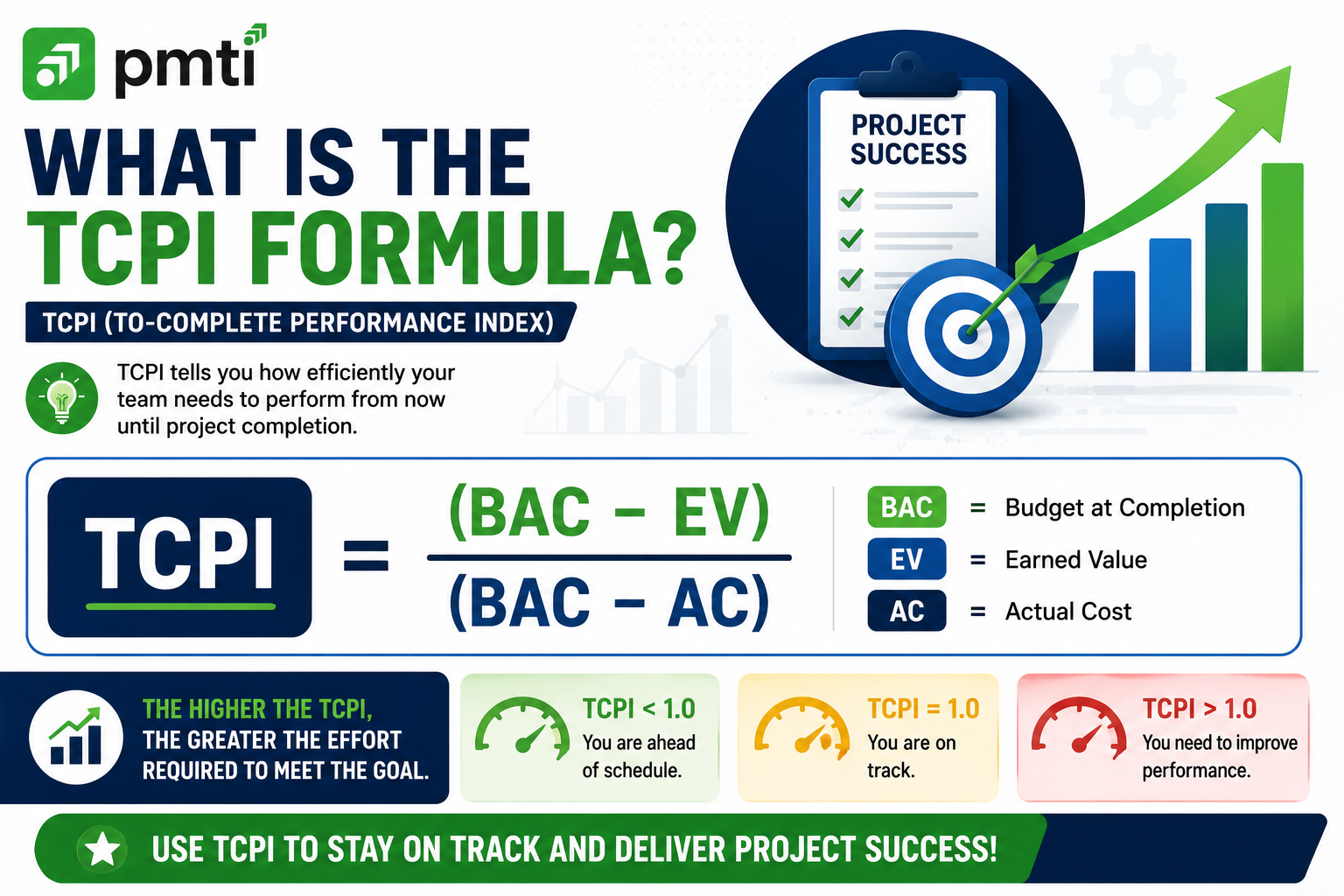
TCPI has two formula variants:one targeting the original Budget at Completion, and one targeting a revised Estimate at Completion.
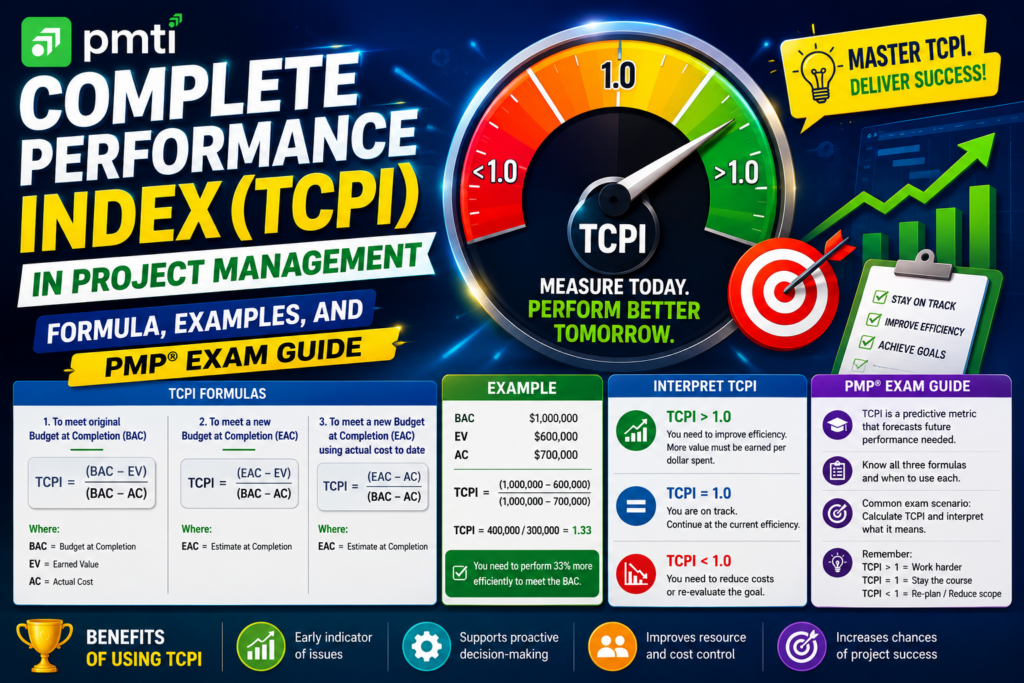
- TCPI to achieve BAC = (BAC − EV) / (BAC − AC) — used when the original budget remains the project’s target.
- TCPI to achieve EAC = (BAC − EV) / (EAC − AC) — used when a revised cost forecast has replaced the original budget as the target.
How Do You Calculate TCPI to Achieve the Original Budget?
To achieve BAC, a project manager calculates the TCPI by dividing the remaining project work (BAC − EV) by the remaining project budget (BAC − AC).
The BAC of a planned product launch is $300,000. As of the last update, EV = $120,000 and AC = $140,000. No changes to the initial budget have been approved.
TCPI = ($300,000 – $120,000) / ($300,000 – $140,000)
TCPI = $180,000 / $160,000
TCPI = 1.125
A TCPI of 1.125 shows that the team will have to execute the remaining work 12.5% more cost efficiently in order to complete the project for $300,000.
How Do You Calculate TCPI to Achieve the Revised Estimate (EAC)?
The project manager finds the TCPI to establish the EAC by dividing the work remaining (BAC – EV) by the remaining available budget (EAC – AC).
The sponsor of the same product launch project looks at the 1.125 TCPI and approves the new estimate of $310,000, conceding that the original budget is a lost cause.
TCPI = ($300,000 – $120,000) / ($310,000 – $140,000)
TCPI = $180,000 / $170,000
TCPI = 1.06
With the new budget of $310,000, the team only has to be 6% more efficient than previously planned, which is a much more attainable goal than the original budget and the 12.5% efficient goal to reach the original budget.
How Do You Choose Which TCPI Formula to Use?
In determining which TCPI formula to use, the main consideration is whether or not the original budget is still the active goal or has been completely replaced by a revised estimate.
Choose the BAC-based formula if the original budget has not been approved to be changed, and the original BAC is the goal.
Use EAC-based approach when a new, approved forecast has been set as the new project cost target.
How Do You Interpret TCPI Values?
A TCPI of 1.0 means work must be completed as efficiently as planned. A TCPI value less than 1.0 indicates the work can be performed even less efficiently than planned and the target will still be achieved. A value of TCPI greater than 1.0 indicates work must be performed in an even more efficient manner than originally planned to achieve the target.
- TCPI = 1.0 — remaining work must proceed at exactly the planned efficiency rate.
- TCPI < 1.0 — the target is achievable even at a lower efficiency than originally planned; a favorable position.
- TCPI > 1.0 — the target requires higher efficiency than originally planned; the higher the value, the more difficult the target becomes.
How Does TCPI Compare to CPI?
CPI measures the cost efficiency a project has already demonstrated, while TCPI measures the cost efficiency the project must still achieve on remaining work — comparing the two reveals whether a target is realistically achievable. If TCPI significantly exceeds current CPI, the project is being asked to suddenly perform far better than its demonstrated track record, a red flag for the target’s feasibility.
- CPI = EV / AC — a backward-looking measure of efficiency already achieved.
- TCPI = (BAC − EV) / (BAC − AC or EAC − AC) — a forward-looking measure of efficiency still required.
What Does a High TCPI Signal?
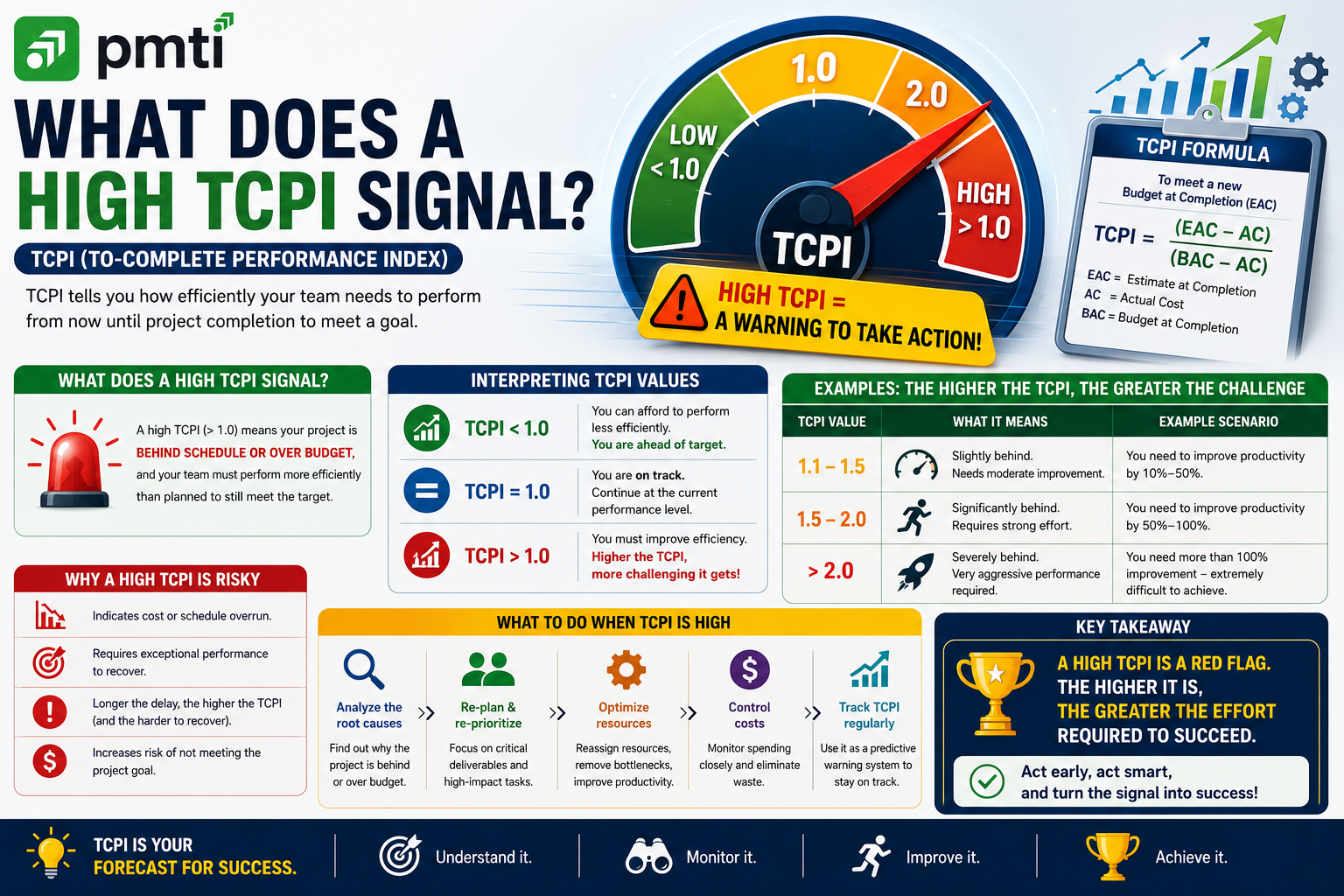
CPI indicates the cost efficiency achieved by a project and TCPI indicates the cost efficiency needed to achieve the remaining work of a project. CPI reflects how well a target is likely to be achieved. When TCPI is significantly greater than CPI, it means the project must achieve an efficiency level greatly exceeding the target.
How Does TCPI Appear on the PMP Exam?
A fairly high TCPI compared to the project’s current CPI means that the target is unrealistic and sometime mitigation strategies that might include: requesting more resources, managing expectations to reduce project scope, or formally rebaselining the budget may be warranted. A project manager notices that the TCPI drifting away from CPI indicates a concern that the sponsor needs to be made aware of before it is too late.
Sample Question 1: A project has BAC = $400,000, EV = $150,000, and AC = $130,000. No change to the original budget has been approved. What is the TCPI? A) 0.93 B) 1.08 C) 1.54 D) 0.68
Sample Question 2: A project has BAC = $250,000, EV = $90,000, and AC = $110,000. The sponsor has approved a revised EAC of $280,000. What is the TCPI to achieve this revised target? A) 1.14 B) 0.94 C) 1.88 D) 0.85
Sample Question 3: A project’s current CPI is 1.02, and its calculated TCPI is 1.35. What does this indicate? A) The target is easily achievable at the current pace B) The team must perform substantially better than its demonstrated performance to meet the target C) The project is already on track with no concerns D) TCPI is irrelevant once CPI is known
Sample Question 4: A project’s cost overrun stems from a one-time vendor pricing error that will not recur, and management has not approved any change to the original budget. Which TCPI formula should the project manager use? A) TCPI to EAC, since a revised forecast is now the target B) TCPI to BAC, since the original budget remains the target with no approved change C) Either formula, since both produce identical results D) Neither formula applies without a schedule variance calculation
Answers: 1) A — TCPI = ($400,000 − $150,000) / ($400,000 − $130,000) = $250,000 / $270,000 = 0.93. 2) B — TCPI = ($250,000 − $90,000) / ($280,000 − $110,000) = $160,000 / $170,000 = 0.94. 3) B — a TCPI well above current CPI signals the remaining work must be completed far more efficiently than the project has demonstrated so far. 4) B with no approved budget change, the original BAC remains the active target, calling for the BAC-based formula.
Frequently Asked Questions
What Is a “Good” TCPI Value?
A TCPI at or below the project’s current CPI is considered achievable, since it does not require performance beyond what the project has already demonstrated. A TCPI significantly above current CPI is a warning sign, even if it remains mathematically calculable.
Can TCPI Be Negative?
TCPI cannot be negative under standard project conditions, since both the numerator and denominator represent remaining work and remaining budget, which are structured to stay positive in a normally functioning calculation. A negative or undefined result typically indicates a data entry error or a project where the denominator has reached zero or below.
Does TCPI Use Planned Value (PV)?
TCPI does not use Planned Value in its formula — it relies on BAC, EV, AC, and, in the EAC-based variant, EAC. PV factors into schedule-focused metrics like SPI and SV, not into the TCPI calculation.
How Is TCPI Different From Estimate at Completion (EAC)?
TCPI measures the efficiency required on remaining work to hit a target, while EAC forecasts the total project cost based on current performance trends. Candidates who want structured, PDU-eligible practice calculating both can enroll in PMTI’s Earned Value Management & Earned Schedule (24 PDUs) course.