


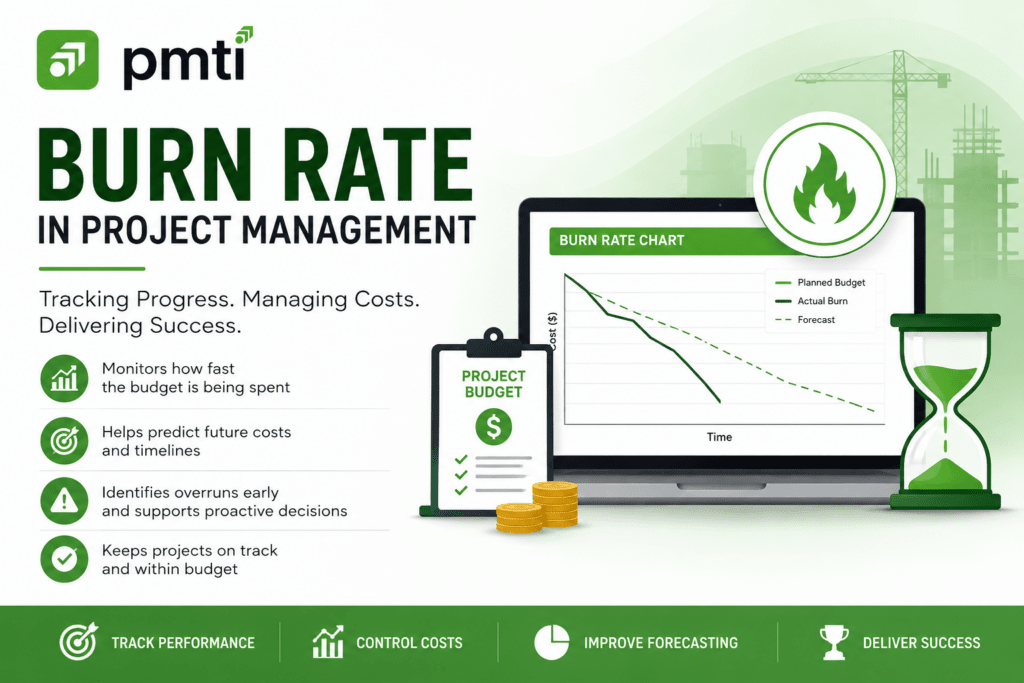
What Is Burn Rate in Project Management?
Burn rate is a method used in project management and cost accounting to assess the cash consumption of a project in the context of value delivered. In this case, value means work accomplished. Burn rate measurement encourages early detection of budget overspend, especially in Agile environments in which the tracking of costs at the level of individual sprints is important.
What Is the Burn Rate Formula?
Burn rate = AC / EV, where AC is Actual Cost and EV is Earned Value. Cost Performance Index and burn rate interpret data in different ways as a result of the contrasting positions of their inputs.
How Do You Calculate Burn Rate?

A project manager calculates burn rate by dividing Actual Cost by Earned Value at a given reporting date.
A sprint has an Actual Cost of $84,000 and an Earned Value of $70,000.
Burn Rate = $84,000 / $70,000 Burn Rate = 1.2
A burn rate of 1.2 indicates the sprint is consuming budget 20% faster than the value of work completed justifies — the project is over budget.
A second sprint has an Actual Cost of $60,000 and an Earned Value of $75,000.
Burn Rate = $60,000 / $75,000 Burn Rate = 0.8
A burn rate of 0.8 indicates the sprint is under budget, consuming resources more slowly than the value of completed work would suggest.
How Do You Interpret Burn Rate?
A burn rate greater than 1.0 indicates a project is over budget, a burn rate less than 1.0 indicates a project is under budget, and a burn rate of exactly 1.0 indicates spending is tracking exactly to plan.
- Burn Rate > 1.0 — over budget; the project is spending faster than it is earning value.
- Burn Rate = 1.0 — on budget; spending exactly matches the value of work completed.
- Burn Rate < 1.0 — under budget; the project is spending slower than the value of work completed.
How Is Burn Rate Related to Cost Performance Index (CPI)?
Burn Rate is the mathematical reciprocal of CPI: Burn Rate = 1 / CPI, and CPI = 1 / Burn Rate. Because the two formulas invert each other, a burn rate above 1.0 always corresponds to a CPI below 1.0, and a burn rate below 1.0 always corresponds to a CPI above 1.0.
Using the first sprint example: CPI = EV / AC = $70,000 / $84,000 = 0.833. Taking the reciprocal, 1 / 0.833 = 1.2, matching the burn rate calculated directly. Mixing up which formula signals “over budget” is the most common error project managers make when moving between the two metrics.
How Is Burn Rate Used in Agile Environments?
In Agile environments, cost burn rate tracks how quickly a sprint consumes its allocated budget, while velocity burn rate tracks how quickly a team completes story points — two related but distinct metrics that share a name. A team can show a healthy velocity burn rate while running an unfavorable cost burn rate, or the reverse, since one measures scope progress and the other measures financial efficiency.
What Is the Difference Between a Burn Rate Chart and a Burndown Chart?
A burn rate chart is a financial tracking tool that shows actual spend vs planned spend over a time period. A burndown chart is a tracking tool for schedule and scope that shows work remaining to be done to completion. Although they share a similar name, burn rate and burndown charts ask different questions. Burn rate asks, “are we spending as planned?” and burndown asks, “are we on track to complete this work as planned?”
If teams are using both charts, they typically pull their burndown data for the same sprint and release cycles that burn rate data is measured against. Agile Release Planning for Projects has useful information on the construction and interpretation of sprint and release burndown charts.
Why Is Tracking Burn Rate Important?
Tracking burn rate helps identify spending concerns prior to the completion of a sprint or project so that the spending can be adjusted. Burn rate tracking can help avoid the difficult, unexpected budget related conversations that project managers are typically faced with.
- Detects budget overruns early, while corrective options are still available.
- Informs stakeholder communication with a single, easy-to-interpret ratio.
- Supports sprint-level financial decisions in Agile and hybrid delivery environments.
How Does Burn Rate Appear on the PMP Exam?
The PMP exam evaluates Burn Rate less frequently than core EVM metrics (CPI and SPI). However, as the exam’s coverage of predictive, agile, and hybrid methods makes the inclusion of Agile and hybrid approaches inevitable, Burn Rate will likely appear in those types of questions as well. The PMP exam candidates should be aware that they will have to answer questions that require either direct calculations for Burn Rate or the inverse relationship with CPI.
Sample Question 1: A sprint has AC = $45,000 and EV = $50,000. What is the burn rate, and what does it indicate? A) 1.1; over budget B) 0.9; under budget C) 0.9; over budget D) 1.1; under budget
Sample Question 2: A sprint has AC = $132,000 and EV = $110,000. What is the burn rate? A) 0.83 B) 1.0 C) 1.2 D) 1.5
Sample Question 3: A project’s CPI is calculated at 1.25. What is the corresponding burn rate? A) 1.25 B) 0.8 C) 1.0 D) 0.75
Sample Question 4: A stakeholder wants to see whether the team is completing planned work on schedule, not whether spending is tracking to budget. Which tool should the project manager use? A) Burn rate chart B) Burndown chart C) Cost Performance Index D) Estimate at Completion
Answers: 1) B — Burn Rate = $45,000 / $50,000 = 0.9, indicating the project is under budget. 2) C — Burn Rate = $132,000 / $110,000 = 1.2. 3) B — Burn Rate = 1 / CPI = 1 / 1.25 = 0.8. 4) B — a burndown chart tracks remaining work toward completion, while a burn rate chart tracks spending against budget.
Frequently Asked Questions
Is Burn Rate an Official PMBOK Term?
Burn Rate doesn’t have a formal definition in the PMBOK Guide the way CPI or EAC do, but it still pops up in many reliable sources for PMP exam prep and Agile project management for tracking costs at the sprint level. Candidates should know the burn rate concept (and the formula) even if they can’t say for sure that the formula will show up in each version of the PMP exam.
Is Burn Rate the Same as CPI?
Burn rate and CPI use the same two inputs but are not the same metric. Burn rate is calculated as AC/EV, whereas CPI is calculated as EV/AC, so the two are reciprocals. A burn rate of greater than 1.0 always corresponds to a CPI of less than 1.0, and the other way around. Confusing which is which is a common incorrect answer.
What Is a “Good” Burn Rate?
A burn rate of around 1.0 is good, as it is a indication that costs are aligned with the work done. A burn rate of greater than 1.0 across many sprints is a sign of a chronic issue with cost efficiency and not a one-time issue.
Is Burn Rate Only Used in Agile Projects?
Burn rate is most commonly associated with Agile and sprint-based environments, but the underlying AC/EV calculation applies equally to traditional, predictive projects tracking cost performance over any reporting period. The term is simply used more frequently in Agile contexts due to the shorter, more frequent reporting cycles sprints create.
Candidates who want structured, PDU-eligible practice with burn rate and the broader EVM formula set can enroll in PMTI’s Earned Value Management & Earned Schedule (24 PDUs) course.


