


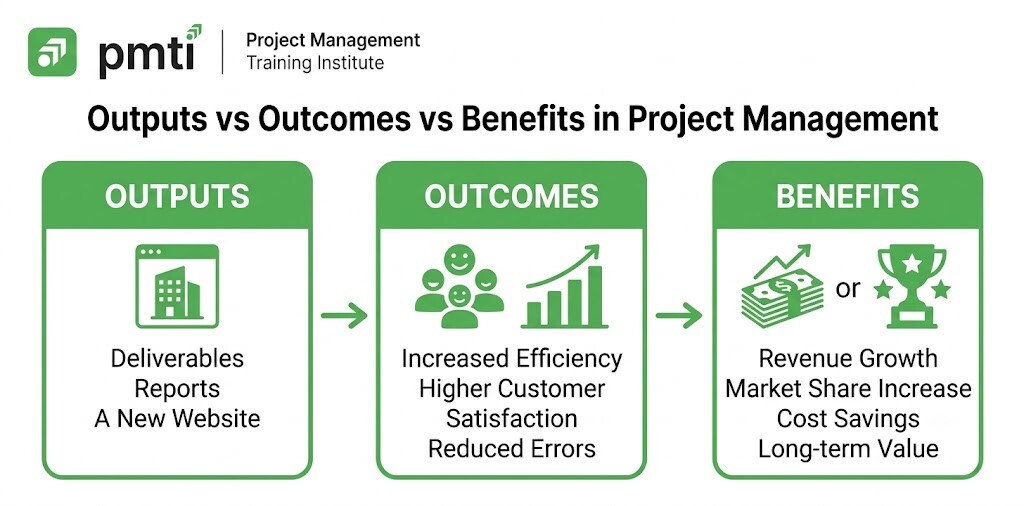

An output is what a project delivers. An outcome is the change that delivery causes. A benefit is the measurable gain the organization receives from that change. Outputs appear at handover, outcomes appear after use, and benefits appear in the business results weeks to years later.
What Is the Difference Between Outputs, Outcomes, and Benefits?
An output is the deliverable the project produces. An outcome is the change in behavior or capability that the output causes. A benefit is the measurable gain to the organization from that change. Each term answers a different question and appears at a different time.
| # | Attribute | Output | Outcome | Benefit |
| 1 | Definition | Deliverable produced by project work | Change caused by using the output | Measurable gain from the change |
| 2 | Question answered | What did we deliver? | What changed? | What did the organization gain? |
| 3 | Appears | At handover | Weeks to months after rollout | Months to years after rollout |
| 4 | Verified by | Acceptance criteria | Usage and performance data | Financial or strategic measures |
| 5 | Typical owner | Project manager | Business or operations manager | Benefits owner or sponsor |
| 6 | Measurement unit | Complete / not complete | Rate, time, or count | Currency or strategic target |
| 7 | Example | Redesigned onboarding workflow | Onboarding time falls from 10 days to 5 days | $144,000 saved per year |
What Is a Project Output?
A project output is a deliverable that project work produces: a product, service, document, or capability. Outputs are verified against acceptance criteria and handed to the customer. Outputs confirm delivery, not value.
An output has 3 attributes:
- Produced: The project team creates it through planned work.
- Verifiable: A review, test, or sign-off confirms it exists.
- Immediate: It exists when the work package or phase finishes.
A released software feature, a training session, and an approved project plan are outputs.
What Is a Project Outcome?
A project outcome is the change in behavior, performance, or capability that occurs when people use the output. Outcomes appear after handover. Teams measure them through usage, speed, quality, and adoption data.
An outcome has 3 attributes:
- Caused: It follows from use of the output, not from the project work itself.
- Delayed: It appears after users adopt the output.
- Measured through signals: Teams track rates, times, counts, and trends.
A redesigned onboarding workflow (output) leads to faster onboarding (outcome). The project team controls the output. Users and operations control adoption, so outcome ownership sits with the business.
What Is a Project Benefit?
A project benefit is a measurable gain that the organization receives from an outcome. Benefits take 2 forms: financial (revenue growth, cost reduction, cost avoidance) and non-financial (customer satisfaction, compliance, safety, capability). A negative effect is a dis-benefit.
A benefit converts an outcome into a business measure. “Onboarding time falls from 10 days to 5 days” is an outcome. “$144,000 in productive time recovered per year” is a benefit. The business case states the expected benefits before the project is approved. The structure of that document is covered in Business Case in Project Management: Contents and Benefits Management Plan.
How Do Outputs, Outcomes, Benefits, and Value Connect?
Outputs, outcomes, benefits, and value form a chain. Project work produces outputs. Users adopt outputs and create outcomes. Outcomes generate benefits. Benefits add up to value for the organization. Planning starts at the benefit and works back to the output. Delivery starts at the output and works forward to the benefit.
| Level | Produces | Owner | Example |
| Work | Tasks and activities | Project team | Draft the workflow map |
| Output | Deliverable | Project manager | Redesigned onboarding workflow |
| Outcome | Change in behavior or capability | Operations manager | Onboarding time: 10 days to 5 days |
| Benefit | Measurable gain | Benefits owner | $144,000 saved per year |
| Value | Strategic achievement | Sponsor or executive | Faster growth through quicker new-hire productivity |
A worked example uses 120 hires per year, a 5-day reduction in onboarding time, a loaded cost of $240 per day, and a project cost of $60,000. The figures are illustrative.
| Step | Calculation | Result |
| Benefit per hire | 5 days x $240 | $1,200 |
| Annual benefit | $1,200 x 120 hires | $144,000 |
| Payback period | $60,000 / $144,000 x 12 months | 5 months |
| Year-1 return on investment | ($144,000 – $60,000) / $60,000 | 140% |
The calculation proves value, and the output alone does not. Methods for weighing benefits against cost are covered in What Is Cost-Benefit Analysis in Project Management? Process, Tools, and Examples.
What Are Examples of Outputs, Outcomes, and Benefits?
Every industry follows the same chain. A software team ships a feature, users adopt it, and retention rises. A hospital installs a system, nurses save time, and the hospital treats more patients. Each example has an output, an outcome, a benefit, and a metric.
The figures below are illustrative.
| Industry | Output | Outcome | Benefit | Metric |
| Software | Self-service password reset feature | Support tickets for resets fall 60% | Support cost falls by $90,000 per year | Tickets per month |
| Healthcare | Electronic health record system | Nurses spend 25% less time on charting | Hospital treats 400 more patients per year | Minutes per patient record |
| Manufacturing | Automated inspection line | Defect rate drops from 3% to 1% | Scrap and rework cost falls by $250,000 per year | Defects per 1,000 units |
| Marketing | Redesigned checkout page | Checkout completion rises from 60% to 68% | Revenue rises by $320,000 per year | Completion rate |
| Operations | Documented handover process | Handover errors fall by 40% | Delay penalties fall by $45,000 per year | Errors per month |
How Do You Measure Outputs, Outcomes, and Benefits?
Measure outputs through acceptance and delivery metrics, outcomes through usage and performance metrics, and benefits through financial or strategic measures. Set a baseline and a target for each measure before the project starts.
| Level | Metric Type | Example Metrics | Measured When |
| Output | Delivery | Deliverables accepted, on-time delivery rate, defect count at acceptance | Closing |
| Outcome | Performance and adoption | Adoption rate, cycle time, error rate, usage per week | 1 to 6 months after rollout |
| Benefit | Business result | Cost saved, revenue gained, customer retention, compliance score | 3 to 24 months after rollout |
A measure without a baseline proves nothing. The onboarding project records the 10-day baseline before work starts, then compares it with the post-rollout average.
When Do Outcomes and Benefits Appear, and Who Owns Them?
Outputs appear when the project closes. Outcomes appear 1 to 6 months later. Benefits appear 3 to 24 months later. The project closes before benefits arrive, so a benefits owner in the business continues measurement after closing.
3 consequences follow from the timing:
- The project manager does not own benefits. The project ends before benefits appear.
- A benefits owner is named at approval. This person tracks benefits after closing.
- Post-project reviews are scheduled. A review at 3, 6, and 12 months compares results with the business case.
What Is Benefits Realization Management?
Benefits realization management is the practice of identifying, planning, delivering, and sustaining benefits. It runs across 4 stages and continues after the project closes. A benefits register records each benefit with an owner, a baseline, and a target.
| Stage | Action | Output |
| Identify | List expected benefits and link each to an outcome | Benefits list |
| Plan | Set metrics, baselines, targets, and owners | Benefits management plan |
| Deliver | Produce outputs that create the outcomes | Accepted deliverables |
| Sustain | Track benefits after closing and correct drift | Benefits report |
A benefits register holds 7 fields: benefit, linked outcome, metric, baseline, target, owner, and measurement date. PMBOK Guide 8th Edition names “Focus on Value” as 1 of its 6 principles, so benefit tracking sits at the center of the standard.
What Mistakes Do Teams Make With Outputs, Outcomes, and Benefits?
5 mistakes cause most value failures: treating delivery as success, writing vague outcomes, naming no benefits owner, measuring benefits at closing, and ignoring dis-benefits. Each mistake has a direct fix.
| Mistake | Consequence | Fix |
| Treating outputs as success | The project closes with no proof of value | Define outcome and benefit targets in the business case |
| Writing vague outcomes (“better experience”) | Teams cannot measure change | State a metric, baseline, target, and date |
| No benefits owner | Nobody tracks benefits after closing | Name an owner at project approval |
| Measuring benefits at closing | Benefits appear to be zero | Schedule reviews 3, 6, and 12 months after rollout |
| Ignoring dis-benefits | The net gain is overstated | List negative effects and subtract them |
FAQs About Outputs, Outcomes, and Benefits
Which Comes First, the Output or the Outcome?
At planning, the benefit and outcome come first, because they justify the project. At execution, the output comes first, because the team must deliver before change occurs.
Is a Benefit the Same as an Outcome?
No. An outcome is the change that occurs. A benefit is the measurable gain to the organization from that change. Faster onboarding is an outcome. $144,000 saved per year is the benefit.
Who Is Accountable for Project Benefits?
The benefits owner is accountable. The sponsor names this person at approval. The benefits owner works in the business, not on the project team, and tracks benefits after the project closes.
What Is a Dis-Benefit?
A dis-benefit is a negative effect that an outcome produces. A new system that saves 5 days of onboarding but adds $20,000 of annual licensing cost carries a dis-benefit. Subtract dis-benefits from benefits to find the net gain.
How Does the PMP Exam Test Benefits and Value?
The PMP exam tests how project managers evaluate and deliver project benefits and value. Candidates link deliverables to outcomes and benefits, and answer scenario questions on business case alignment and value delivery.
Candidates build this skill through scenario practice on business case, benefits management, and value delivery. The PMP®Certification Training — PMI Authorized Training Partner course from PMTI covers these topics in exam-aligned lessons.


