


What Is Cost-Benefit Analysis (CBA)?
Cost-Benefit Analysis is a systematic approach to review the total costs and total benefits of a project in order to provide a “go” or “no-go” recommendation. CBAs are important elements of each business case because they support a numerical justification for a request for a resource allocation to a project.
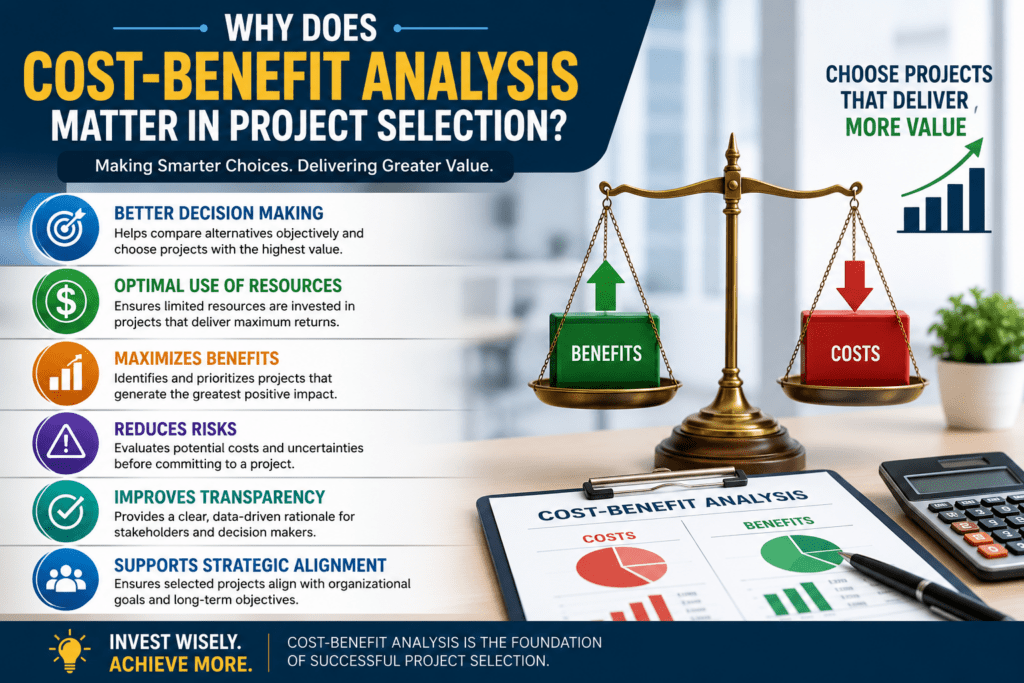
Why Does Cost-Benefit Analysis Matter in Project Selection?

Most organizations review multiple competing project requests and use a cost-benefit analysis to prioritize which projects the organization will consider for investment. A cost-benefit analysis converts the value of a proposed project into easily comparable terms, thereby reducing the risk of project funding decisions being made based on conjecture instead of evidence.
What Types of Costs Belong in a Cost-Benefit Analysis?
A complete Cost-Benefit Analysis includes all direct, indirect, and opportunity costs. Omitting any category results in understating the costs of a project. Each cost type is executed differently and is captured at different phases of the planning process.
- Direct costs are expenses billed specifically to the project, such as labor, materials, and equipment.
- Indirect costs are shared expenses that support the project alongside other work, such as facilities or shared software licenses.
- Opportunity costs represent the value of the next-best alternative given up by pursuing this project instead.
What Types of Benefits Belong in a Cost-Benefit Analysis?
A complete Cost-Benefit Analysis accounts for both tangible benefits, which carry a direct monetary value, and intangible benefits, which require estimation to quantify. Intangible benefits are frequently underrepresented in a CBA simply because they are harder to measure, not because they carry less real value.
- Tangible benefits include measurable financial gains, such as increased revenue or reduced operating costs.
- Intangible benefits include harder-to-quantify gains, such as improved customer satisfaction or brand reputation, estimated using proxy metrics or expert judgment.
How Do You Conduct a Cost-Benefit Analysis?
A project manager conducts a Cost-Benefit Analysis by identifying all costs and benefits, assigning monetary values to each, applying financial analysis tools to compare them, and presenting the result to stakeholders as part of the business case.
- Identify every cost and benefit associated with the project, including indirect and intangible categories.
- Quantify each identified cost and benefit in monetary terms, using Present Value adjustments where time periods differ.
- Apply a financial analysis tool to compare the totals and produce a decision-ready result.
- Present the analysis to stakeholders with clear assumptions, so the business case can be evaluated and challenged transparently.
Which Financial Analysis Tools Support a Cost-Benefit Analysis?
When looking to conduct a Cost-Benefit Analysis, project managers utilize tools that assess empirical data, including Return on Investment (ROI), the Net Present Value (NPV), and Benefit Cost Ratio (BCR). The use of more than one tool is encouraged, as a Cost-Benefit Analysis is not just a case of balancing the metrics, but assessing the overall financial impact.
- Benefit-Cost Ratio (BCR) expresses benefits relative to costs as a ratio.
- Return on Investment (ROI) expresses profitability as a percentage of the initial investment.
- Net Present Value (NPV) expresses total profitability in dollar terms, adjusted for the time value of money across the project’s full timeline.
How Do You Calculate a Basic Cost-Benefit Analysis?
A basic Cost-Benefit Analysis totals all identified costs, totals all identified benefits, and compares the two figures directly or through a financial ratio.
A process-improvement initiative identifies the following costs and benefits over its first year:
- Direct costs: $85,000 (software licensing and implementation labor)
- Indirect costs: $15,000 (shared IT support time)
- Total costs: $100,000
- Tangible benefits: $150,000 (reduced processing time, measured in labor cost savings)
- Intangible benefits: estimated $20,000 (improved customer satisfaction, based on proxy retention data)
- Total benefits: $170,000
Net Benefit = $170,000 − $100,000 = $70,000 Benefit-Cost Ratio = $170,000 / $100,000 = 1.7
The analysis supports moving forward with the initiative, since total benefits exceed total costs by $70,000 and the BCR of 1.7 clears the 1.0 profitability threshold.
How Do You Present a Cost-Benefit Analysis to Stakeholders?
Assumptions should be included, benefits should be identified as either concrete or abstract, and the financial tool output should be shown along with the raw data. The final conclusion should not be given without the supporting data. Stakeholders are more likely to be on board with the recommendation when they understand the supporting data, even if it means seeing details as raw data inputs to a BCR or ROI.
How Does Cost-Benefit Analysis Differ From a Full Business Case?
Cost-Benefit Analysis is the financial element of the analysis that is concerned with trade-offs of costs versus benefits, whereas a full business case includes the assessment of trade-offs, strategies, risks, and whether the plan is feasible. A strong Cost-Benefit Analysis is a good starting point for a business case, but other components of the complete business case are required.
How Does Cost-Benefit Analysis Appear on the PMP Exam?
On the PMP Exam, Cost-Benefit Analysis is located in the Business Environment domain and is usually tested through project selection cases in which candidates are required to analyze the information given and interpret the result of a Cost-Benefit Analysis, as opposed to actually performing the calculation. It is important to know when analysis supports a given project and when it does not support the analysis.
Sample Question 1: A project’s total costs are calculated at $220,000 and total benefits at $195,000. Based on this Cost-Benefit Analysis, what should the project manager recommend? A) Proceed with the project, since benefits are substantial B) Do not proceed, since costs exceed benefits C) Proceed, but only if intangible benefits are added D) The analysis is inconclusive without further data
Sample Question 2: A project manager’s Cost-Benefit Analysis includes only direct costs, omitting indirect and opportunity costs. What is the primary risk of this approach? A) The analysis overstates the project’s true cost B) The analysis understates the project’s true cost, making it appear more favorable than it is C) The analysis becomes more accurate by simplifying inputs D) There is no meaningful risk, since indirect costs are negligible
Sample Question 3: Two projects show the following results: Project A has a Net Benefit of $40,000 and a BCR of 1.2. Project B has a Net Benefit of $25,000 and a BCR of 1.8. Which project delivers stronger relative efficiency per dollar invested? A) Project A, because its Net Benefit is higher B) Project B, because its BCR is higher C) Both projects perform identically D) Neither project is financially favorable
Answers: 1) B — total costs exceed total benefits, indicating the project should not proceed based on this analysis alone. 2) B — omitting indirect and opportunity costs understates true project cost, making the project appear more financially favorable than it actually is. 3) B — a higher BCR indicates stronger relative return per dollar invested, even when the absolute Net Benefit is lower.
Frequently Asked Questions
What Is the Difference Between Cost-Benefit Analysis and ROI?
The process of considering all costs and benefits of a project is Cost-Benefit Analysis. Evaluating a project’s profitability as a percentage is one of the tools of this process and is called Return on Investment (ROI). When carrying out a Cost-Benefit Analysis, we may rely more on the combination of these tools (ROI, BCR, and NPV), rather than focus on one tool exclusively.
How Do You Account for Intangible Benefits in a Cost-Benefit Analysis?
When proxy metrics and expert judgment can determine an approximate value, we can capture intangible benefits. If we do not include intangible benefits, we are not evaluating the entire benefit of the project, especially on initiatives related to improvement of the process, the outcome satisfaction, and reputation.
Is Cost-Benefit Analysis Required for Every Project?
Cost-Benefit Analysis is not a requirement for all projects. However, most organizations have a limit on the cost of the project and/or strategic importance, beyond which they require a Cost-Benefit Analysis. Small and low importance projects may move forward with a limited justification in place of a complete Cost-Benefit Analysis.
Does a Positive Cost-Benefit Analysis Guarantee Project Approval?
A positive Cost-Benefit Analysis does not guarantee project approval. Other considerations include project alignment, risk, and balance of resources. A positive Cost-Benefit Analysis completes a business case. A Cost-Benefit Analysis does not complete the full project evaluation before approval.PMP Exam Update 2026: Who’s Affected and How to Successfully Pass the New Exam


