


What Does PERT Stand For?

PERT stands for Program Evaluation and Review Technique, a scheduling method the US Navy developed in 1958 for the Polaris missile program. PMI’s PMBOK Guide classifies PERT as one type of three-point estimating technique, alongside triangular distribution.
What Is the PERT Formula?
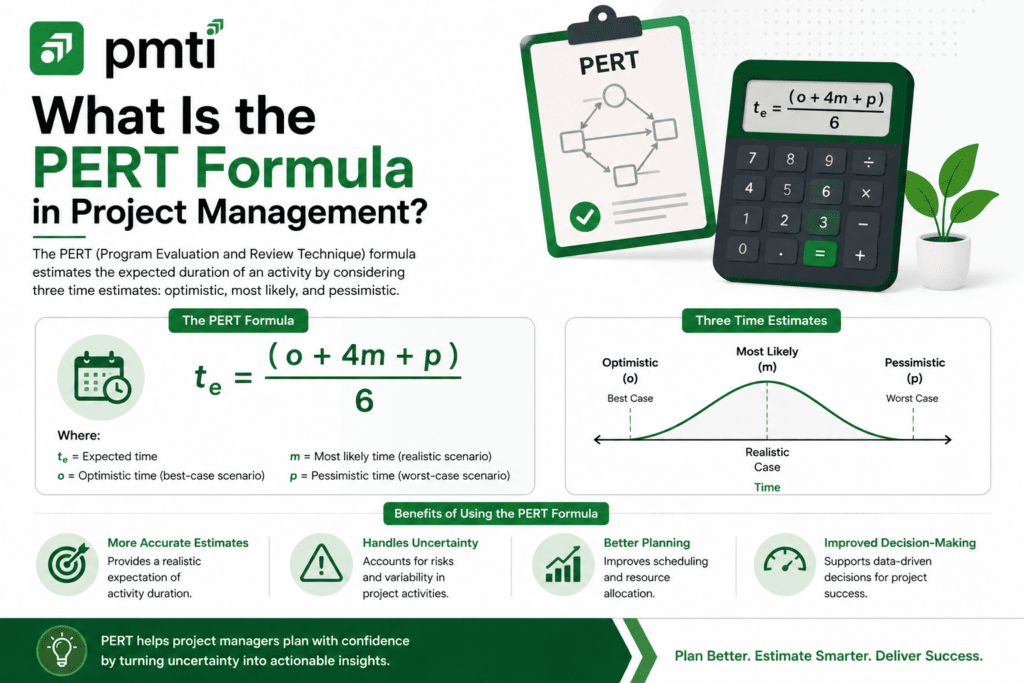
The PERT formula is (O + 4M + P) / 6, where O is the optimistic estimate, M is the most likely estimate, and P is the pessimistic estimate. This weighted average gives the most likely estimate four times the influence of either extreme, reflecting its higher probability of occurrence.
- Optimistic estimate (O) measures duration or cost under the best possible conditions, with zero risks materializing.
- Most likely estimate (M) measures duration or cost under normal conditions, with some risks occurring and mitigated.
- Pessimistic estimate (P) measures duration or cost under the worst possible conditions, with every negative risk occurring unmitigated.
How Do You Calculate a PERT Estimate?
A project manager calculates a PERT estimate by gathering optimistic, most likely, and pessimistic values from subject-matter experts, then applying the weighted-average formula. The result is a single duration or cost figure suitable for the project schedule or budget.
Consider a server migration task. Three estimates come from the infrastructure lead:
- Optimistic (O): 8 hours
- Most Likely (M): 14 hours
- Pessimistic (P): 30 hours
PERT = (8 + [4 × 14] + 30) / 6 PERT = (8 + 56 + 30) / 6 PERT = 94 / 6 PERT = 15.67 hours
The project manager schedules 15.67 hours for the migration task, a figure that accounts for both routine friction and worst-case delay without defaulting to either extreme.
Why Does the PERT Formula Weigh the Most Likely Estimate by 4?
The PERT formula weighs the most likely estimate by 4 because the calculation approximates a Beta probability distribution, which assigns the highest occurrence probability to the most likely value. A simple average of the three points would treat all three as equally probable, producing a less accurate estimate.
When Do Project Managers Use PERT Analysis?
Project managers use PERT analysis during the planning phase, specifically for activities with high uncertainty, limited historical data, or first-time work. Activities with reliable historical benchmarks are better suited to analogous or parametric estimating instead.
How Does PERT Differ From Other Three-Point Estimating Techniques?
PERT differs from triangular distribution by applying a weighted average instead of a simple average across the three estimates. Triangular distribution uses the formula (O + M + P) / 3, giving each estimate equal weight regardless of probability. PERT’s weighting toward the most likely estimate produces a tighter, more defensible range for schedule and cost baselines.
How Does PERT Appear on the PMP Exam?
The PMP exam tests PERT through direct formula calculations and situational questions that require identifying when PERT is the correct estimating tool. Exam questions typically supply three time or cost values and ask for the weighted-average result, or describe a scenario and ask which inputs PERT requires.
Sample Question 1: A project manager is preparing activity duration estimates for a new integration task with no prior benchmark data. She interviews the lead developer to gather best-case, expected, and worst-case durations. Which estimating inputs is she collecting? A) Triangular estimates B) Optimistic, Most Likely, and Pessimistic estimates C) Best and worst-case estimations only D) Standard deviation
Sample Question 2: A team estimates a testing activity at 150 hours (optimistic), 200 hours (most likely), and 250 hours (pessimistic). What is the PERT estimate? A) 190 B) 200 C) 210 D) 225
Answers: 1) B — PERT requires all three inputs: Optimistic, Most Likely, and Pessimistic. 2) B — (150 + [4 × 200] + 250) / 6 = 1,200 / 6 = 200.
Frequently Asked Questions
Is PERT the Same as Three-Point Estimating?
PERT is one specific type of three-point estimating, distinguished from triangular distribution by its weighted-average formula. All PERT calculations are three-point estimates, but not all three-point estimates use the PERT formula.
Can PERT Estimate Cost as Well as Duration?
PERT estimates both cost and duration using the same weighted-average formula, substituting cost values for time values in the O, M, and P inputs. Project managers apply the identical calculation regardless of which variable they are estimating.
What Is the Difference Between PERT and CPM?
PERT estimates individual activity duration under uncertainty, while the Critical Path Method (CPM) sequences activities to identify the longest path through a project schedule. Project managers frequently use PERT-derived estimates as inputs to a CPM schedule, applying the two techniques together rather than as substitutes.


