


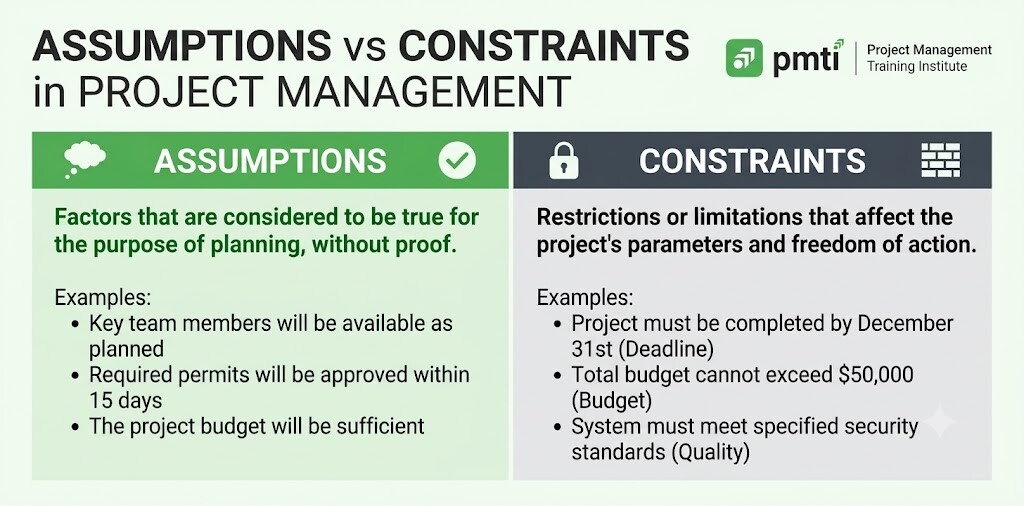

An assumption is a factor the project treats as true without proof. A constraint is a limiting factor the project cannot change. Assumptions carry uncertainty and become risks when they prove false. Constraints are known limits that shape the plan.
What Is the Difference Between Assumptions and Constraints?
An assumption is a planning factor treated as true without proof. A constraint is a known limit that restricts the project. Assumptions carry uncertainty and require validation. Constraints are fixed facts that the plan must respect.
| # | Attribute | Assumption | Constraint |
| 1 | Definition | Factor considered true, real, or certain without proof | Limiting factor that affects execution |
| 2 | Certainty | Uncertain | Known |
| 3 | Source | Experience, estimates, and expectations | Contracts, budgets, regulations, deadlines |
| 4 | Action required | Validate by a set date | Plan within the limit |
| 5 | Can the team change it? | Yes, once validated or disproved | Rarely; the sponsor negotiates changes |
| 6 | Risk link | Becomes a risk when it may be false | Creates risk when the limit is tight |
| 7 | Record | Assumption log | Constraint log or project charter |
| 8 | Example | “The vendor delivers in 4 weeks” | “The budget is capped at $250,000” |
PMBOK-aligned wording defines an assumption as a planning factor considered true, real, or certain without proof or demonstration. It defines a constraint as a limiting factor that affects execution.
What Is an Assumption in Project Management?
An assumption is a factor in the planning process that the team considers true without proof. Assumptions fill information gaps so planning proceeds. Every assumption carries a risk: if the assumption proves false, the plan changes.
An assumption has 3 attributes:
- Unverified: No evidence confirms it at the time of planning.
- Plan-relevant: The schedule, budget, or scope depends on it.
- Owned: One person validates it by a set date.
The project charter and scope statement record high-level assumptions. The assumption log records each one in detail. A plan with no recorded assumptions carries hidden risk, because the team still holds assumptions, only unwritten ones.
What Is a Constraint in Project Management?
A constraint is a limiting factor that affects the execution of a project. Budget caps, fixed deadlines, regulations, contracts, and resource limits are constraints. The team cannot remove a constraint and must plan inside it.
Constraints fall into 2 types:
- Hard (fixed): The limit does not move. A regulatory deadline is a hard constraint.
- Soft (negotiable): The sponsor can move the limit. An internal target launch date is a soft constraint.
The 3 best-known constraints are scope, time, and cost. PMBOK Guide 6th Edition lists 6 competing constraints: scope, schedule, cost, quality, resources, and risk. The relationship among the first 3 is covered in Triple Constraint in Project Management: Scope, Time, Cost, and Quality.
What Are Examples of Assumptions and Constraints?
Every project category holds both. An assumption states what the team expects to be true, such as a vendor delivery date. A constraint states what the team must respect, such as a budget cap. Both appear in the same plan.
The figures below are illustrative.
| Category | Assumption (uncertain) | Constraint (known) |
| Schedule | The vendor delivers servers within 4 weeks of order | Go-live is fixed for 1 November |
| Cost | Contractor rates stay at $95 per hour | Budget is capped at $250,000 |
| Resources | Two senior developers remain on the team for 6 months | The team holds a maximum of 8 members |
| Technology | The vendor supports API version 2 through project closing | The system runs on the existing cloud platform |
| Regulatory | The regulator approves the filing within 30 days | The product complies with the data-privacy law |
| Quality | The test environment mirrors production | The system meets a 99.9% uptime standard |
| Scope | Stakeholders approve requirements in 1 review round | The release excludes the mobile application |
| Organization | The sponsor holds the role until closing | No hiring before the third quarter |
Each row pairs the same topic. The constraint sets the limit, and the assumption describes the expectation inside it.
How Do Assumptions Become Risks and Issues?
An assumption becomes a risk when evidence suggests it may be false. A risk becomes an issue when the event occurs. A constraint stays a limit throughout. Assumptions, risks, and issues describe 3 stages of the same uncertainty.
| Term | Definition | Time Orientation | Example |
| Assumption | Factor considered true without proof | Present expectation | The vendor delivers in 4 weeks |
| Risk | Uncertain event that affects objectives | Future | The vendor may deliver in 8 weeks |
| Issue | Event that has occurred | Present | The vendor delivered in 8 weeks |
| Constraint | Known limiting factor | Present and future | Go-live is fixed for 1 November |
| Dependency | Relationship between 2 activities | Present and future | Testing starts after delivery |
An invalid assumption follows a fixed path: the team tests it, finds it false, logs a risk or issue, and updates the plan. The difference between a risk and an issue is covered in Difference Between Risk and Issue in Project Management.
How Do You Document Assumptions and Constraints?
Record each assumption and constraint in an assumption log. The log holds an ID, description, category, owner, validation date, impact if false, and status. The project manager creates the log at the charter and updates it each phase.
| Field | Purpose | Example Entry |
| ID | Unique reference | A-014 |
| Description | Statement of the assumption or constraint | Vendor delivers servers within 4 weeks of order |
| Type | Assumption or constraint | Assumption |
| Category | Schedule, cost, resources, technology, regulatory, quality, scope | Schedule |
| Owner | Person who validates or monitors | Procurement lead |
| Validation date | Date the team confirms or rejects it | 15 March |
| Impact if false | Effect on scope, schedule, or cost | 4-week delay on testing |
| Status | Open, validated, invalid, closed | Open |
Log entries link to the risk register. An open assumption with a high impact becomes a risk entry with a probability and impact score.
How Do You Validate an Assumption?
Validate an assumption in 5 steps: identify it, rate it, assign an owner, test it by a date, and update its status. Assumption analysis rates each assumption for stability and for consequence if false.
- Identify: List assumptions from the charter, the scope statement, estimates, and stakeholder interviews.
- Rate: Score each assumption for stability (likelihood it holds) and consequence (impact if false), on a 1 to 5 scale.
- Assign: Name one owner for each assumption.
- Test: Gather evidence by the validation date, such as a signed vendor commitment.
- Update: Change the status to validated or invalid, and revise the plan when an assumption is invalid.
PMBOK-aligned assumption and constraint analysis checks 3 qualities of each assumption: validity, consistency with other assumptions, and completeness. An assumption rated low stability and high consequence moves to the risk register first.
How Does Each Project Phase Use Assumptions and Constraints?
Initiating records the first assumptions and constraints in the charter. Planning expands them in the log. Executing validates assumptions. Monitoring updates the log and risk register. Closing archives the log as lessons learned.
| Phase | Action |
| Initiating | Record high-level assumptions and constraints in the project charter |
| Planning | Build the assumption log, rate assumptions, and link them to the risk register |
| Executing | Validate assumptions as evidence arrives |
| Monitoring and controlling | Review the log at each status meeting; convert invalid assumptions into risks or issues |
| Closing | Archive the log; record which assumptions held and which failed |
FAQs About Assumptions and Constraints
Is an Assumption a Risk?
No. An assumption is a planning factor treated as true. A risk is an uncertain event. An assumption creates a risk when it may prove false, and the team then records the risk in the risk register.
Are Constraints Negotiable?
Some are. Hard constraints, such as regulations and contract terms, do not move. Soft constraints, such as an internal target date, move through sponsor approval and change control.
Who Owns the Assumption Log?
The project manager owns the log. Each entry has an assigned owner who validates it. The project manager reviews the log at every status meeting and reports invalid assumptions to the sponsor.
When Does a Project Document Assumptions?
A project documents assumptions at initiating and keeps recording until closing. High-level assumptions enter the charter. Detailed assumptions enter the log during planning. New assumptions enter the log as they arise.
How Do You Manage the Risk Created by Assumptions?
Convert each unvalidated assumption with a high consequence into a risk entry. Score its probability and impact, assign an owner, and plan a response. Monitor the risk until the assumption is validated or disproved.
Assumption analysis feeds directly into risk identification. The Project Risk Management Course(24 PDUs) from PMI Authorized Training Partner PMTI teaches how to identify, score, and respond to these risks.


