



Benefit-Cost Ratio (BCR) PMP Exam Guide: Formula, Examples, and Limitations
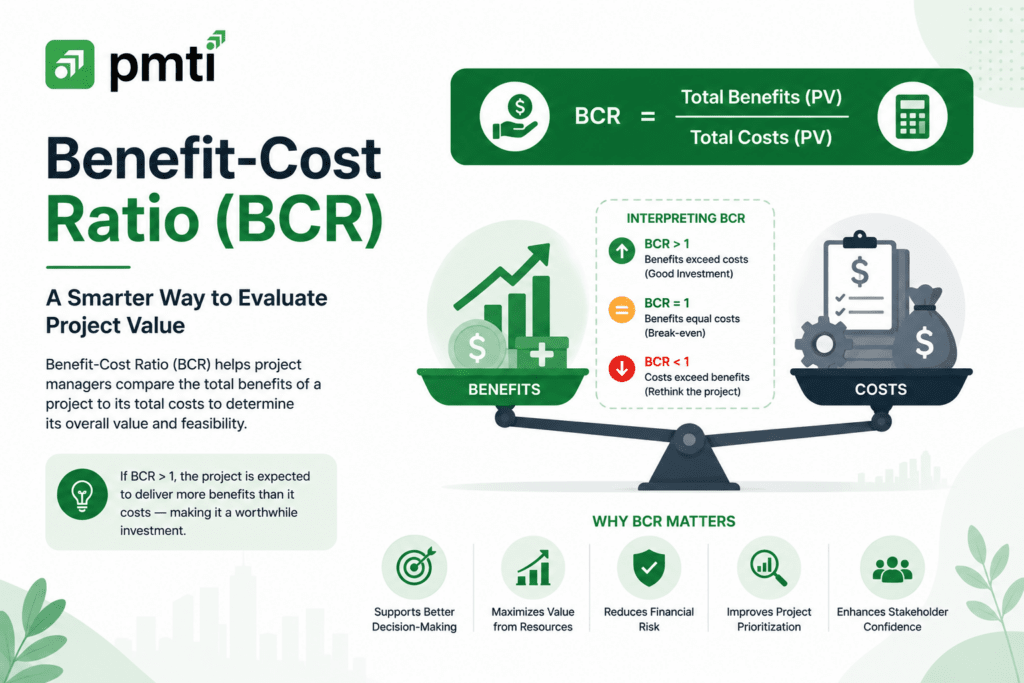
The Benefit-Cost Ratio (BCR) determines the present value of the costs of a project compared to the present value of the benefits of a project, and is expressed as a single value. For example, if a BCR is greater than 1, then the benefits of a project are greater than the costs. Conversely, if a BCR is less than 1, then the costs of the project are greater than the benefits. While the Benefit-Cost Ratio is one of the several methods used to prioritize potential projects, its use poses several challenges that must be mitigated by the project manager prior to using it to determine the final decision.
What Is the Benefit-Cost Ratio (BCR)?
The Benefit-Cost Ratio (BCR) is a project-selection metric that measures the present value of a project’s anticipated benefits less the present value of the anticipated costs. A single BCR value provides a summary of an analysis that is often complex and inconcise. The BCR is typically utilized in the Business Environment domain of project selection.
What Is the Benefit-Cost Ratio Formula?
The Benefit-Cost Ratio (BCR) is represented by the formula; BCR = PV of Benefits / PV of Costs. Both values are adjusted to present value to account for the time value of money. Candidates for the PMP exam are not expected to know the Benefit-Cost Ratio (BCR) formula at an obscure level. It is likely that they will be presented with the formula and asked to determine the ratio, rather than rebuild it.
How Do You Calculate the Benefit-Cost Ratio?
To calculate the Benefit-Cost Ratio (BCR), a project manager divides the benefits by the costs.
A facilities upgrade project has a present value of benefits totaling $450,000 and a present value of costs totaling $180,000.
BCR = $450,000 / $180,000 BCR = 2.5
A BCR of 2.5 indicates the project returns $2.50 in benefit for every $1.00 invested.
How Do You Interpret a Benefit-Cost Ratio?
A BCR of 2.5 means the benefits of the project outweigh the costs. A BCR less than 1.0 means costs outweigh benefits. A BCR of exactly 1.0 means benefits and costs are exactly equal. For a project manager, this ratio is the first cut to see which projects he or she will even consider further.
- BCR > 1.0 — the project is financially favorable; benefits exceed costs.
- BCR = 1.0 — the project breaks even; benefits equal costs exactly.
- BCR < 1.0 — the project is financially unfavorable; costs exceed benefits.
How Do You Use BCR to Compare Multiple Projects?
Project managers set BCR values as criteria and eliminate options that would represent a loss for their organization. The remaining options would be ranked according to how much potential profit each brings to the organization.
Four proposals are under review for the same budget cycle:
- Project W: BCR = 1.1
- Project X: BCR = 0.8
- Project Y: BCR = 1.6
- Project Z: BCR = 1.3
Of the four options, Project X was eliminated due to BCR being less than 1.0. Of the remaining three, Project Y has the highest BCR due to its relative profitability, but magnitude is also important. A project with a smaller scope may have a significant profit margin when compared to a larger project.
What Are the Disadvantages of the Benefit-Cost Ratio?
The benefit-cost ratio (BCR) only establishes comparative value. A BCR of 10 on a $2,000 project may make it seem significantly more valuable than a competing project with a BCR of 2. However, this competing project may have a $500,000 cost and a $1,000,000 benefit, making it a much more valuable project. Using BCR as the only metric in project selection would likely result in the selection of hundreds of small projects with a BCR in the thousands, rather than the project that is most beneficial.
Consider three projects evaluated by BCR alone:
- Small project: $50 in costs, $300 in benefits → BCR = 6.0, total profit = $250
- Mid-size project: $15,000 in costs, $40,000 in benefits → BCR = 2.67, total profit = $25,000
- Large project: $600,000 in costs, $1,500,000 in benefits → BCR = 2.5, total profit = $900,000
The small project posts the highest BCR by a wide margin, yet delivers the least absolute value of the three. A project manager selecting on BCR alone would favor the smallest, least impactful option.
- Reduces a complex project comparison to a single number, obscuring scale and risk differences.
- Ignores absolute profit, favoring high-ratio small projects over larger, more valuable ones.
- Assumes cost and benefit estimates remain accurate, which grows less reliable as project size and duration increase.
- Loses accuracy on interdependent projects, where one project’s benefits depend on another project’s deliverables.
How Does BCR Relate to Opportunity Cost?
BCR measures the trade-off of the cost and the benefits of a project. Opportunity cost relates to considering the best alternative that was not chosen when a project is selected. The opportunity cost is the value of the next best alternative. Choosing any of the available alternatives means that the other opportunities will not be available.
Three project options carry the following Net Present Values:
- Project P: NPV = $220,000
- Project Q: NPV = $275,000
- Project R: NPV = $410,000
Selecting Project R, the highest-value option, means giving up Project Q, the next-best alternative. The opportunity cost of choosing Project R is $275,000 — not the combined $495,000 value of Projects P and Q together.
How Does BCR Compare to NPV and ROI?
The profitability of a project can be measured in many ways, BCR calculates profitability in a ratio format, NPV calculates profitability in terms of Aristotle’s absolute dollar value, and ROI calculates profitability in relation to the percent return of the investment. While they relate to one another, the three measure different aspects of a project; therefore, project managers rely on the appropriate combination of the three metrics.
- BCR answers: how many dollars of benefit does this project return per dollar of cost?
- NPV answers: what is the total dollar value this project adds, after discounting future cash flows?
- ROI answers: what percentage return does this investment generate relative to its cost?
Where Do Sunk Cost and Depreciation Fit Alongside BCR?
Sunk costs do not enter into consideration when evaluating BCR, as they are costs incurred in the past, regardless of the option that is selected in the future. Depreciation does enter into the equation, as it affects the present value of cash flows. Both concepts do enter the BCR equation, however neither is part of the equation.
When a project manager examines whether to continue an ongoing project, the money spent previously is completely ignored, as this manager only looks at the future costs and benefits associated with the project.
How Does BCR Appear on the PMP Exam?
In the context of the PMP exam, applicants will come across BCR when selecting a project, giving candidates the project with the highest BCR, when discussing what a particular BCR value means, and when using opportunity cost in the context of a BCR comparison. In the exam, BCR is often expressed as the ratio of 7 to 3, requiring the applicant to divide before making a comparison.
Sample Question 1: Four projects are under consideration. Project A has a BCR of 7:3. Project B has a BCR of 9:5. Project C has a BCR of 11:4. Project D has a BCR of 6:2. Which project should be recommended based on BCR alone? A) Project A B) Project B C) Project C D) Project D
Sample Question 2: A project’s BCR is calculated at 0.65. What does this indicate? A) The project returns $0.65 in benefit for every $1.00 in cost B) The project returns $1.00 in benefit for every $0.65 in cost C) The project breaks even D) The project has no measurable benefit
Sample Question 3: Three projects have NPVs of $180,000, $240,000, and $310,000. If the project with the highest NPV is selected, what is the opportunity cost? A) $180,000 B) $240,000 C) $310,000 D) $420,000
Sample Question 4: A project manager is comparing two options: a small project with a BCR of 8.0 and total profit of $700, and a large project with a BCR of 2.2 and total profit of $1,200,000. Based on total value delivered, which project is the stronger choice, and why? A) The small project, because its BCR is higher B) The large project, because it delivers significantly more absolute profit C) Both projects are equally strong D) Neither project is financially favorable
Answers: 1) D — Project D’s ratio of 6:2 equals 3.0, the highest of the four options (A = 2.33, B = 1.8, C = 2.75, D = 3.0). 2) A — a BCR below 1.0 means benefit is smaller than cost; $0.65 in benefit for every $1.00 spent. 3) B — opportunity cost equals the value of the single best alternative given up, which is $240,000, not the combined value of the other two options. 4) B — a high BCR on a small project does not outweigh the significantly greater absolute value delivered by the large project.
Frequently Asked Questions
Is a Higher BCR Always the Better Choice?
A positive BCR is a good sign; however, a ratio does not give the absolute value or the size of the project and therefore will favor a smaller project. A ratio does not provide enough detail to make a decision on a project. Project managers will take into consideration BCR, NPV, and total profit.
What Is the Difference Between BCR and ROI?
BCR stands for Benefit-Cost ratio, and ROI stands for Return on Investment. BCR is the ratio of benefits to costs, and ROI is the ratio of benefits to costs as a percentage. It is possible for different projects when putting these two concepts into practice that they will result in different things.
Do You Need to Calculate Present Value to Find BCR on the Exam?
PVPV for the PMI exam is needed to answer a question regarding BCR, even if it is not stated that the Present Value will be given, knowing Present Value will make the exam question easier. To answer, you don’t need to know the economics.
Should Sunk Costs Affect a BCR-Based Decision?
Sunk costs always occur in the past and, therefore, should be disregarded in a BCR-based decision. Sunk costs, if incorporated in a BCR case study, may mislead the decision-maker into considering an ongoing, money-losing project simply because of expenses that were incurred in the past.PMP Exam Update 2026: Who’s Affected and How to Successfully Pass the New Exam


