


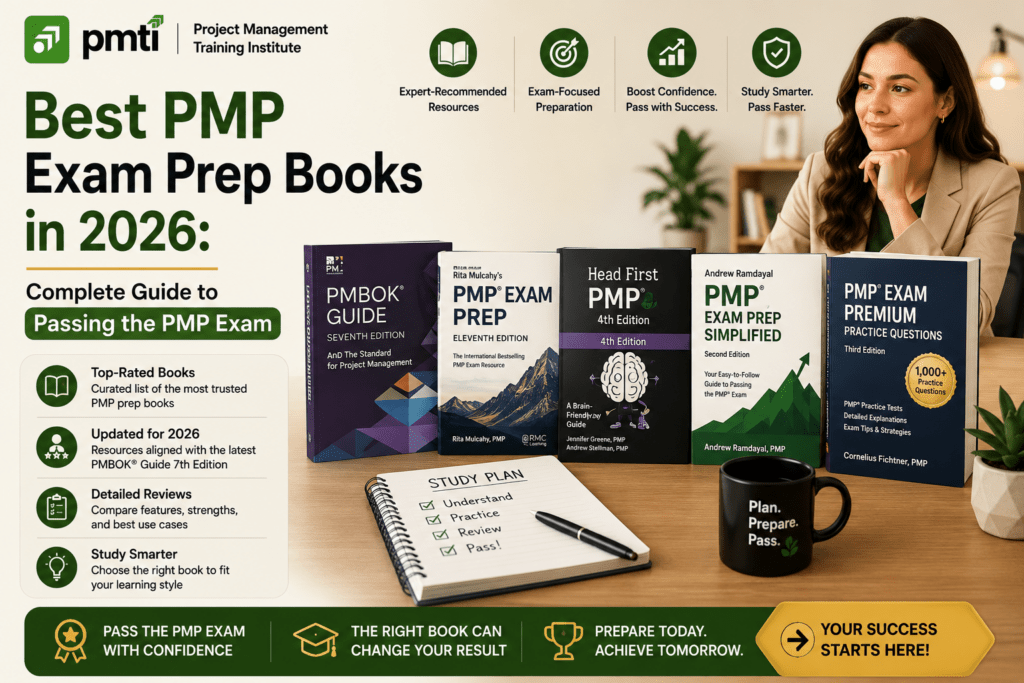
Best PMP Exam Prep Books in 2026: Complete Guide to Passing the PMP Exam

The Project Management Professional (PMP) certification remains one of the most respected project management credentials worldwide. Following PMI’s July 2026 exam update, candidates must prepare for a greater emphasis on business value delivery, stakeholder engagement, sustainability, AI-assisted project environments, and hybrid delivery approaches.
The PMP exam contains 180 questions and is completed within 240 minutes. Success depends on combining the right study resources, realistic practice questions, and structured exam preparation. This guide ranks the best PMP exam prep books for 2026 and explains how to build an effective study plan.
What Is the Best PMP Exam Prep Book in 2026?
Rita Mulcahy’s PMP Exam Prep remains the strongest overall PMP study book for most candidates. Its scenario-based questions, exam strategy guidance, and active-learning exercises closely reflect the decision-making style used on the PMP exam.However, no single book covers everything required for success.The most effective study stack combines:<br><br><br>
- Rita Mulcahy PMP Exam Prep
- PMBOK Guide 7th Edition — the active PMI-recognized standard for exam preparation
- Agile Practice Guide
- PMP Exam Content Outline (ECO 2026)
Note: The PMBOK Guide 8th Edition was published in late 2025 but PMI has not formally confirmed it as the controlling exam source. Candidates should prioritize the 7th edition alongside the official ECO 2026 until PMI issues updated guidance.
Together these resources cover predictive, agile, hybrid, business, and leadership topics tested on the current exam.
Top 7 PMP Exam Prep Books Ranked
1. Rita Mulcahy PMP Exam Prep – Best Overall
2. PMBOK Guide Eighth Edition – Best Official Reference
3. Agile Practice Guide – Best for Agile & Hybrid
4. PMP Exam Prep Simplified (Andrew Ramdayal) – Best Supplemental Guide
5. Head First PMP – Best for Visual Learners
6. Project Management: A Systems Approach (Harold Kerzner) – Best Technical Reference
7. Essential Scrum (Kenneth Rubin) – Best Scrum Deep Dive
1. Rita Mulcahy PMP Exam Prep
Rita Mulcahy’s guide continues to be the gold standard for PMP preparation. The book emphasizes critical thinking and situational decision-making rather than memorization.
Strengths:
• 400+ practice questions
• Strong exam strategy coaching
• Covers predictive, agile, and hybrid approaches
• Excellent chapter exercises
• Focus on PMI mindset
Best For:
Candidates seeking the highest probability of passing on their first attempt.
2. PMBOK Guide — 7th Edition
The PMBOK Guide 7th Edition is PMI’s current active principles-based standard and the recommended reference for PMP exam preparation. The 8th Edition was published in late 2025 but PMI has not formally announced it as the controlling exam source — candidates should use the 7th Edition until PMI confirms otherwise.
3. Agile Practice Guide
Agile and hybrid concepts represent approximately 60% of PMP exam content under the updated ECO 2026. The Agile Practice Guide remains the most efficient PMI resource for understanding Scrum, Kanban, XP, Lean, and hybrid delivery models.
Strengths:
• Easy to read
• PMI-approved terminology
• Strong hybrid delivery coverage
• Useful for PMP and PMI-ACP candidates
Candidates struggling with agile scenarios should prioritize this resource early in their preparation.
4. PMP Exam Prep Simplified by Andrew Ramdayal
Andrew Ramdayal’s book is popular because it explains PMP concepts using straightforward language. Many candidates appreciate the practical examples and agile-focused discussions.
Strengths:
• Easy-to-understand explanations
• Strong agile emphasis
• Affordable pricing
• Good supplemental question bank
This book works best alongside Rita Mulcahy rather than replacing it.
5. Head First PMP
Head First PMP uses diagrams, illustrations, exercises, and visual learning techniques to make project management concepts easier to understand.
Strengths:
• Highly visual format
• Beginner-friendly
• Interactive exercises
• Memorable explanations
It is especially useful for candidates who find traditional certification books too dense.
6. Project Management: A Systems Approach
Harold Kerzner’s classic text provides extensive project management theory and practical applications. Although it is not written specifically for PMP exam preparation, it remains one of the industry’s most respected references.
Best For:
• Experienced professionals
• Engineering managers
• Technical project leaders
• Candidates seeking deeper knowledge beyond certification requirements
7. Essential Scrum
Essential Scrum is one of the best resources for mastering Scrum roles, events, artifacts, and agile team dynamics. Candidates who lack agile experience often benefit significantly from this book.
Best For:
• Agile beginners
• Scrum practitioners
• Hybrid project managers
How Important Is AI Knowledge for the 2026 PMP Exam?
The updated PMP exam introduces greater awareness of AI-enabled project environments. PMI does not expect candidates to be AI engineers, but project managers should understand how AI can support planning, forecasting, reporting, stakeholder communication, and decision-making.
Candidates should be comfortable discussing:
• AI-assisted project planning
• Ethical use of AI
• Data-driven decision support
• Governance and risk considerations
• Human oversight of automated systems
Does the PMP Exam Include Sustainability?
Which PMP Book Has the Best Practice Questions?
Rita Mulcahy remains the leader for practice questions. The scenarios closely resemble real PMP exam situations and encourage candidates to think like project managers rather than memorize definitions.
For additional practice:
• Andrew Ramdayal PMP Exam Prep Simplified
• Commercial PMP simulators
• PMI Study Hall
• Instructor-led mock exams
How Many PMP Books Do You Need?
Most candidates only need four core resources:
1. PMBOK Guide Eighth Edition
2. Agile Practice Guide
3. Rita Mulcahy PMP Exam Prep
4. PMP Examination Content Outline (ECO)
Adding too many books often reduces the time available for practice exams and review sessions.
Can PMP Books Replace Formal Training?
No. PMI requires 35 contact hours of project management education before candidates can sit for the PMP exam. Books are valuable study tools but do not satisfy the education requirement on their own.
Formal training provides:
• Contact hours
• Instructor support
• Application guidance
• Live Q&A
• Structured accountability
• Exam strategy coaching
Recommended PMP Study Plan for 2026
Week 1: Download and read the ECO 2026 in full. Map every domain, task, and enabler before opening any other resource.
Week 2–3: Read PMBOK Guide 7th Edition as a conceptual reference against ECO tasks.
Week 4–5: Complete the Agile Practice Guide. Agile and hybrid scenarios represent ~60% of exam content.
Week 6–9: Study Rita Mulcahy chapter by chapter with all exercises completed.
Week 10–11: Take full-length timed practice exams under 240-minute conditions.
Week 12: Review weak domains, focus on Business Environment and case study question formats.
The most successful candidates spend significant time on scenario-based practice questions rather than passive reading.
Final Verdict
For most candidates, the best PMP study combination in 2026 is Rita Mulcahy PMP Exam Prep, PMBOK Guide Eighth Edition, Agile Practice Guide, and the official PMP Examination Content Outline.
Rita Mulcahy remains the strongest overall prep book because of its realistic scenarios and exam-focused coaching. The PMBOK Guide 7th Edition provides PMI’s active principles-based framework, while the Agile Practice Guide covers the Agile and hybrid delivery concepts that represent approximately 60% of the updated exam.
Candidates who combine these resources with 35 contact hours of training and extensive exam simulation practice position themselves for the highest likelihood of passing the PMP exam on their first attempt.


