


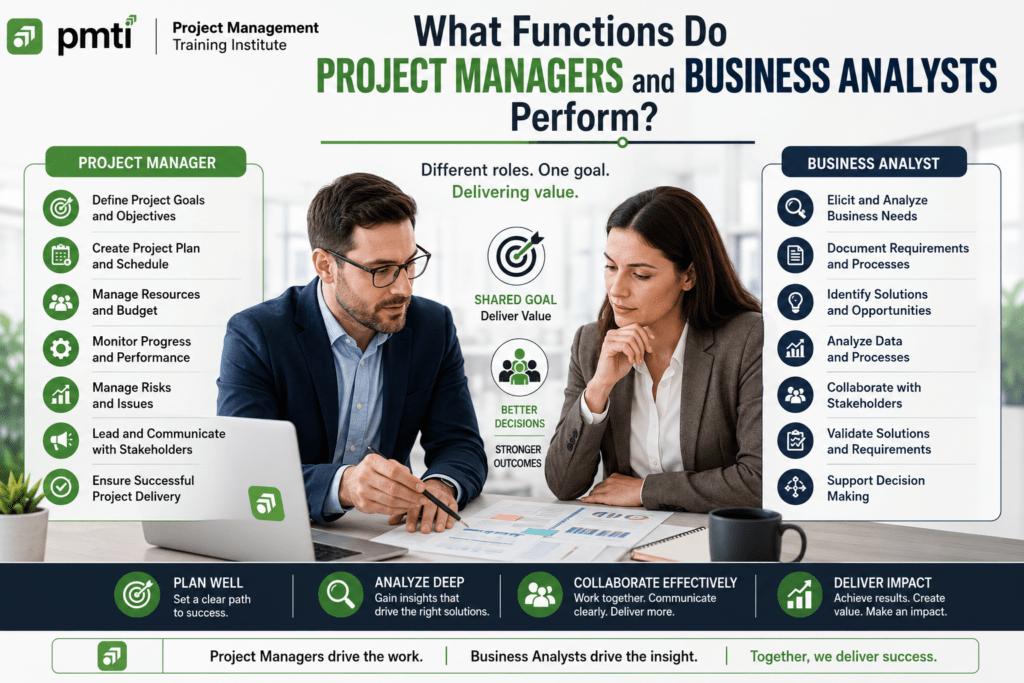
Business Analysts vs Project Managers: Key Differences
Most Project Managers and Business Analysts are part of the same PMO, because their roles overlap so much during the project delivery. However, there is a bit of a difference in the distribution of work.
- Business Analysts identify what exactly needs to be delivered by the project through the documentation of the requirements and assurance that the delivered solution is going to address the problem.
- On the other hand, Project Managers are in charge of the entire delivery. This includes leading the project team, managing the project constraints, and as the name suggests, managing all the project communications.
One role is responsible for the definition of the problem, and the other, for the delivery. Without either of them, the project cannot be delivered successfully.
What Functions Do Project Managers and Business Analysts Perform?

Project Managers are in charge of the project delivery and Business Analysts are in charge of the project needs and how they are realized through the project. Some specific things that Business Analysts do include the following:
- Managing and documenting requirements
- Constructing and modeling business processes
- Assuring that the solution that is offered will address the needs of the project and realize the business goals
- Ensuring that project outputs are aligned with business goals and yet do not manage the team or the constraints of the project
The overall responsibility of a Business Analyst is to safeguard the integrity of the requirements and assess whether changes that are being proposed are either going to enhance the business goal or whether the changes will introduce unnecessary scope.
Critical Outputs of a Business Analyst
Some critical outputs for a Business Analyst are:
- Business Requirements Document (BRD) – outlines a business problem, identifies stakeholders and their needs, and project objectives prior to outlining a potential solution
- Functional Requirements Specification (FRS) – outlines the potential solution in detail
- Use Cases and User Stories – captures system behavior from a user’s perspective
- Requirements Traceability Matrix (RTM) – outlines each requirement, and traces it to a business goal, a design component, and a test case
- Business Case – assesses different potential solutions and outlines the solution that will provide the most value
- Process Models – diagram current and future business processes (swim lane, BPMN)
BAs might work in Agile, Predictive, or hybrid environments. The deliverable format might change, but the requirements will still need to be elicited, documented, traced, and validated.
What Does a Project Manager Do?
The PM is responsible for:
- Leading the project team
- Managing scope, schedule, and cost performance
- Managing risks and issues
- Reporting status to stakeholders
- Controlling project delivery from initiation to closure
The PM focuses the team’s attention on the project goal within the agreed constraints. The PM controls scope changes, executes risk responses, and reports project status to the sponsor.
6 Main PM Deliverables
- Project Charter – formally starts project; describes goals, stakeholders, and scope
- Project Management Plan – describes how the team will manage scope, timeline, cost, quality, risk and communication
- Schedule Baseline – formally approves the sequence of project activities and the assignment of project resources
- Risk Register – captures project risks, their analysis, response strategies, and risk owners
- Status Reports – convey how project scope, timeline, and budget are progressing
- Lessons Learned – captures project outcomes, deviations from expected performance and provides suggestions for the future
PMs use predictive, Agile, and hybrid methods for management. In Agile, the PM might function as a Scrum Master or Agile Delivery Manager, but the main function of governing delivery and leading the team is the same.
PM and BA Differences
| Dimension | Business Analyst | Project Manager |
| Primary Question | What are the solution requirements? | What is the implementation plan? |
| Accountability | Requirements and business solution | Delivery and business solution |
| Stakeholder Relationship | Deals with requirements | Deals with project status and change |
| Team Relationship | Clarifies requirements for team members | Manages, coaches, and guides staff members |
| Main Concern | Developed solution is wrong | Developed solution is right, but low quality, high cost, late |
| Authority Over | Requirements | Cost, time, and scope of the project |
| Organizational Position | Reports to PMO, PM, or business | Reports to PMO, program manager, or sponsor |
The reporting structure represents the PMI vs IIBA system:
- PMI: BAs report to the PM
- IIBA: BAs and PMs are reporting business peers
BA and PM Salary Comparison
BA salary will never exceed PM salary (it is always the opposite):
| Career Level | BA Role | BA Salary | PM Role | PM Salary |
| Entry | Junior BA | $65-80K | Project Coordinator | $52-68K |
| Mid | Business Analyst | $80-110K | Project Manager | $95-125K |
| Senior | Senior BA | $100-130K | Senior PM | $110-145K |
| Leadership | Requirements Manager/Business Architect | $105-140K | Program Manager/PMO Director | $130-180K+ |
Salary comparisons show that Junior BAs earn more than Project Coordinators at the entry level, but at all other levels, as the scope of Project Managers is broader, Project Managers will have higher salaries than BAs.
BA and PM Skills
BAs focus on narrower skill sets (depth) and PMs on broader (high) skill sets. Both focus and are challenged by the same issue of managing stakeholder communication.
Core Skills of a BA
- Requirements Elicitation – Planning and conducting interviews, surveys, etc. to understand stakeholder needs
- Process Modeling – Creating charts to capture current/future state of process analysis
- Data Analysis – Analyzing business process data to determine patterns or gaps
- Stakeholder Analysis – Identifying, classifying and managing stakeholder expectations during requirements definition
- Requirements Documentation – Writing BRD/FRS/use cases/user stories/acceptance criteria in clear, concise, traceable, testable format
- Business Case Development – Identifying business needs and proposing highest value solutions from cost-benefit perspective
Core Skills of a PM
- Leading Agile/Cross-Functional Teams
- Manage Schedules – Use CPM/Agile to sequence tasks, allocate people, monitor work
- Manage Risk – Use response strategies and assign risk owners
- Control Budgets – Use EVM to assess if project spending aligns with baseline
- Communicate with Stakeholders – Use governance to control expectations, report progress and issues
- Manage Change – Assess impact of scope changes for approval
While the differences are few, they are impactful:
- BAs gather requirements from stakeholders; PMs provide status updates
- BAs and PMs both handle change, but BAs focus on business need and PMs on project scope
The key distinction is accountability and the judgment involved.
Certifications for BAs and PMs
| Certification | Focus | Exam |
| PMI-PBA | BAs involved in project delivery and governing requirements | 200 Qs / 240 min / 5 BA domains |
| CBAP | BA practices from enterprise perspective, strategy to solution | IIBA certification |
| CCBA | Mid-level BA practices, requirements and stakeholder management | IIBA certification |
| IIBA-AAC | Agile BA, focusing on iterative requirements | IIBA certification |
| PMP | Predictive, Agile, hybrid project delivery management | 180 Qs / 240 min / 3 PM domains |
| CAPM | Fundamentals of PM as defined by PMBOK | PMI certification |
| PMI-ACP | Agile PM, including Scrum, Kanban, Lean, XP, Crystal | PMI certification |
| PRINCE2 Practitioner | Structured project management | AXELOS certification |
The PMI-PBA and PMP certifications have the same sponsor, exam duration, and PDU renewal, allowing for easy recertification for both.
Deciding Between BA and PM
- BA is the track to take if you like focusing on solving problems, validating business value, evaluating needs
- Go the PM route if you prefer governance of delivery and directing teams
- Don’t use compensation to decide as both PM and BA roles have similar compensation. Instead focus on:
5 BA Signals
- Committing to ‘why’ before ‘how’
- Attending to details in stakeholder interviews and requirements workshops
- Demanding definition of requirements
- Identifying opportunities to improve processes and evaluate solutions
- Developing specialized business acumen over generalized leadership
5 PM Signals
- Phrasing ‘What are we building?’ after ‘Who owns this?’ and ‘What’s blocking the team?’
- Mastering status meetings and constructive conflict
- Coping with competing priorities and complex, paradoxical constraints
- Possessing authority to organize and direct the team, given accountability for results
Neither path closes the other:
- BAs with PM experience are eligible for PMP
- PMs with BA experience are eligible for PMI-PBA
These roles are complementary. It’s best for delivery professionals to understand both, even if practicing one.
Holding Both BA and PM Roles
Yes, having an integrated BA/PM position is regular practice for small to medium enterprises:
- Eliciting requirements from stakeholders
- Leading the build team
- Verifying the solution meets requirements
This role combines two different competencies:
- Requirements elicitation (analytic, stakeholder centric)
- Project governance (leadership, execution centric)
There is a significant market for this role, as separating PM from BA creates coordination burden.
Integrated role professionals should pursue:
- PMI-PBA first if BA is dominant function
- PMP first if PM is dominant function
PMI allows documenting integrated role experience in both applications.
Key Takeaways
- BAs and PMs each have distinct areas of focus in an initiative.
- BAs define a project’s issue whereas PMs define the solution.
- In large and complex initiatives, a PM’s position is of a higher order than a BA’s position.
- Senior PMs with a median compensation of $150-180K (Program Manager, PMO Director)
- Senior BAs with a median compensation of $105-140K (Business Architect)
- BAs can become PMs after they have experience managing a project’s scope, team, cost, and time which makes them PMP eligible.
- Most BAs actually end up doing PM activities since the PM role is broader, making the BA to PM transition easier.
Frequently Asked Questions
What are the potential certifications for BAs?
- PMI-PBA: A 200-question exam on the 5 BA domains in 240 minutes
- CBAP: IIBA certification with 7500 hours of BA
Both certifications demonstrate requirements management competency.
Is PM knowledge required for BAs?
Yes, if BAs have some PM governance knowledge (change, scope, risk, stakeholder) they will perform better on the project since PMI aligns BAs in project roles.
Is BA knowledge required for PMs?
Yes, PMs will perform better if they have BA knowledge for scope and change definition and control since the 2026 PMP exam will include a 26% emphasis on the Business Environment Domain.


