


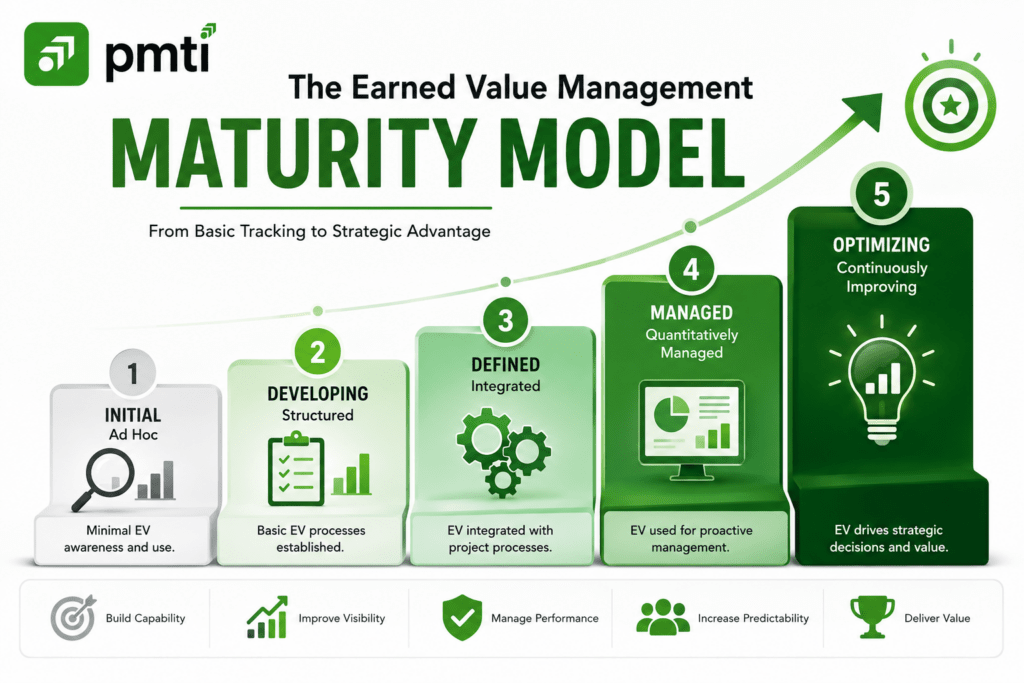
The Earned Value Management Maturity Model (EVM3) is a five-level model designed to assess and improve an organization’s use of earned value management. EVM3 was developed by Ray Stratton after the Software Engineering Institute’s Capability Maturity Model Integration (CMMI), so organizations now have a way to describe their current use of Earned Value Management (EVM) and a plan to be more consistent, accurate with data, and transparent to their stakeholders.
What Is the EVM Maturity Model (EVM3)?
EVM3 is a five-level maturity model that describes an organization’s use of earned value management, from no formal practice at the lowest level, to self-improving fully committed EVM systems at the highest. The logic of the staged maturity model of software process improvement has been applied to the discipline of earned value management.
What Are the Five Levels of the EVM3?

EVM3 defines five maturity levels, each representing a meaningfully greater investment in EVM process, data quality, and organizational commitment than the level before it.
- Level 1 — Ad Hoc: little to no structured earned value management practice exists; cost and schedule tracking, if present, remains informal.
- Level 2 — Basic: a low-cost EVM system is in place, allowing the project team to monitor cost and schedule performance using a structured, repeatable approach.
- Level 3 — Compliant: the organization achieves full compliance with ANSI/EIA-748 EVM standards, the formal industry benchmark most commonly required on government contracts.
- Level 4 — Managed: EVM data quality and system health are actively and continuously monitored, supported by systemic training, a historical EVM data repository, and a dedicated Earned Value Process Group.
- Level 5 — Optimizing: the organization actively improves its own EVM systems over time, treating EVM process improvement itself as an ongoing initiative.
How Does EVM3 Compare to the Software Engineering Institute’s CMMI?
EVM3 is built upon the Software Engineering Institute’s Capability Maturity Model Integration (CMMI) and uses the same ‘staged maturity’ model to fit Earned Value Management as opposed to models built for the wider industry of Software Engineering. Both models are based on the same principle, that an organization reaches a higher level of maturity not because of one internally driven improvement, but rather through a number of maturity-improving steps that flow sequentially.
Why Do Most Organizations Operate at Low EVM3 Maturity Levels?
The majority of organizations stay at Levels 1 or 2 as a higher maturity level requires executive sponsorship that is sustained over time, along with significant company-wide training and building of appropriate internal structures (which most companies without a regulatory reporting obligation simply will not do). As opposed to being incorporated throughout a company, EVM is most commonly seen in industries where “the contract” requires it, primarily government contracting, rather than where an organic case would justify it.
When Should an Organization Pursue Higher EVM3 Maturity?
An organization should pursue Level 3 or higher when its contracts require ANSI/EIA-748 compliance, and can generally achieve strong value at Levels 1 or 2 without that requirement, since those levels demand comparatively little investment while still delivering real cost and schedule visibility. Pursuing Level 4 or 5 without a clear business driver behind it risks investing significant training and system resources into a maturity level the organization does not actually need.
- Government contractors and regulated industries typically require Level 3 compliance as a contractual baseline.
- Organizations without external EVM reporting requirements capture most of the practical benefit at Levels 1 and 2, at far lower cost.
- Organizations pursuing Level 4 or 5 should have a clear strategic reason, such as competing for EVM-intensive contracts or standardizing practice across a large portfolio.
How Does EVM3 Relate to the Core EVM Formulas?
Evaluating the maturity of a process focuses on whether and how the EVM processes are integrated into an organization’s structures and systems. By contrast, the core EVM formulas focus on how each individual project performs with respect to the level of process integration that currently exists. A team may accurately calculate CV, SPI, EAC, TCPI, and VAC for a single project, but the organization as a whole may still be at a low level of EVM3 maturity, where maturity is focused on the consistency of a system and process, and not the accuracy of individual calculations.
Does the PMP Exam Test EVM3?
As EVM3 is Stratton’s proprietary maturity framework, the PMP exam does not test it. Candidates, therefore, should perceive this maturity model as an integration framework for Earned Value Management within an organization, PMI’s EVM formulas and terms appearing in the exam would also have to be known.
Frequently Asked Questions
Is EVM3 a PMI-Defined Standard?
EVM3 is not a PMI standard. EVM3 is a maturity framework authored by Stratton and is found in his book The Earned Value Management Maturity Model. The PMI standards framework for EVM is available in the PMBOK and Practice Standard on EVM.
What Is ANSI/EIA-748?
ANSI/EIA-748 is the American National Standards Institute’s formal earned value management systems standard, commonly required as a compliance benchmark on U.S. government contracts. Reaching EVM3 Level 3 specifically means achieving full compliance with this standard.
Does Every Organization Need to Reach Level 5?
Most organizations do not need to reach Level 5, since the practical cost and schedule visibility benefits of EVM are largely achievable at Levels 1 through 3 depending on contractual requirements. Level 5 suits organizations for which continuous EVM system improvement is itself a strategic priority, such as large government contractors managing EVM across many concurrent projects.
Who Created the EVM Maturity Model?
The EVM Maturity Model was created by Ray Stratton, who patterned its five-stage structure after the Software Engineering Institute’s Capability Maturity Model Integration. The model applies that same staged-improvement logic specifically to earned value management practice.


