


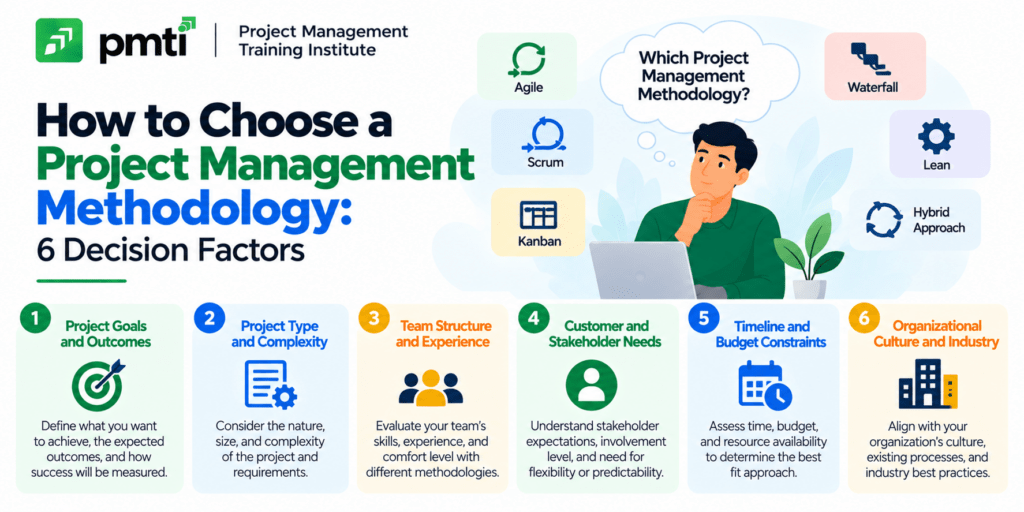
How to Choose a Project Management Methodology: 6 Decision Factors
Choose a project management methodology by scoring the project on 6 factors: requirement stability, cost of change, complexity and scale, stakeholder involvement, team capability, and governance and contract. Stable, regulated, fixed-price work points to predictive methods. Evolving, feedback-driven work points to adaptive methods. Mixed scores point to hybrid.
No methodology wins on every project. PMI’s PMBOK Guide 7th Edition places the choice in the Development Approach and Life Cycle performance domain and treats it as a fit decision, not a preference. This article defines the 6 factors, adds a scoring rule, maps scores to 9 methodologies, and lists 5 common selection mistakes.
What are the main methodology options to choose from?

The main options fall into 3 families: predictive (Waterfall, PRINCE2), adaptive (Scrum, Kanban, Extreme Programming), and hybrid. Scaling frameworks (SAFe, LeSS) and improvement methods (Lean, Six Sigma) extend them. Each family fits a different level of uncertainty.
| Methodology | Family | Fits when |
|---|---|---|
| Waterfall | Predictive | Scope is fixed and phases run in sequence |
| PRINCE2 | Predictive, process-based | Governance needs 7 themes, 7 principles, and 7 processes of control |
| Scrum | Adaptive | Requirements evolve and the team has 10 or fewer people |
| Kanban | Adaptive, flow-based | Work arrives continuously and releases happen at any time |
| Extreme Programming (XP) | Adaptive, engineering-focused | Code quality and short feedback loops drive the work |
| Hybrid | Mixed | Some components are stable and others are uncertain |
| SAFe and LeSS | Scaled adaptive | Many teams need coordination |
| Lean | Improvement | Waste and delays dominate the value stream |
| Six Sigma | Improvement | Defects and process variation dominate |
Read the full predictive-versus-adaptive comparison in agile vs waterfall.
How does requirement stability affect the choice?
Stable, signed-off requirements favor predictive methods because upfront planning pays off. Evolving or unknown requirements favor adaptive methods because short cycles reveal what the customer wants. Requirement stability is the first factor to rate.
Ask 3 questions: Does the customer know the exact deliverable? Will the scope hold for the project’s duration? Can a specification be written and frozen? Three yes answers favor Waterfall or PRINCE2. Three no answers favor Scrum or Kanban.
How does the cost of change affect the choice?
High cost of change favors predictive methods because late changes trigger expensive rework. Low cost of change favors adaptive methods because iterations absorb change cheaply. Physical, irreversible, and regulated deliverables carry the highest cost of change.
A concrete test: price a change request at the midpoint of the project. A foundation redesign on a building project costs a multiple of the original design effort. A reordered backlog item on a software product costs a planning meeting. Rate the cost as high, medium, or low. Risk appetite belongs here too. Organizations that accept little schedule or cost variance lean predictive.
How do complexity and scale affect the choice?
Complexity and scale decide whether 1 team or many teams deliver the work. A single small team fits Scrum or Kanban. Many dependent teams need a scaling framework such as SAFe or LeSS, or a predictive program structure with phase gates.
Rate 3 dimensions: team count, dependency count, and technology uncertainty. A Scrum Team holds 10 or fewer people, so larger efforts split into several teams that share 1 Product Goal. SAFe coordinates the teams through Program Increments.
How does stakeholder involvement affect the choice?
Stakeholders who give feedback every 1 to 4 weeks fit adaptive methods. Stakeholders who review at milestones and sign off at gates fit predictive methods. The feedback cadence the sponsor and customers can sustain sets the iteration rhythm.
Adaptive methods demand a Product Owner or customer representative who attends reviews and decides priorities. A sponsor who is available only at gates cannot support Scrum events. Match the method to the availability that exists, not to the availability the plan assumes.
How does team capability affect the choice?
Team experience and readiness decide whether a method works in practice. A team new to Agile needs coaching on roles and events before it self-organizes. An experienced predictive team delivers faster with Waterfall. Training investment belongs in the cost of switching.
Check 3 attributes: prior experience with the method, ability to self-organize, and capacity to learn new roles and events. Scrum adds a Product Owner and a Scrum Master. Kanban adds only a board and work-in-progress limits, which makes it the lightest change for teams that resist new roles.
How do governance and contract type affect the choice?
Regulation, fixed-price contracts, and centralized decision-making favor predictive methods because they demand documented baselines and approvals. Time-and-materials contracts and decentralized decisions favor adaptive methods. Compliance requirements can force a predictive spine inside any approach.
Check 4 items: regulatory traceability requirements, contract type, approval authority, and audit demands. Pharmaceutical and government work often requires phase approvals regardless of team preference. A hybrid approach keeps the compliance gates and runs the build iteratively.
How do you score the 6 factors and pick a methodology?
Rate each factor 1 (predictive), 2 (hybrid), or 3 (adaptive), then add the scores. A total of 6 to 9 points to predictive. A total of 10 to 14 points to hybrid. A total of 15 to 18 points to adaptive.
This scoring rule is a decision aid built on the factors above. Use it as a starting point and adjust with judgment.
| Factor | 1 point (predictive) | 2 points (hybrid) | 3 points (adaptive) |
|---|---|---|---|
| Requirement stability | Fixed and signed off | Core fixed, edges open | Evolving or unknown |
| Cost of change | High | Medium | Low |
| Complexity and scale | Large, many dependencies, gated | Mixed components | Small team, few dependencies |
| Stakeholder involvement | Milestone reviews | Monthly reviews | Every 1 to 4 weeks |
| Team capability | Experienced in predictive | Mixed experience | Experienced in agile |
| Governance and contract | Fixed-price, regulated | Gated with flexible build | Time-and-materials, light controls |
Follow these 5 steps:
- Rate each of the 6 factors with the stakeholders in the room.
- Add the scores.
- Select the family from the total.
- Choose the specific method inside the family, using the table in the first section.
- Review the choice at each phase gate or Retrospective and adjust.
What are the best methodologies by project type?
Match common project types to a starting methodology: construction to Waterfall, regulated software to hybrid, product development to Scrum, support operations to Kanban, and process improvement to Lean or Six Sigma.
| Project type | Starting methodology | Reason |
|---|---|---|
| Building or infrastructure | Waterfall or PRINCE2 | Fixed scope, high cost of change |
| Regulated software or medical device | Hybrid | Compliance gates plus iterative build |
| New product development | Scrum | Evolving requirements, frequent feedback |
| IT support or service desk | Kanban | Continuous flow, no fixed release |
| Large software program | SAFe | Many teams, shared roadmap |
| Operations improvement | Lean | Waste and delay dominate |
| Quality-critical manufacturing | Six Sigma | Defects and variation dominate |
Study the improvement option in lean project management.
What mistakes do teams make when choosing a methodology?
Five mistakes recur: choosing by trend, copying a competitor, ignoring team readiness, forcing 1 method on every project, and never revisiting the choice. Each mistake replaces fit analysis with habit.
Avoid these 5 mistakes:
- Choosing by trend: a team adopts Agile because peers did and ignores a fixed-price contract.
- Copying a competitor: a method that fits another firm’s scale and culture fails in yours.
- Ignoring readiness: a team without a Product Owner runs Scrum events and gains no feedback.
- Forcing 1 method everywhere: the same method on a construction project and a marketing launch fits neither.
- Never revisiting: the project profile changes, and the method stays the same.
How does the PMP exam test methodology selection?
The PMP exam tests methodology selection directly. The Process domain of the exam content outline includes a task to determine the appropriate project methodology, methods, and practices. Candidates choose predictive, agile, or hybrid for a scenario. About 60% of the 2026 exam sits in agile and hybrid contexts.
The task asks candidates to evaluate project needs, complexity, and size, recommend an execution strategy, choose a predictive, agile, or hybrid approach, and apply iterative and incremental practices. The 6 factors above mirror the clues in the scenarios: requirement stability, compliance, stakeholder engagement, and organizational readiness. Practice with exam-style scenarios in a weekend PMP certification training class from Project Management Training Institute.
